

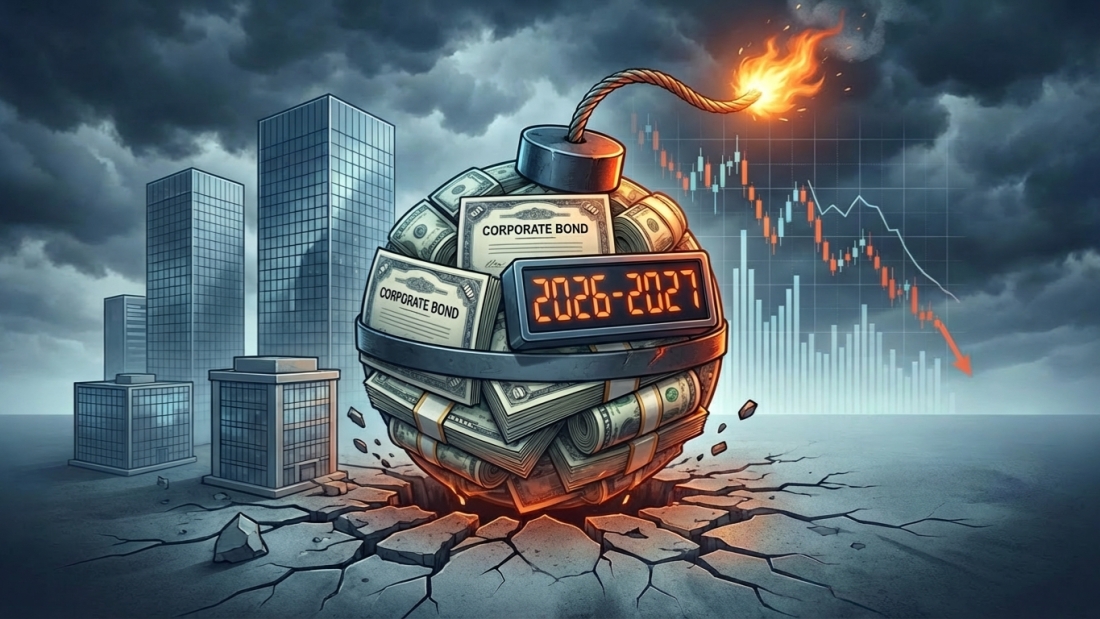
Corporate America is sitting on a ticking time bomb, and the fuse is burning faster than most executives want to admit. Between 2026 and 2027, an estimated $1.5 trillion in corporate debt will come due for refinancing—debt that was issued when interest rates were near zero and money was essentially free. Now, companies face refinancing costs that are 2-3 times higher than their original borrowing rates, threatening to trigger a wave of defaults, bankruptcies, and forced asset sales that could reshape the American economy.
This isn’t a hypothetical crisis. It’s already happening. The first cracks are showing in commercial real estate, where over $1.5 trillion in CRE loans will mature by the end of 2026. But the contagion extends far beyond office buildings and shopping malls. High-yield bonds, leveraged loans, and investment-grade corporate debt are all facing the same brutal math. Borrow at 3%, refinance at 7%, and pray your business can absorb the difference.
The Maturity Wall: How We Got Here
The corporate debt maturity wall is a direct consequence of the Federal Reserve’s decade-long experiment with ultra-low interest rates. From 2010 through 2021, companies gorged on cheap debt, issuing bonds and loans at rates between 2% and 4%. The logic was simple: why pay down debt when you can borrow at near-zero rates and use the cash for stock buybacks, acquisitions, or capital expenditures? The numbers are staggering:
- S&P Global estimates U.S. companies face a $2.3 trillion maturity wall between 2024 and 2026, with $1.8 trillion maturing specifically in 2025 and 2026 for non-financial issuers
- Debt maturities are projected to rise from nearly $2 trillion in 2024 to nearly $3 trillion in 2026
- Non-investment grade corporate debt maturities will jump from $185 billion in 2025 to $328 billion in 2026, $381 billion in 2027, and $730 billion in 2028
- In the leveraged debt market alone, approximately $1.2 trillion in loans and high-yield bonds will mature between 2027 and 2029
The problem isn’t just the volume—it’s the timing. These loans are coming due just as the Federal Reserve has jacked interest rates to their highest levels in over two decades. The effective federal funds rate sits around 4.33%, with a target range of 4.25%-4.5%. Companies that borrowed at 2% in 2020 now face refinancing costs in the range of 5% to 8% for investment-grade and high-yield debt, respectively.
Commercial Real Estate: The Canary in the Coal Mine
Commercial real estate is ground zero for the refinancing crisis. Over $930 billion in CRE debt matures in 2026 alone, a sharp increase driven by loan extensions from the low-rate era. Many of these loans were originated around 2015 when interest rates were 3% to 4%. Borrowers now face refinancing rates hovering around 6.5% or more—on properties that have often declined in value. The multifamily sector faces the most immediate pressure:
- $162.1 billion in multifamily maturities in 2026
- $167.7 billion in 2027
- Total distressed CRE volume reached $126.6 billion in Q3 2025, with multifamily accounting for $22.8 billion
The office sector is even worse. Remote work has gutted demand for office space, leaving buildings with high vacancy rates and plummeting valuations. Over $21.3 billion in CMBS office loan balances are due through the end of 2026, with delinquency rates trending steadily upward.Foreclosures are already climbing. Nearly 150 CRE foreclosures were recorded in the first half of 2025—the highest midyear total since 2014. Two-thirds of apartment foreclosures involved loans from 2021 or 2022, when property values peaked and lenders underwrote deals at historically low cap rates.
The “extend and pretend” strategy that worked in 2024-2025 is running out of road. Lenders are growing less patient, especially for struggling office buildings and highly leveraged apartments. MSCI expects a surge in apartment foreclosures as 60% of 2021-2022 loans mature in the second half of 2026.
High-Yield Debt and Leveraged Loans: The Next Domino
While commercial real estate grabs headlines, the high-yield debt and leveraged loan markets represent an even larger systemic risk. For publicly traded U.S. and Canada-based high-yield companies:
- $79.2 billion of debt matures in 2026
- $140.3 billion in 2027
- Over $700 billion of high-yield bonds mature between 2027-2029, with over $350 billion in 2029 alone
The leveraged loan maturity wall has been temporarily reduced through aggressive refinancing. As of December 2025, the maturity wall for 2026 and 2027 decreased to $59 billion (down from $195 billion at the end of 2024), but maturities are expected to sharply increase to $301 billion in 2028.
High-yield issuance has been strong—$226.15 billion in the first nine months of 2025, a 14.4% increase over 2024. But here’s the catch: over 70% of total issuance (by volume) in 2025 was for refinancing, not new investment. Companies are scrambling to lock in rates before the maturity wall hits, but they’re doing so at significantly higher costs.
Bankers project a fourth consecutive annual increase for bond volume in 2026, with street projections ranging from $340-$410 billion. BofA Global Research projects a 25% jump in refinancing volume to $250 billion, while JPM projects $225 billion for high-yield refinancing activity in 2026.
The Hidden Leverage Problem
The refinancing crisis is compounded by a less visible threat: hidden leverage. Competition between syndicated lenders and private credit has led to looser covenants and increased leverage risks. Companies are using off-balance sheet structures and Payment-In-Kind (PIK) debt to mask their true debt burdens.
Moody’s warns that hidden leverage through Net Asset Value (NAV) lending is becoming more prevalent and harder to monitor. This can amplify cash flow strain and credit risk during downturns, making it difficult for investors and lenders to accurately assess a company’s financial health. The prevalence of weak documentation is another red flag. Covenant-lite loans, which give lenders less protection in the event of financial distress, have become the norm in the leveraged loan market. When companies start missing payments, lenders have fewer tools to force restructuring or asset sales.
Who’s Most at Risk?
Not all sectors face equal risk. The most vulnerable include:
Speculative-Grade Industries: Chemicals, packaging, forest products, building materials, metals and mining: 40%-60% of their debt is speculative grade. Media/entertainment & retail (particularly Class B and C properties)
Small-Cap Companies: These firms often have higher debt-to-profit ratios and limited access to capital markets, making refinancing more difficult and expensive.
Real Estate (REITs): Already under pressure from rate hikes and falling valuations, REITs face a critical test with $930 billion in loans maturing in 2026.
Utilities & Telecom: Capital-intensive sectors with limited pricing power are particularly vulnerable to rising interest costs.
Private Equity Portfolio Companies: Healthcare services and business services—private equity favorites—face threats from overpayment by buyers and inflation-related margin pressure.
The Shift in Corporate Behavior
The maturity wall is already forcing a fundamental shift in how companies allocate capital. For the past decade, stock buybacks have been a primary use of corporate cash. All this did was prop up share prices and boost earnings per share. That’s about to change.Companies are expected to prioritize debt repayment and balance sheet fortification over stock buybacks. The “buyback bid” that has been a significant driver of U.S. stock performance is likely to weaken, potentially reducing support for stock prices.
Higher interest expenses will impact corporate earnings and margins, even if revenue remains stable. For companies with speculative-grade debt, the impact could be severe enough to trigger covenant breaches, credit rating downgrades, or outright defaults. The first half of 2025 saw a record number of “mega” bankruptcies, up 81% over the long-term average. This trend is expected to accelerate as the maturity wall grows, despite potential interest rate reductions.
🚨AI infrastructure is being built on a mountain of new DEBT:
— Global Markets Investor (@GlobalMktObserv) December 2, 2025
Amazon, Meta, Google, and Oracle have added nearly $200 BILLION in debt this year, including off-balance-sheet financing.
This is more than the previous 7 years COMBINED.
Holy cow, this is INSANE. pic.twitter.com/8GGkxPllVz
🇺🇸 US national debt.
— World of Statistics (@stats_feed) January 1, 2026
1st of January, 2000: $5.7 trillion
1st of January, 2010: $12.3 trillion
1st of January, 2020: $23.2 trillion
1st of January, 2024: $33.9 trillion
1st of January, 2025: $36.3 trillion
1st of January, 2026: $38.5 trillion
The Federal Reserve’s Dilemma
The Federal Reserve faces a difficult choice. Cutting rates too aggressively risks reigniting inflation, which remains above the Fed’s 2% target. Maintaining tight policy allows the corporate debt crisis to escalate, potentially triggering a broader economic downturn.
Unlike previous cycles where the Fed could easily cut rates to bail out overleveraged companies, persistent inflation makes this a real son of a b*tch. The Fed’s balance sheet strategy, including temporary reserve management purchases and aligning its SOMA portfolio with Treasury’s issuance mix, could influence market dynamics and volatility, particularly for longer-term Treasuries. The uncertainty surrounding the neutral rate of interest (r-star) means that the 10-year Treasury yield may remain elevated, keeping corporate borrowing costs high even if the Fed cuts short-term rates.
What Happens Next?
The consensus among market participants is that the debt wall will be a “ramp” or “tide” rather than an abrupt “cliff.” Most resolutions are expected to occur through:
- Negotiated workouts
- Loan paydowns
- Longer amortization terms
- Interest-only renewals
- Quiet sales rather than widespread catastrophic defaults
For extreme cases, pre-packaged bankruptcies or Section 363 asset sales are alternatives. There may be a rise in “change-of-control” restructurings where ownership shifts to creditors. Distressed investors are preparing for a busy 2026, driven by cash-based defaults and ratings defaults. The looming maturity wall and a potentially steepening U.S. Treasury yield curve create opportunities for well-capitalized investors to acquire assets at discounted valuations.
Private credit has emerged as a critical alternative, with deal volume hitting $90.9 billion by Q3 2025, a 60% year-over-year increase. Private credit offers tailored financing to riskier borrowers who can’t access traditional capital markets, but at significantly higher costs.
Is This The Soft Landing?
The $1.5 trillion corporate debt maturity wall isn’t a sudden crisis. It’s a slow-motion train wreck that’s been years in the making. Companies that borrowed aggressively during the era of free money are now facing the consequences of that leverage in a higher-rate environment. The impact will be uneven. Well-capitalized companies with strong cash flows will refinance at higher costs but survive. Highly leveraged companies in struggling sectors will face restructuring, asset sales, or bankruptcy. The “zombie companies”—smaller cap firms with interest costs exceeding income—will be the first casualties.
For investors, the message is clear. Scrutinize balance sheets, avoid companies with near-term maturities and weak cash flows, and prepare for increased volatility in credit markets. The companies that survive this refinancing cycle will emerge stronger, but the path from here to there will be littered with defaults, distressed sales, and restructurings. The Federal Reserve’s decade-long experiment with ultra-low rates created a corporate debt bubble. Now, as that bubble deflates, the question isn’t whether there will be pain—it’s how much, and who will bear it. The answer is becoming clearer with each passing quarter: a lot, and it won’t be the executives who loaded up on cheap debt while the getting was good.
Leave A Comment