

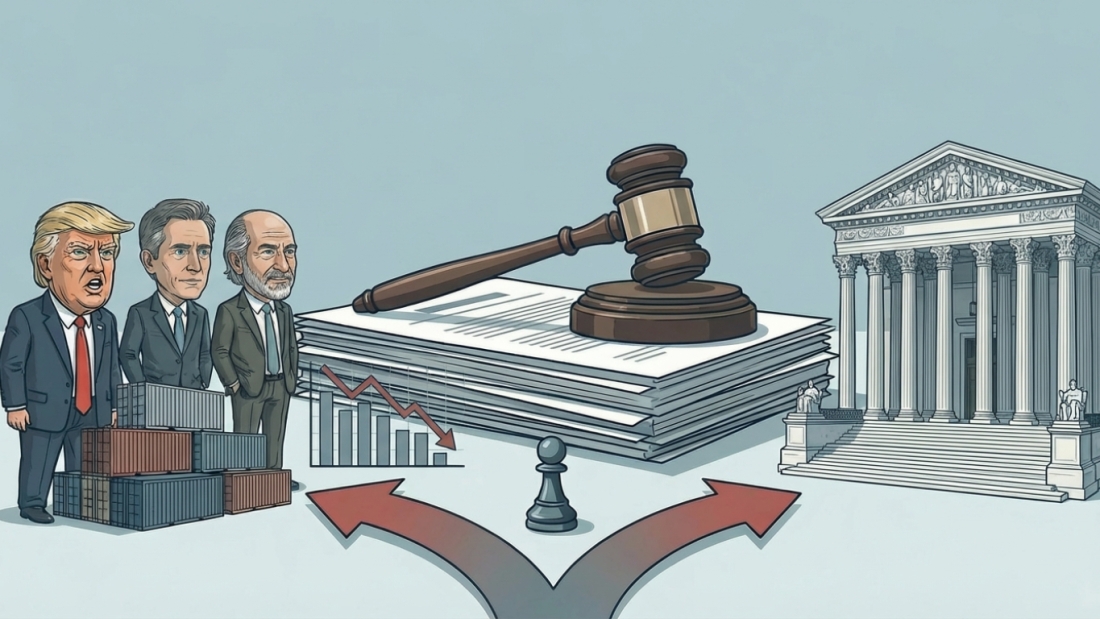
On February 20, 2026, the Supreme Court delivered a 6-3 ruling that struck down President Trump’s sweeping tariffs imposed under the International Emergency Economic Powers Act (IEEPA). Chief Justice John Roberts authored the majority opinion, declaring that IEEPA—a 1977 law designed for financial sanctions—does not grant the President authority to impose tariffs. The decision represents one of the most significant checks on executive power in recent memory. But here’s the question no one in Washington wants to answer: What happens to the $130-200 billion already collected under those now-illegal tariffs?
The Court’s ruling was silent on refunds. The billions of dollars extracted from American importers—ultimately paid by American consumers—now sit in legal limbo while lower courts sort out the mess. Meanwhile, Trump has already pivoted to new tariff authorities, and his Commerce Secretary’s former company may stand to profit enormously from the chaos.
Welcome to the most ethically tangled trade policy in American history.
The Supreme Court Decision: IEEPA Doesn’t Mean Tariffs
The Supreme Court’s decision in Learning Resources, Inc. v. Trump systematically dismantled the administration’s legal theory. President Trump had invoked IEEPA to declare national emergencies—citing fentanyl trafficking from Mexico, Canada, and China, and large trade deficits as threats—and then imposed tariffs as the remedy. Chief Justice Roberts rejected this interpretation on multiple grounds:
IEEPA allows the President to “investigate, block… regulate, direct and compel, nullify, prevent or prohibit… importation or exportation” during national emergencies. Roberts noted that tariffs are conspicuously absent from this list. The word “regulate” does not encompass taxation, especially since applying that interpretation would render parts of IEEPA unconstitutional—the Constitution explicitly bars taxes on exports.
Major Questions Doctrine
In a portion of the opinion joined by Justices Gorsuch and Barrett, Roberts invoked the “major questions” doctrine, which requires Congress to speak clearly when delegating decisions of “vast economic or political significance.” The power to impose sweeping tariffs affecting hundreds of billions in trade certainly qualifies. Congress has granted tariff authority through specific statutes with defined limits—IEEPA is not one of them.
Roberts emphasized that no President before Trump had interpreted IEEPA to include tariff powers. The novelty of the interpretation was itself evidence of overreach.
Justices Thomas, Alito, and Kavanaugh dissented, arguing that tariffs are a traditional tool to regulate importation and that the “major questions” doctrine shouldn’t apply to foreign affairs. Justice Kavanaugh specifically warned that the ruling would create a “mess” regarding refunds—a prediction that may prove accurate.
Trump’s Pivot: Section 122 and Section 301
Within hours of the Supreme Court ruling, Trump signed an executive order imposing new tariffs under different legal authorities—demonstrating that the tariff war isn’t over; it’s just operating under different letterhead.
Section 122 of the Trade Act of 1974
Trump invoked Section 122 to impose a 10% “temporary import surcharge” on products from almost all countries, effective February 24, 2026. Section 122 grants the President emergency authority to address “large and serious balance-of-payments deficits.” Key limitations:
- Maximum 15% tariff rate
- 150-day maximum duration
- Must be nondiscriminatory (cannot favor certain trading partners)
This authority had reportedly never been used before. Trump has already announced he plans to increase the rate to 15%—the legal maximum. Various exemptions apply to minerals, fertilizers, pharmaceuticals, agricultural products, and certain vehicles. Canada and Mexico retain USMCA exemptions for most goods, but countries that had negotiated trade deals with the U.S.—including the UK, India, and the EU—now face the global 10% levy.
Section 301 Investigations
The Office of the United States Trade Representative (USTR) announced “several” new investigations under Section 301 to address “unreasonable and discriminatory acts, policies, and practices that burden U.S. commerce.” Unlike Section 122, Section 301 requires an investigation to confirm unfair practices before tariffs can be imposed—but the administration has stated these will proceed on an “accelerated timeframe.”
Section 301 was the legal basis for Trump’s previous tariffs on steel, aluminum, and automobiles—which were unaffected by the Supreme Court ruling. Treasury Secretary Scott Bessent claimed that the combination of Section 122, Section 232 (national security tariffs), and Section 301 will result in “virtually unchanged tariff revenue in 2026.”
🚨 Howard Lutnick's family firm bought up the rights to tariff refunds for 20-30 cents on the dollar after Liberation Day last year.
— Meet Kevin (@realMeetKevin) February 20, 2026
Today, the Supreme Court struck the tariffs down. For every $100 invested, Lutnick's sons just made 3-5x.
Welcome to Crony Corrupt America. pic.twitter.com/Wr1FkA5kZk
LOL! SCOTUS’s ruling basically said Trump was using the wrong law for his tariffs, so Trump just issued the same tariffs under different laws and increased them by 10%.
— Wall Street Mav (@WallStreetMav) February 20, 2026
“Thank you for your attention to this matter.” - Trump 🤣
Follow: @WallStreetMav pic.twitter.com/GDoVuYyCuV
The $200 Billion Question: Where Are the Refunds?
Here’s where the story gets deeply uncomfortable. The Supreme Court invalidated the IEEPA tariffs—but it did not address whether importers are entitled to refunds for duties they paid under an authority the Court has now ruled unconstitutional.
Estimates suggest $130-200 billion or more was collected under the invalidated tariffs. That money came from American importers, who largely passed costs onto American consumers through higher prices. Those funds now sit with the federal government, collected under illegal authority. The refund question is heading to the U.S. Court of International Trade (CIT). Several outcomes are possible:
- Full Refunds: Importers receive all duties paid under IEEPA, plus interest.
- Partial Refunds: Some formula reduces the payout, perhaps based on when companies filed challenges.
- No Refunds: The government successfully argues that the illegality wasn’t clear at the time of collection, or procedural hurdles prevent recovery.
Critically, Trump cannot backdate the new Section 122 tariffs to cover the old IEEPA collections. The new tariffs take effect February 24, 2026. Everything collected before that date under IEEPA authority is legally distinct. This creates an extraordinary situation: the federal government may be sitting on hundreds of billions of dollars collected without legal authority—and may fight to keep it.
The Lutnick Connection: Conflict of Interest or Conspiracy?
The refund question becomes even more troubling when you examine who might profit from it. Howard Lutnick, Trump’s Commerce Secretary, was the CEO of Cantor Fitzgerald for nearly three decades before joining the administration. Upon his appointment, he divested his stake and transferred control to his sons, who now serve as Chairman/CEO and Executive Vice Chairman, respectively.
The Tariff Refund Product
In July 2025, Wired reported that Cantor Fitzgerald’s investment banking subsidiary was pitching a financial product that would allow companies to trade their legal claims to future tariff refunds. Here’s how it allegedly worked:
- Companies that paid IEEPA tariffs have potential claims to refunds if those tariffs are ruled unlawful.
- Cantor Fitzgerald offered to purchase these claims at a discount—reportedly 20 to 30 cents on the dollar.
- If the Supreme Court struck down the tariffs and refunds were ordered, Cantor would collect the full refund amount, potentially earning 3-5x returns on their investment.
An internal Cantor salesman email, cited in reports, stated the firm had “already put a trade through representing about ~$10 million” of tariff-refund rights and anticipated this number would “balloon in the coming weeks.”
Senate Investigation
Senators Ron Wyden (D-OR) and Elizabeth Warren (D-MA) launched an investigation into potential conflicts of interest and possible insider trading. Their letter to Brandon Lutnick requested detailed information on:
- The number of tariff refund agreements drafted and finalized
- The counterparties involved
- Whether the idea originated internally or from clients
- Any communications between Cantor employees and individuals within the Executive Branch—including President Trump, Secretary Lutnick, or Commerce Department staff—regarding tariffs, refunds, or legal cases
The implications are staggering. Howard Lutnick, as Commerce Secretary, was a key architect of the tariff policy. His former firm, now run by his sons, was allegedly betting against those same tariffs. If Cantor purchased $100 million in tariff refund claims at 25 cents on the dollar and collects the full $100 million after the Supreme Court ruling, they’d net a $75 million profit.
Cantor’s Denial
Cantor Fitzgerald has denied these claims. A spokesperson stated the firm has “never executed any transactions or taken risk on the legality of tariffs” and that reports suggesting otherwise are “completely false.” The firm attributed the salesman’s email to an “erroneous” belief that the business would be greenlit.
A Commerce Department spokesperson affirmed that Howard Lutnick has fully complied with his ethics agreement regarding divestiture and recusals and has “no strategic control” over Cantor Fitzgerald.
But even if Cantor didn’t execute the trades, the appearance of conflict is damning. A Commerce Secretary who built the tariff policy, whose sons now run his former firm, which was at minimum exploring ways to profit from that policy being struck down? The optics are catastrophic regardless of whether actual trades occurred.
Who Bears the Cost?
American consumers paid higher prices because of the now-illegal IEEPA tariffs. If refunds go to importers, there’s no mechanism to return that money to the families who paid more for everything from electronics to groceries. The economic damage is done. The little guy gets screwed once again.
The administration collected $130-200 billion under authority the Supreme Court has ruled unconstitutional. If those funds aren’t returned, the precedent is chilling: the government can keep money it collected illegally, as long as the illegality isn’t established until after collection.
If Cantor Fitzgerald was pitching tariff refund products before the Supreme Court ruled, someone believed the tariffs were legally vulnerable. Did Commerce Department officials share that assessment internally? Did anyone in the administration know the IEEPA authority was on shaky ground while publicly defending it?
More Questions Than Answers
The Supreme Court decision could have been a straightforward story: presidential overreach was checked, the Constitution’s separation of powers was upheld, and tariffs require congressional authorization. Instead, we’re left with:
- Hundreds of billions in legally questionable collections that may never be refunded
- A Commerce Secretary whose former company was allegedly positioned to profit from his policy’s collapse
- New tariffs immediately imposed under different authority, continuing the economic disruption
- No accountability for who knew the IEEPA tariffs were legally vulnerable and when
The tariff turnaround isn’t just about trade policy. It’s about whether the rule of law applies equally to everyone—including the people writing the rules. And right now, that question doesn’t have a comfortable answer as the American public is getting screwed once again.
Leave A Comment