

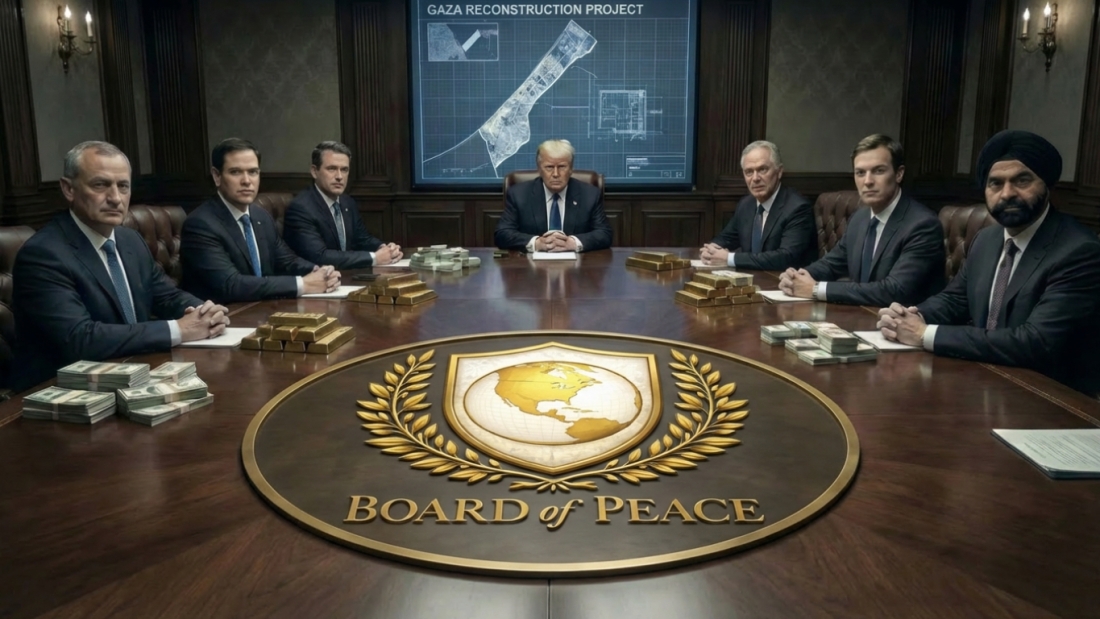
In January 2026, President Donald Trump announced the creation of the Board of Peace—the international organization ostensibly designed to promote peacekeeping globally, beginning with the reconstruction of Gaza. The name suggests diplomacy, cooperation, and humanitarian purpose. The reality, we will leave for you to interpret. Zooming out, it seems the “Board of Peace” is a $1 billion pay-to-play club dominated by authoritarian regimes, accused war criminals, and leaders with documented human rights violations.
It excludes Palestinian representation from its Gaza governance. It funnels $10 billion in U.S. taxpayer money to an entity without Congressional approval. And it positions Donald Trump as chairman for life, with unilateral control over finances, membership, and decision-making. This isn’t peace. It’s a rogues’ gallery disguised as diplomacy—and American tax dollars are funding it. What else is new?
What Is the Board of Peace?
The Board of Peace (BoP) was formally established by charter in early 2026, initially framed as a vehicle for managing Gaza’s reconstruction following the Israeli military assault. Trump invited approximately 60 countries to join as founding members, with permanent membership requiring a $1 billion contribution. Countries that don’t pay are limited to three-year terms. The charter explicitly names Donald Trump as chairman, holding this position for life with extraordinary powers:
- Sole authority to nominate his successor
- Power to invite or eject member countries
- Ability to create or dissolve subsidiary entities
- Approval authority over all charter revisions and administrative directives
The U.S. pledged $10 billion to the Board of Peace. Nine other member states pledged an additional $7 billion. The source of the American commitment was never specified by Trump, the White House did not respond to inquiries, and Congress never approved the appropriation. Senator Chris Murphy (D-CT) called this arrangement “totally illegal”, noting the funds would flow to “a pseudo-governmental body that has no basis in law.”
The Membership: Authoritarians, Strongmen, and Dictators
If the Board of Peace were genuinely dedicated to peace, you’d expect its membership to reflect democratic values, human rights commitments, and humanitarian track records. Instead, The Guardian catalogued the attendees at the inaugural meeting:
Countries Rated “Not Free” by Freedom House:
- Egypt: Prime Minister Mostafa Madbouly represents a country with tightly restricted civil liberties, mass political imprisonment, and documented human rights abuses.
- Kazakhstan: President Kassym-Jomart Tokayev leads a nation with unfree and unfair elections, restricted freedoms, and endemic corruption.
- Uzbekistan: President Shavkat Mirziyoyev governs what observers call an “authoritarian state with few signs of democratization.”
- Vietnam: Represented by Communist Party General Secretary Tô Lâm, a one-party state with severely restricted freedoms.
- Belarus: A founding member despite being complicit in Russia’s invasion of Ukraine. President Alexander Lukashenko has been accused of rigging elections and violently suppressing protests.
- El Salvador: Under President Nayib Bukele’s “state of exception,” civil liberties have been suspended and tens of thousands detained without due process.
Leaders with Authoritarian Tendencies:
- Turkey: Foreign Minister Hakan Fidan represents a country where President Recep Tayyip Erdoğan has consolidated power, imprisoned political opponents, and restricted press freedom.
- Hungary: Prime Minister Viktor Orbán, a Trump ally, leads a country rated “Partly Free” and known for anti-migrant and anti-LGBTQ+ policies.
- Indonesia: President Prabowo Subianto, whom Trump praised at the summit, has been accused of human rights abuses in East Timor during Indonesia’s military occupation.
Invitations to Accused War Criminals:
Trump extended invitations to Vladimir Putin and Benjamin Netanyahu—both of whom have arrest warrants from the International Criminal Court for alleged war crimes. Netanyahu declined to attend the charter signing ceremony in Switzerland due to concerns over arrest. Human Rights Watch characterized the Board as a “rogues’ gallery of leaders and governments with human rights records ranging from questionable to appalling” and a “club of impunity.”
Who Refused: The Democratic Rejection
The most telling detail about the Board of Peace is who declined to join. Major democratic allies rejected their invitations:
- France: Rejected because the charter “goes beyond the framework of Gaza and raises serious questions, in particular with respect to the principles and structure of the United Nations.”
- Germany: Declined to participate.
- United Kingdom: Rejected the invitation.
- Norway: Stated they “cannot be part of a structure that challenges the role of the U.N. and existing international law.”
- Sweden, Canada, Greece, Italy, Slovenia: All declined.
- Vatican: Pope Leo XIV rejected the invitation, with the Vatican expressing concern that the U.N. should remain primarily responsible for managing crisis situations.
- Ukraine: President Volodymyr Zelensky called the idea of inviting Russia and Belarus “absurd” given their invasion of his country.
Canada’s invitation was rescinded entirely after Prime Minister Mark Carney denounced “American hegemony” at the World Economic Forum. The pattern is unmistakable: traditional democratic allies with strong human rights records refused, while authoritarian regimes with documented abuses eagerly joined.
The Colonial Gaza Project
The Board of Peace includes a subsidiary Gaza Executive Board tasked with overseeing the reconstruction and temporary governance of Gaza. Notable members include Marco Rubio (Secretary of State), Steve Witkoff (Special Envoy to the Middle East), Jared Kushner (Trump’s son-in-law with no official government position), and Tony Blair.
Human rights experts have condemned this structure as colonial. Cardinal Pierbattista Pizzaballa, the Latin Patriarch of Jerusalem, stated: “It is a colonialist operation: others deciding for the Palestinians.” The criticism centers on one glaring absence: no Palestinian representation. A board designed to govern a Palestinian territory, overseeing its reconstruction and temporary administration, includes Israel, Turkey, Qatar, Egypt, and the United States—but not a single Palestinian voice.
Jared Kushner presented a vision for a “New Gaza” (sometimes called “Trump Riviera”) that did not include Palestinians determining their future. The United Nations, World Bank, and European Union estimate Gaza’s reconstruction will cost $70 billion—making the Board’s pledged funds a fraction of actual needs.
Meanwhile, Israel—whose military assault devastated Gaza and whose leaders face ICC war crimes charges—sits on the executive board overseeing Gaza’s reconstruction.
$10 Billion Without Oversight: The Slush Fund Concern
The U.S. commitment of $10 billion raises profound legal and ethical questions:
No Congressional Approval
Congress appropriates federal funds. The Constitution is explicit. Yet Trump pledged $10 billion to the Board of Peace without any congressional vote or authorization. Senator Murphy called this “totally illegal”—and he’s correct.
Personal Control
The Board’s charter positions Trump as chairman for life with total financial control. Critics have described the $10 billion as a potential “slush fund” that Trump could control even after leaving the White House. Reddit discussions have framed this as “Trump giving himself $10B.”
Opaque Spending
There is no clarity regarding how, when, where, or by whom the $10 billion would be spent. No accountability mechanisms have been disclosed. No auditing requirements have been announced.
Discrepancy with UN Contributions
The U.S. pledge to the Board of Peace is more than 12 times its $767 million pledge to the UN’s annual budget. Meanwhile, the U.S. has withheld much of its assessed UN contributions and owes approximately $4 billion to the international organization. Trump claims he wants to “strengthen up” the UN—while simultaneously creating an alternative body and defunding the original.
Undermining the United Nations
Trump has explicitly suggested the Board of Peace could replace the United Nations. European nations have expressed concern that this is precisely the goal—to usurp the UN’s role as the primary international forum for conflict resolution and peacekeeping.
The Board’s charter notably does not mention human rights. The Trump administration has been actively working to undermine UN efforts to uphold universal human rights, including:
- Withdrawing from UN organizations
- Stopping funding for programs like the UN Population Fund
- Pushing to remove “human rights language” (terms like “gender,” “diversity,” and “climate”) from UN resolutions and statements, viewing them as “woke” or politically correct
The Board of Peace represents an alternative framework—one where human rights aren’t mentioned, authoritarian regimes have equal standing with democracies, and American taxpayer money flows without Congressional oversight.
US wires $10 BILLION to 'Board of Peace'
— Kim Dotcom (@KimDotcom) February 23, 2026
An offshore entity Trump controls.
Trump is chairman for life.
Pure robbery.pic.twitter.com/MtVnE5ln5r
The board of Peace is meeting. Which, of course, means war is imminent.
— Aaron Day (@AaronRDay) February 19, 2026
pic.twitter.com/nwpHT80tgV
Money Laundering Concerns and Reputation Washing
Multiple analysts have raised concerns about the Board’s function as a vehicle for what critics call a “global grift”:
Pay-to-Play Structure
The $1 billion membership fee creates a transactional relationship. Countries pay for access to an organization chaired by the U.S. President, gaining diplomatic legitimacy in exchange.
Reputation Laundering
For authoritarian regimes with poor human rights records, membership in a “peace” organization provides cover. Belarus, accused of complicity in Russia’s war crimes in Ukraine, now sits alongside the United States in a body ostensibly dedicated to peace.
Financial Opacity
With Trump holding “ultimate decision-making power” over an organization receiving tens of billions in contributions, the potential for financial misuse is significant. No independent auditing or oversight mechanisms have been disclosed.
The IRS defines money laundering as knowingly engaging in financial transactions using funds derived from specified unlawful activity. While no one has alleged that definition applies here, the structural opacity of the Board invites legitimate scrutiny.
The Fundamental Questions
Is This Peace or Power?
A board dominated by authoritarian regimes, excluding democratic allies, governed by one man for life, funded by billions without Congressional approval, and overseeing Palestinian territory without Palestinian representation—does this sound like peace? Or does it sound like a power consolidation project with a euphemistic name?
Who Benefits?
Follow the money. Tens of billions flow into an organization with no transparency requirements, controlled by Trump, with members who pay $1 billion for access. The countries joining aren’t known for humanitarian commitments—they’re known for seeking legitimacy and access.
What Happens to the UN?
If the Board of Peace succeeds in replacing or marginalizing the UN, international law loses its primary enforcement mechanism. Human rights frameworks weaken. The post-WWII international order—imperfect as it is—fragments further.
Are American Tax Dollars Funding Conflict?
The great irony of the “Board of Peace” is that its members include governments actively engaged in conflicts, human rights abuses, and democratic backsliding. American taxpayers are contributing $10 billion to an organization that includes:
- Belarus (complicit in Ukraine invasion)
- Israel (facing ICC war crimes charges)
- Turkey (military operations in Syria and Kurdistan)
- El Salvador (mass detention and suspended civil liberties)
Is this stopping wars—or funding the governments that wage them?
Peace in Name Only
The Board of Peace is precisely what critics warned it would be: a parallel international structure designed to circumvent the UN, legitimate authoritarian regimes, concentrate power in Trump’s hands, and funnel billions of dollars without accountability.
It’s full of violent leaders because violent leaders are the only ones willing to pay for membership. Democratic allies with human rights commitments declined because they recognized the Board for what it is.
The name “Board of Peace” is the only peaceful thing about it. Everything else—the membership, the structure, the funding, the colonial governance of Gaza—reflects something far darker. And American taxpayers are footing the $10 billion bill.
Leave A Comment