

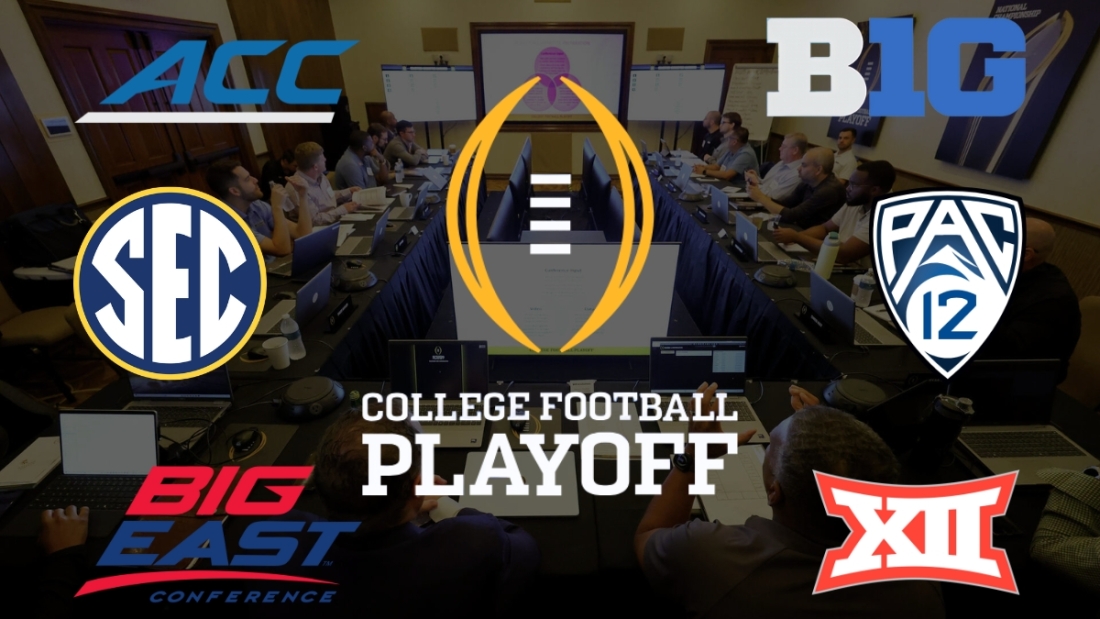
On December 7th, the 2025 College Football Playoff selection committee delivered its verdict on the 12-team playoff bracket. The result? Controversy. Just like every other year when one or two programs gets the short end of the stick. This year, Notre Dame—ranked in the top 10 every single week leading up to the final rankings—was suddenly dropped to No. 11 and left out entirely. Miami, who Notre Dame had been ranked ahead of for weeks, jumped them at the last second based on a Week 1 head-to-head result. Alabama, a three-loss team that got demolished 28-7 in the SEC Championship Game, was rewarded with the No. 9 seed. The reaction was swift and brutal. Notre Dame’s athletic director called the process a “farce” and said the playoff berth was “stolen” from their players.
The sport we love has morphed into a bloated, unwieldy mess of super-conferences, unbalanced schedules, and a playoff system that somehow manages to be both too large and too exclusive at the same time. Teams that never play each other are being compared on spreadsheets. The current system is breaking—many believe since the expansion of 12-teams it has become fundamentally unfair. It’s time for to progress in the restructuring that brings sanity, fairness, and competitive balance back to college football.
The 2025 Controversy: What Went Wrong
Let’s break down the madness:
Notre Dame finished 10-2, winning their final 10 games by double digits after an 0-2 start. Their only losses came to Texas A&M and Miami by a combined four points—both playoff teams. They were ranked ahead of Miami in every single CFP ranking released before the final selection. Then, on Selection Sunday, the committee suddenly decided that Miami’s Week 1 victory over Notre Dame—a game played four months earlier—was the deciding factor.
The committee’s explanation? Once Miami moved ahead of BYU, they had to do a “side-by-side comparison” between Miami and Notre Dame, and since everything else was “almost equal,” they fell back on the head-to-head result. Never mind that they’d been ranking Notre Dame higher for weeks without that head-to-head mattering. Never mind that Notre Dame had been dominant down the stretch while Miami had a mid-season lull.
Alabama got blown out 28-7 by Georgia in the SEC Championship Game. They finished 10-3 with losses to Florida State, Oklahoma, and Georgia. Their offense was anemic down the stretch. And yet? They got the No. 9 seed. The committee’s reasoning? “Strength of schedule” and “quality wins.” Alabama played the sixth-toughest schedule and beat Georgia earlier in the season. Fair enough—but then why was BYU punished for losing their conference championship game while Alabama wasn’t? Why did Alabama’s blowout loss not matter while BYU’s did?
Let’s be clear:
Tulane and James Madison earned their spots by winning their conferences. They played the schedules in front of them and won. The automatic bids for Group of Five champions were specifically designed to give these programs a path to the playoff.
The Root Problem: Super-Conferences and Unbalanced Schedules
All of these controversies stem from the same fundamental problem: you can’t fairly compare teams that don’t play the same opponents. The Big Ten and SEC have ballooned to 16+ teams each. Conferences are so massive that teams play completely different schedules even within the same league. One team faces Ohio State, Michigan, and Penn State while another dodges all three. One team gets Georgia, Alabama, and Texas A&M while another skates by with a cupcake slate.
When you have 16-18 teams in a conference but only play 8-9 conference games, you’re not measuring who’s best—you’re measuring who got lucky with their schedule. And then the committee has to use subjective criteria like “strength of schedule,” “quality wins,” and “eye test” to fill in the gaps. That’s how you end up with Notre Dame ranked No. 10 one week and No. 11 the next without playing a game. That’s how you end up with Alabama getting rewarded for a blowout loss while BYU gets punished for theirs. The tie-breaker scenarios have become so convoluted that coaches can’t even explain to their players why they’re eliminated from championship contention.
It doesn’t have to be this way.
Notre Dame AD Pete Bevacqua says the ACC did “permanent damage” to its relationship with ND for all of the anti-Irish playoff politicking the conference publicly leaned into in the lead up to the selection show.
— Tyler Horka (@tbhorka) December 8, 2025
“We didn’t appreciate the fact we were singled out repeatedly.” pic.twitter.com/6oF2ZxqIo6
WAIT...
— FanDuel (@FanDuel) December 7, 2025
Should TEXAS get into the CFB Playoff over Alabama? 😳
(via @trillhill87) pic.twitter.com/i1PkbLBN6c
The Solution: Power 6 Structure
Here’s the blueprint for fixing college football—and preventing another 2025-style disaster:
Bring back the Pac-12. Create a football-focused Big East. Keep the SEC, Big Ten, Big 12, and ACC. Each conference gets exactly 12 teams—no more, no less. Why 12? Because it’s the sweet spot. Each team plays at least 10 conference games (ideally all 11 conference opponents), giving you a minimum of 8 common opponents with every team in your conference. No more comparing apples to oranges. No more “well, they didn’t play each other” excuses. Eliminate the committee subjectivity about whose schedule was tougher. You want to win your conference? Beat the teams in your conference. It’s that simple.
Here’s how the Power 6 would look:
SEC (12 teams): Alabama, Georgia, Ole Miss, Vanderbilt, Tennessee, LSU, Missouri, Florida, Auburn, Mississippi State, South Carolina, Arkansas
Big Ten (12 teams): Ohio State, Michigan, Iowa, Michigan State, Purdue, Minnesota, Nebraska, Northwestern, Illinois, Wisconsin, Cincinnati, Iowa State
Big East (12 teams): Penn State, Syracuse, Boston College, Pittsburgh, Louisville, Notre Dame, Rutgers, UConn, West Virginia, Indiana, Kentucky, Maryland
ACC (12 teams): Duke, UNC, UCF, Georgia Tech, NC State, Wake Forest, Miami, Florida State, Virginia Tech, Virginia, James Madison, Clemson
Big 12 (12 teams): Houston, Baylor, Texas, Oklahoma, Oklahoma State, Kansas, Kansas State, Texas A&M, Texas Tech, TCU, SMU, Colorado
Pac-12 (12 teams): BYU, Utah, USC, UCLA, Arizona, Arizona State, Washington State, Oregon, Oregon State, Washington, Stanford, Cal
Notice what this does: It brings Texas and Oklahoma back to the Big 12 where they belong. It reunites Texas A&M with its natural rivals. The Pac-12 gets resurrected with its traditional West Coast powers. It creates a football-focused Big East that includes Notre Dame—solving their independence issue and giving them a clear conference affiliation. And it keeps the SEC as the dominant Southern conference without bloating it beyond recognition.
Group of 6: Championship Game Innovation
The Group of 6 conferences get a revolutionary twist: inter-conference championship games.
Instead of each conference crowning a champion in isolation, we pair them up:
- Sunbelt vs. American (Championship Game 1)
- MAC vs. Mountain West (Championship Game 2)
- Conference USA vs. *New Conference* (Championship Game 3)
The winners of these three championship games become your Group of 6 automatic qualifiers for the playoff. This creates must-watch television, eliminates the “which Group of 6 conference is better” debate, and gives these programs a clear, fair path to the playoff. And here’s the key: No one can complain that these teams don’t deserve their spot. They won their conference championship game against another conference champion. They earned it on the field, not in a committee room.
Here’s the Group of 6 Conference Alignment:
American (11 teams): North Texas, Navy, Army, UTSA, Tulane, Rice, Texas State, Tulsa, Charlotte, Sam Houston, Missouri State
Conference USA (11 teams): Kennesaw State, WKU, LA Tech, Delaware, Liberty, Middle Tennessee, New Mexico State, UTEP, Memphis, Northern Illinois, New Mexico
MAC (11 teams): Western Michigan, Ohio, Toledo, Miami (OH), Central Michigan, Akron, Buffalo, Kent State, Eastern Michigan, Ball State, Bowling Green
Mountain West (11 teams): Boise State, San Diego State, UNLV, Fresno State, Hawaii, Utah State, Air Force, Nevada, Wyoming, San Jose State, Colorado State
Sunbelt (10 teams): Old Dominion, Coastal Carolina, Georgia Southern, Georgia State, Troy, Southern Miss, Louisiana, Arkansas State, South Alabama, Louisiana-Monroe
New Conference (10 teams): FAU, USF, Temple, FIU, App State, ECU, UAB, UMass, Jacksonville State, Marshall
The 12-Team Playoff: Automatic Bids with Zero Subjectivity
The playoff structure is straightforward, transparent, and eliminates committee bias:
- 6 automatic bids for Power 6 conference champions
- 3 automatic bids for Group of 6 inter-conference championship game winners
- 3 at-large bids selected from the highest-ranked conference championship game losers
This means every conference champion from the Power 6 is in. No committee subjectivity about whether the ACC champion “deserves” it or debates about SEC bias. No last-minute ranking flips. You win your conference, you’re in. Period.
The Group of 6 teams have to win their championship game to get in—but they’re playing against another Group of 6 conference champion, so it’s a fair fight. The winner absolutely deserves their spot. And Nick Saban can’t complain that they didn’t earn it, because they literally beat another conference champion to get there. And the three at-large bids? They go to the best teams that came up just short in their conference championship games. This rewards teams that played tough schedules and made it to their conference title game but lost a close one.
How This System Would Have Fixed the 2025 Disaster
Let’s apply this system to the 2025 season and see how it would have played out:
Power 6 Automatic Bids (Conference Champions):
- Indiana (Big Ten Champion)
- Georgia (SEC Champion)
- Texas Tech (Big 12 Champion)
- [ACC Champion]
- [Pac-12 Champion]
- [Big East Champion – likely Notre Dame or a team that beat them in the title game]
Group of 6 Automatic Bids (Inter-Conference Championship Winners):
7. Tulane or American opponent (Sunbelt vs. American winner)
8. James Madison or MAC opponent (MAC vs. Mountain West winner)
9. [Conference USA vs. New Conference winner]
At-Large Bids (Top 3 Conference Championship Game Losers):
10. Ohio State (lost Big Ten Championship to Indiana)
11. Alabama (lost SEC Championship to Georgia)
12. [Third-highest ranked conference championship game loser]
Notice what this eliminates:
No Notre Dame controversy: Notre Dame would be in the Big East, playing for a conference championship. If they win, they’re automatically in. If they lose, they’re likely one of the top-ranked conference championship game losers and get an at-large bid. Either way, there’s no subjective committee decision about whether they “deserve” it.
No Alabama free pass: Alabama still gets in as a conference championship game loser—but only because they actually played in the SEC Championship Game. Teams that don’t make their conference championship game don’t get at-large consideration. You have to earn your way to the title game to be eligible for an at-large bid.
No Group of 5 complaints: Tulane and James Madison would have to win their inter-conference championship games to get in. If they do, no one can say they didn’t earn it. They beat another conference champion on the field.
No committee bias: The criteria are crystal clear. Win your conference, you’re in. Lose your conference championship game, you’re eligible for an at-large bid based on ranking. There’s no room for SEC favoritism, no “side-by-side comparisons,” no last-minute ranking flips.
Why This Works: Common Opponents and True Comparison
The genius of this system is the common opponent requirement. When every team in your conference plays at least 8 of the same opponents, you can actually compare them fairly.
It eliminates the “Team A beat Team B, but Team B had a harder schedule” debates. No more tie-breakers based on opponent win percentage calculated three levels deep. No more coaches pulling out spreadsheets to explain why their 10-2 team is eliminated while a 9-3 team advances.
You play the same teams. You accumulate the same data points. The best team rises to the top. And when you get to the conference championship game, you’ve earned it based on a fair, balanced schedule.
This is what the 2025 selection committee couldn’t do. They had to compare Notre Dame (independent, played a unique schedule) to Miami (ACC, played a different schedule) to Alabama (SEC, played yet another different schedule). With no common opponents and wildly different conference structures, they had to resort to subjective criteria and convoluted explanations.
Our system eliminates that problem entirely. With 10-11 conference games, you still have 1-2 non-conference games for:
- Traditional rivalry games (Georgia-Georgia Tech, Clemson-South Carolina, etc.)
- Marquee intersectional matchups
- Revenue-generating home games
But the bulk of your schedule—the part that matters for playoff qualification—is standardized and fair. Everyone plays roughly the same strength of schedule within their conference because everyone plays the same teams.
The Financial Reality: This Makes Money
Let’s be honest: Money drives college football. But this system doesn’t sacrifice revenue—it enhances it. Conference championship games remain lucrative for Power 6 conferences
- Inter-conference championship games create new, compelling television products for Group of 6 (imagine the hype for a Sunbelt vs. American championship game with a playoff berth on the line)
- 12-team playoff generates massive revenue with more games and more fanbases involved
- Smaller conferences mean more meaningful games throughout the season (every conference game matters when you’re competing against 11 teams, not 17)
- Elimination of controversy means fans trust the system and stay engaged instead of tuning out in disgust
The current super-conference model was sold as a financial windfall, but it’s created a product where half the games don’t matter and fans are tuning out regular season matchups. The 2025 selection show left fans angry and disillusioned. That’s not good for business. This system makes every game count and gives fans a transparent, fair process they can believe in.
The Fairness Factor: What College Football Desperately Needs
At its core, this proposal is about fairness & transparent criteria. This eliminates teams getting left out because the committee changed its mind at the last second. No more undefeated or one-loss teams being excluded because they played in the “wrong” conference. No more three-loss teams backing into the playoff while 10-win teams sit home. No more analysts complaining that Group of Five teams don’t “deserve” their automatic bids.
You want in? Win your conference. Or come in second in your conference championship game and hope you’re one of the three best runners-up. It’s transparent and merit-based. The 2025 College Football Playoff proved that the current system needs work. All of it stems from the same root problem: super-conferences, unbalanced schedules, and subjective selection criteria.
Enhancing the Playoff
College football is at a crossroads. We can continue down the path of super-conferences, unbalanced schedules, and playoff chaos—watching the sport tear itself apart with controversy after controversy—or we can restructure the sport around competitive balance, fairness, and common sense.
The Power 6 with 12 teams each. Group of 6 with inter-conference championship games. A 12-team playoff with clear, fair, transparent qualification criteria. Common opponents ensuring apples-to-apples comparisons. Zero room for committee bias or last-minute ranking flips.
This isn’t just a proposal—it’s a blueprint for saving college football from itself. The 2025 selection disaster was a wake-up call. The circus needs to end. The sport needs structure. And fairness needs to return. It’s time to make college football great again—not with bigger conferences, but with smarter ones. Not with subjective committee decisions, but with transparent, merit-based criteria. Not with controversy and chaos, but with fairness and integrity.
Leave A Comment