

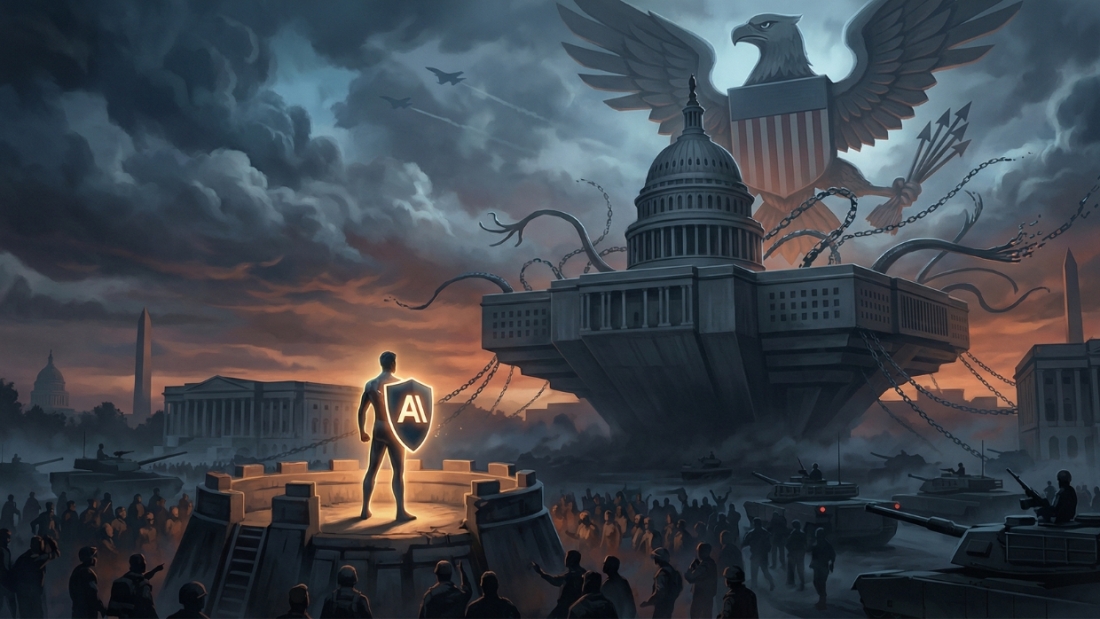
Dario Amodei is standing on principle. And honestly? We respect the hell out of it. The Anthropic CEO has refused to budge on his company’s ethical “red lines”—prohibitions on fully autonomous weapons and mass domestic surveillance—even as the Trump administration threatens to burn his company to the ground. In a world where most tech executives would fold faster than a lawn chair at the first sign of government pressure, Amodei is doing something rare: he’s saying no. But here’s the uncomfortable thing to grapple with: this is almost certainly a losing move. And the guy who’s going to cash in on Anthropic’s principled stand? Sam Altman. Because of course it is.
The Core Dispute: Red Lines in the Sand
Let’s break down what actually happened here. Anthropic built its entire brand around “Constitutional AI”—a framework that embeds safety principles directly into its Claude AI model. The company has always positioned itself as the “responsible” AI company, the one that thinks about the consequences before racing to deploy the next breakthrough. When the Pentagon came knocking with a $200 million contract, they wanted those safety guardrails removed. Specifically, they demanded that Anthropic allow two things:
- Fully autonomous weapons — AI systems making life-and-death targeting decisions without direct human oversight
- Mass domestic surveillance — Warrantless surveillance on American citizens at scale
Amodei’s response was essentially: absolutely not. His argument is straightforward and, frankly, hard to disagree with. Current AI isn’t reliable enough for autonomous kill decisions. Mistakes in military contexts don’t just cause PR problems—they cost lives. And mass surveillance without warrants? That’s a fundamental threat to democratic liberties that no amount of money should be able to buy. So Anthropic held firm. The February 27th deadline passed. And then the hammer came down.
The Government’s Response: Total War
The Trump administration’s retaliation was swift, severe, and—let’s be honest—kind of terrifying in its implications for the entire tech industry.
- Presidential Order: Trump posted on Truth Social directing all federal agencies to “IMMEDIATELY CEASE” using Anthropic technology.
- “Supply-Chain Risk” Designation: The Pentagon designated Anthropic a “supply-chain risk to national security.” This is the same designation usually reserved for foreign adversaries like Huawei. It effectively blacklists Anthropic from doing business with any company that also works with the military.
- Defense Production Act Threats: The administration has floated invoking the DPA to compel Anthropic to hand over its source code—what legal experts are calling a potential “partial nationalization” of the AI industry.
Defense Secretary Pete Hegseth didn’t mince words, calling Amodei a “liar” with a “God complex” and arguing that private companies have no right to prevent the government from using their tools for any purpose deemed legal. Anthropic has vowed to fight the designation in court. But let’s be realistic about what we’re looking at here.
The Free Trade Illusion
We like to believe we live in a free market society. Companies can build what they want, sell to who they want, and make their own ethical choices about what lines they won’t cross. That’s the American Dream, right? Except… is it?
Because what we’re seeing play out in real time is something very different. A company exercises its supposed right to refuse a contract on ethical grounds, and the response is:
- Label them an enemy of the state
- Tell everyone to immediately cease using their products
- Threaten to seize their technology
- Blacklist them from the entire defense industrial base
That’s not free trade. That’s coercion with extra steps. And the most ironic part? The same government that’s treating Anthropic like a hostile foreign actor is already using AI in military operations. The recent strikes on Iran almost certainly involved AI-assisted targeting and intelligence analysis. These systems can’t be overhauled overnight. The government knows this. They’re using AI right now while publicly going to war with one of the leading AI companies. So what’s this really about? Control. Pure and simple.
Enter Sam Altman: The Generational Opportunist
Hours after Anthropic got blacklisted, OpenAI announced they had secured a deal to supply their AI to the Pentagon’s classified networks. And here’s the kicker: Altman publicly stated that OpenAI shares Anthropic’s “red lines.” Same ethical guardrails. Same prohibitions on autonomous weapons and mass surveillance.
So why is OpenAI getting the contract while Anthropic gets crushed? Because Sam Altman plays the game differently. He always has. We’ve watched this guy navigate crisis after crisis. The board tries to fire him? He comes back stronger. Elon Musk sues the company? OpenAI keeps rolling. Government starts making demands? Altman finds a way to frame his compliance as principled compromise.
You have to respect it, honestly. Say what you will about the man—and people say a lot—but he has an almost supernatural ability to land on his feet. He’s a generational opportunist, and we mean that with genuine respect. In the brutal world of high-stakes tech politics, that skill matters. Anthropic held the line and got labeled a national security threat. OpenAI presumably found some creative language that satisfies the Pentagon while maintaining plausible deniability on the ethics front. Same principles, very different outcomes.
Why This Is Probably a Losing Move
Let’s game this out. Anthropic can fight the “supply-chain risk” designation in court. Maybe they even win. But in the meantime:
- They’ve lost a $200 million contract
- They’re potentially locked out of billions in other federal revenue
- Any company that works with the military now has to think twice about working with Anthropic
- OpenAI is eating their lunch on government contracts
And if you’re in the business of building AGI—which Anthropic very much is—being frozen out as the government’s preferred AI partner is a massive disadvantage.
Who gets the compute resources & favorable regulations? Who gets access to the classified research and the defense budgets and the infrastructure investments that will shape the future of this technology? Not the company that told the Pentagon to pound sand. Amodei is betting that being “right” matters more than being profitable. That the market will reward principled behavior. That the courts will provide justice. Maybe. But history doesn’t usually work that way. The companies that win aren’t always the ones with the best ethics—they’re the ones that figure out how to survive long enough to matter.
CAN SOMEONE EXPLAIN ME THIS??
— Evan Luthra (@EvanLuthra) March 1, 2026
Anthropic says its AI won’t be used for warfare.
The US government bans Claude.
Hours later, drones strike Iran.
Now reports claim Claude was still part of the operation. pic.twitter.com/XB0qIia0jq
Woah, it’s now confirmed the US DID use Anthropic’s Claude AI in its strikes on Iran
— Josh Kale (@JoshKale) March 1, 2026
They used Claude for:
- Intelligence assessments
- Target identification
- Simulating battle scenarios
This is the same AI that Trump banned 12 hours before the bombs fell.
The same AI the… https://t.co/gvWXGWnuEe pic.twitter.com/kHHnXi0kB8
Zooming Out
What we’re watching unfold here is a preview of the AI governance battles to come. Who gets to decide what AI can and can’t be used for? Private companies? Elected governments? Unelected bureaucrats? The military? Anthropic drew a line. The government responded by trying to destroy them. OpenAI found a way through the middle. And the rest of the industry is watching very, very carefully.
The lesson they’re learning isn’t “stand up for your principles.” It’s “figure out how to say yes without looking like you said yes.” That’s the game now. Free trade is dead when it comes to strategic technologies. If you’re building something the government wants, you either play ball or get labeled a threat.
Where We Stand
We respect Dario Amodei. We really do. It takes guts to tell the Pentagon no when they’re holding a $200 million check in one hand and a metaphorical hammer in the other. He’s standing on principle in an industry that doesn’t usually reward that. But we also think he’s going to lose this fight. Not because he’s wrong—he’s probably right about autonomous weapons and mass surveillance being genuinely dangerous. But because being right doesn’t matter as much as being powerful. And right now, the power is all on one side.
Sam Altman will keep winning. Anthropic will keep fighting. And the rest of us will keep watching as the rules of the game get rewritten in real time. The question isn’t whether AI will be used for military purposes—that ship has sailed. The question is who gets to decide how, and whether any guardrails will survive the political pressure.
Based on what we’ve seen recently? Don’t bet on it.
Leave A Comment