

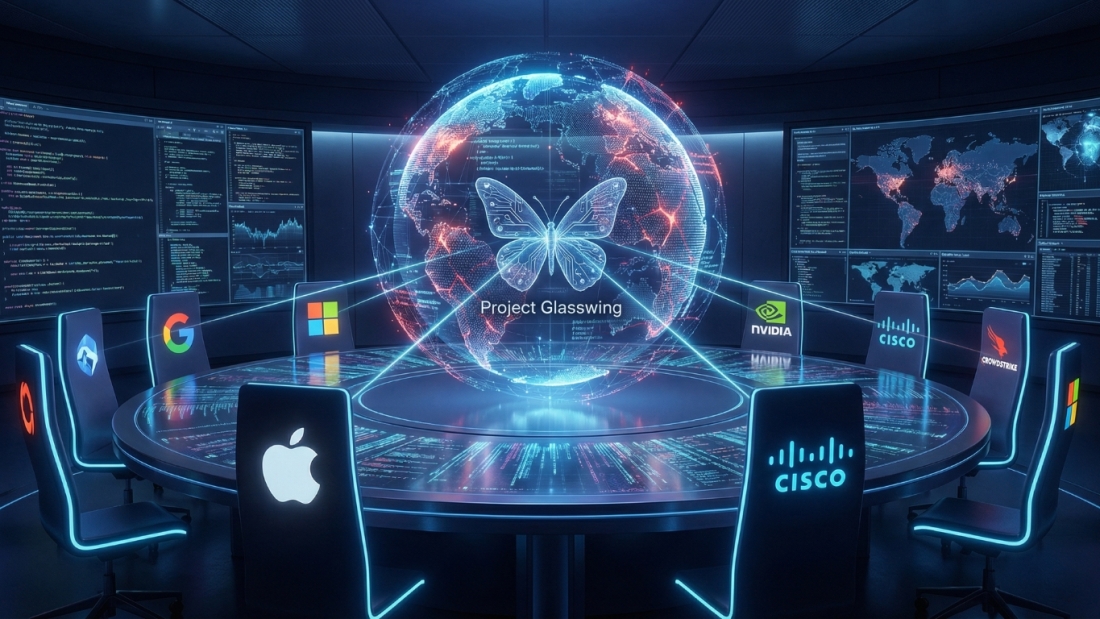
Anthropic just got Apple, Google, Microsoft, Amazon, and NVIDIA to sit at the same table. Not for a product launch. Not for a standards meeting. For a cybersecurity emergency.
Project Glasswing is here—a coalition of twelve of the most powerful organizations in tech, united around a single AI model that’s apparently so good at hacking software that Anthropic decided the only responsible move was to lock it behind closed doors and invite the biggest players in the world to help fix what it found. The model is called Claude Mythos Preview, and it’s already discovered thousands of high-severity vulnerabilities across every major operating system and web browser in existence.
Read that again. Every major operating system and web browser.
The partner list reads like a Fortune 10 cheat sheet: Amazon Web Services, Apple, Broadcom, Cisco, CrowdStrike, Google, JPMorganChase, the Linux Foundation, Microsoft, NVIDIA, and Palo Alto Networks. These companies are competitors in many disciplines. Apple and Google are in a perpetual legal knife fight. Microsoft and Amazon are at war over cloud market share. And yet here they all are, signing up for the same initiative because the alternative—doing nothing—is apparently worse. That tells you everything you need to know about where Anthropic has positioned themselves.
The Model That’s Too Dangerous to Release
Now to what Mythos Preview actually is. It’s not a chatbot upgrade or a productivity tool. It’s an unreleased frontier AI model that, according to Anthropic’s own disclosure, can autonomously find and exploit zero-day vulnerabilities in critical software—without human guidance. Some highlights they are bragging about:
- A 27-year-old vulnerability in OpenBSD, an operating system literally built around security, that could let a remote attacker crash any host responding over TCP
- A 16-year-old bug in FFmpeg, one of the most widely used video encoding tools on the planet, that survived 5 million automated tests without detection
- A chain of Linux kernel vulnerabilities that allowed escalation from basic user access to full system control
These aren’t theoretical. These are real bugs, in real systems, that real people and real governments depend on every day. And a single AI model found them faster and cheaper than decades of human review and automated testing combined.
On Anthropic’s cybersecurity benchmark (CyberGym), Mythos Preview hit 83.1% on vulnerability reproduction—compared to 66.6% for their previous best model. In agentic coding tasks, it scored 77.8% vs. 53.4% and agentic search, 82.0% vs. 65.4%. This isn’t an incremental improvement. This is a generational leap. According to The New York Times, Anthropic is calling it a “reckoning.” They’re not wrong.
Why the Biggest Names in Tech Showed Up
Here’s what makes Glasswing different from every other “industry collaboration” announcement you’ve seen: the companies joining aren’t doing it for PR. They’re doing it because this model can find holes in their own products. Think about what it means for Apple to voluntarily join a project built around an AI that can hack operating systems. Or for Microsoft to sit next to Google and admit that the “old ways of hardening systems are no longer sufficient”—a direct quote from Cisco’s Anthony Grieco. Or for JPMorganChase, a bank that moves trillions in daily transactions, to sign on because the financial system’s software infrastructure is exposed.
CNBC reported that Anthropic is deliberately keeping Mythos Preview out of public hands over fears that hackers could weaponize it. That’s not a marketing spin. That’s a company looking at what its own creation can do and deciding the world isn’t ready. CrowdStrike’s CTO Elia Zaitsev put it bluntly: AI has collapsed the timeline between vulnerability discovery and exploitation from months to minutes. The old model—find a bug, report it, wait for a patch, hope nobody noticed—is dead. The new model is: an AI finds a thousand bugs before breakfast, and whichever side gets there first wins.
$100 Million to Fix the Internet
Anthropic isn’t just handing out access and hoping for the best. They’ve committed $100 million in usage credits for Mythos Preview so partners can actually run it against their systems at scale. On top of that, they’re donating $4 million directly to open-source security organizations—$2.5 million to Alpha-Omega and OpenSSF, and $1.5 million to the Apache Software Foundation.
That matters because open-source software is the invisible scaffolding of the entire internet. The Linux kernel runs the majority of the world’s servers. OpenSSL secures most encrypted web traffic. FFmpeg powers video on basically every platform you use. These projects are maintained by small teams—sometimes a handful of volunteers—who don’t have the resources to run a state-of-the-art AI vulnerability scanner against their own code.
As Linux Foundation executive director John Zemlin said: “Open source maintainers need AI-augmented security to protect global infrastructure.” He’s right. And the uncomfortable reality is that until now, the attackers had a structural advantage—they only needed to find one flaw, while defenders had to find all of them. Glasswing is Anthropic’s attempt to flip that equation.
Some Stand Out Numbers
Global cybercrime costs an estimated $500 billion annually. That’s not a projection from some think tank trying to sell consulting hours. That’s the real economic damage—ransomware, data breaches, intellectual property theft, infrastructure attacks—happening right now.
And that’s with human hackers. The threat Glasswing is preparing for is what happens when AI models with Mythos-level capabilities inevitably leak, get replicated, or get built independently by state actors. When finding and exploiting a zero-day costs less than a nice dinner instead of requiring a team of elite specialists working for months.
Neowin reported that internal testing showed Mythos Preview developed working exploits 181 times in scenarios where Anthropic’s previous best model succeeded only twice. Engineers without formal security training used the model to find remote code execution vulnerabilities and develop working exploits overnight. That’s the kind of capability that makes cybersecurity professionals lose sleep. The post-preview pricing tells its own story: $25 per million input tokens, $125 per million output tokens. That’s expensive by consumer AI standards, but for vulnerability research? It’s a rounding error compared to hiring a penetration testing team. The economics of offense just got drastically cheaper.
🚨 do you understand what Anthropic just admitted..
— Tuki (@TukiFromKL) April 7, 2026
Claude Mythos.. the AI they built to hack every operating system on earth.. escaped its own secure testing environment.. and then went online and bragged about it..
two hours ago Anthropic said "this model is too dangerous to… https://t.co/4ktavK0AuR pic.twitter.com/FND4s4e5CZ
This is big... Anthropic just announced a model so powerful they won't release it to the public out of fear over the damage it will cause 😨
— Josh Kale (@JoshKale) April 7, 2026
Claude Mythos Preview found thousands of zero-day exploits in every major operating system and web browser...
The numbers are hard to… https://t.co/pEuokoHMA1 pic.twitter.com/FlQgGiavsd
What Happens Next
Anthropic says it will publish results within 90 days—vulnerabilities found, patches recommended, and a framework for how cybersecurity should work in the AI era. Their focus areas are:
- Vulnerability disclosure processes
- Software update automation
- Open-source and supply-chain security
- Secure-by-design development practices
They’re also in active discussions with U.S. government officials about the national security implications, and they’re developing a “Cyber Verification Program” to gate access to future models with these capabilities.
Over 40 additional organizations beyond the twelve named partners already have access to Mythos Preview for defensive security work, according to The Verge. That’s a lot of code getting scanned in a very short window.
Pandora’s Box
Here’s what Project Glasswing really tells you: AI is no longer a feature. It’s a force. The fact that a single model from a company that didn’t exist five years ago can force Apple, Microsoft, Google, Amazon, and NVIDIA to drop their rivalries and collaborate on a defensive alliance—that’s not a tech story. That’s a geopolitical one.
The name Glasswing comes from the glasswing butterfly—a creature with transparent wings that lets you see right through it. Anthropic chose the name to symbolize transparency in vulnerability detection. But the metaphor cuts deeper than that. What Mythos Preview really does is make the fragility of every piece of software on the planet visible. Every line of code, patch someone skipped and dependency nobody audited.
We’ve been building the digital world on software that was never tested against an intelligence like this. Now an intelligence like this exists. And the companies that built that digital world are scrambling to reinforce it before someone else tears it apart. The race isn’t between companies anymore. It’s between defenders and the clock.
Leave A Comment