

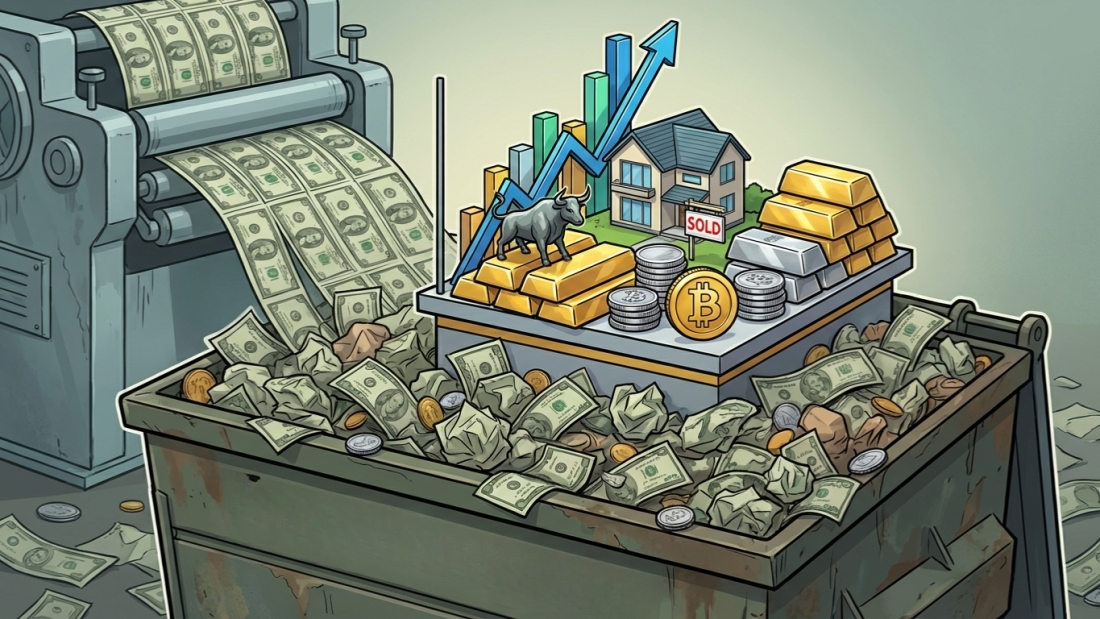
The S&P 500 just hit an all-time high. So did the Dow Jones. Gold reached record levels. Silver broke its all-time high for the first time since 1980. Bitcoin surged past its previous peak. Home prices continue climbing. Rents keep rising. Everything is at or near all-time highs. Stocks. Real estate. Precious metals. Crypto. Alternative assets across the board.
So what does that tell us? It’s not that everything suddenly became more valuable. It’s that your money became less valuable.
The Uncomfortable Math
Let’s start with the numbers that should make every American uncomfortable. Between February 2020 and June 2020, the M2 money supply in the United States exploded from $15.3 trillion to $18 trillion. That’s a $2.7 trillion increase in four months. By November 2025, M2 reached $22.3 trillion. That’s a 45% increase in the money supply in less than six years.
The Federal Reserve’s balance sheet tells the same story. It grew from $4.2 trillion in early 2020 to over $8.9 trillion by April 2022. The Fed created approximately $3.3 trillion in 2020 alone—roughly 20% of all US dollars in circulation at that time. And what was the result? The US dollar lost approximately 25% of its purchasing power between 2020 and 2025. What cost $100 in 2020 now costs $125. Inflation hit 9%, the highest in 40 years. This isn’t a conspiracy theory. This is monetary policy.
When Everything Goes Up, Nothing Went Up
We hate rain on your parade but, when stocks, housing, gold, silver, and Bitcoin all hit record highs simultaneously, it’s not because the world suddenly became wealthier. It’s because the measuring stick—the U.S. dollar—shrank and every asset priced in dollars appears to be “growing” when in reality, the dollar is shrinking.
The S&P 500’s market capitalization hit a record $62.0 trillion in January 2026. Sounds impressive. But when you adjust for the devaluation of the currency those stocks are priced in, the picture changes. The index is trading at a cyclically-adjusted price-to-earnings (CAPE) ratio hovering around 40, a level only surpassed once since 1871—during the dot-com bubble. That’s not a sign of strength. That’s a sign of distortion.
Home prices have risen 25% since 2020. But wages haven’t kept pace. The median single-family home price is now about five times the median household income, well above the traditionally affordable price-to-income ratio of three. People aren’t getting richer. They’re getting priced out.
The Printing Press Never Stopped
The Federal Reserve officially ended its balance sheet wind-down (quantitative tightening) on December 1, 2025. The very next day, it injected $13.5 billion into the financial system. The Fed plans to buy approximately $40 billion of government bonds per month, totaling almost half a trillion dollars a year. They call it “reserve management purchases.” The rest of us call it what it is: money printing.
And it’s not slowing down. The U.S. national debt has surpassed $38 trillion, with some reports citing it as high as $38.5 trillion. That’s approximately $114,000 per person and $285,000 per household. Annual interest payments on this debt now exceed $1 trillion, up from $345 billion in 2020. To put that in perspective: if the $1 trillion annual interest cost were divided among U.S. households, it would amount to approximately $650 per household per month. That’s not going toward infrastructure, education, or healthcare. That’s just servicing the debt.
The government is spending more than it takes in. The deficit for Fiscal Year 2026 was $602 billion by the end of December 2025, with the Congressional Budget Office projecting a $1.7 trillion deficit for the full year. To cover these deficits, the government borrows money by selling Treasury securities. And who’s buying? Increasingly, it’s the Federal Reserve—using newly created money. This is the cycle. Spend more than you earn. Borrow to cover the gap. Print money to buy the debt. Repeat.
The Flight to Real Assets
Investors aren’t stupid. They see what’s happening. And they’re responding by fleeing fiat currency and moving into real assets.
Gold surged 70% since January 2025. Central banks are increasing their purchases, reflecting skepticism towards the U.S. dollar’s dominance. The People’s Bank of China purchased gold for 11 consecutive months in 2025. J.P. Morgan forecasts gold could reach $5,000 to $6,000 per ounce by the end of 2026 or beyond.
Silver, which has both industrial and monetary demand, broke past $93 per ounce for the first time ever. Analysts believe it’s possible for silver to reach $100 an ounce in 2026. Citigroup strategists upgraded their 0–3 month target for silver to $100 per ounce, projecting the bull market for precious metals to continue through early 2026. Bitcoin, despite its volatility, is gaining institutional traction. While it experienced a correction from its all-time high of $126,210.50 in October 2025, experts like Tom Lee of Fundstrat Global Advisors predict Bitcoin could reach $200,000 to $250,000 by year-end 2026. Its fixed supply—21 million coins, ever—contrasts sharply with the infinite expansion potential of fiat currencies.
Real estate, despite affordability challenges, continues to attract capital. U.S. real estate offers both income and appreciation, and it’s a tangible asset that can’t be printed into existence. Investors are reallocating portfolios towards these alternative stores of value to hedge against fiat devaluation risks.
BREAKING: Silver reaches new all-time high of $94.36/oz.
— Steve Hanke (@steve_hanke) January 19, 2026
GOLD is insurance. SILVER is the alarm bell. pic.twitter.com/H4Kf3wlVH2
An American Federal Reserve Note Dollar is now worth 1/4,616th of an ounce of gold. pic.twitter.com/7e5g9R4Yeq
— Matt Bracken (@Matt_Bracken48) January 15, 2026
he Debasement Playbook
This isn’t new. It’s a pattern that repeats throughout history. Governments overspend. They borrow to cover the gap. Eventually, they debase the currency to manage the debt. The Roman Empire did it by reducing the silver content in their coins. Weimar Germany did it by printing marks. Zimbabwe did it in the 2000s. Venezuela is doing it now.
The United States is doing it with digital ledgers and bond purchases, but the mechanism is the same. Increase the money supply. Devalue the currency. Transfer wealth from savers to debtors—and the biggest debtor is the government.
Since the Federal Reserve’s creation in 1913, the US dollar has lost 97% of its purchasing power. After the 2008 financial crisis, the Fed expanded its balance sheet from $900 billion to $4.5 trillion through multiple rounds of quantitative easing, leading to a 20% reduction in the US dollar’s purchasing power by the end of that decade.
And now, we’re doing it again. Bigger. Faster.
Billionaire hedge fund manager Ray Dalio has warned of a 1970s-style currency shock, predicting that all fiat currencies will “go down together” in a major devaluation cycle. Economist Dawie Roodt predicts a “post-fiat era” within the next decade, where fiat currencies will either disappear or transition into Central Bank Digital Currencies (CBDCs).
What This Means for You
If you’re holding cash, you’re losing purchasing power. Your savings account earning 0.5% interest while inflation runs at 3-4%, has you going backwards. If your salary increased 3% last year but the cost of groceries, rent, and gas increased 5-7%, you got a pay cut. The system is designed this way. Inflation is a hidden tax. It transfers wealth from those who hold currency to those who hold assets. It benefits debtors at the expense of savers. And the biggest debtor in the world is the U.S. government.
The assets hitting all-time highs aren’t appreciating in real terms. They’re maintaining their value while the currency they’re priced in deteriorates. A house is still a house. An ounce of gold is still an ounce of gold. A share of a productive company is still a share of a productive company. What’s changing is the value of the dollar. This is the reality check. The printing press has consequences. The bill for decades of deficit spending, quantitative easing, and monetary expansion is coming due. And it’s being paid in the form of a devalued currency.
Your fiat currency is trash. The assets at all-time highs are just reflecting that truth.
Leave A Comment