

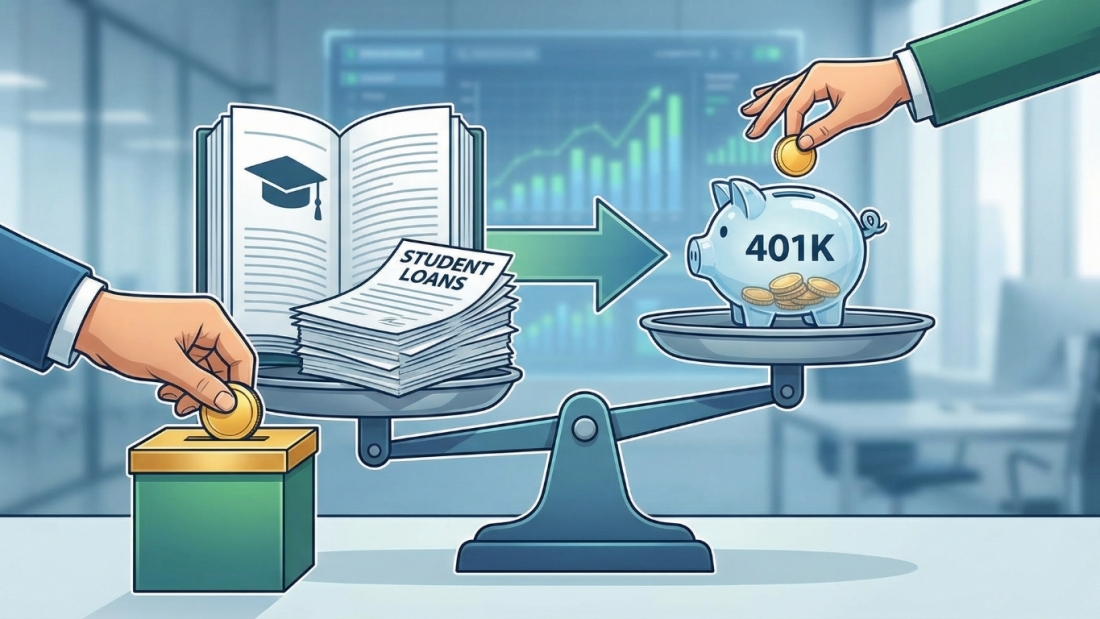
There’s a peculiar insanity to watching someone drown while you toss them a life raft scheduled to arrive in 40 years. Yet that’s exactly what we’re doing with America’s workforce. We’ve got 43 million Americans buried under $1.77 trillion in student loan debt, and our solution is to keep prioritizing their retirement accounts (which many don’t have anyway). Here’s a radical idea: What if employers matched student loan payments BEFORE—or instead of—401(k) contributions? Not as a cute side benefit. Not as an afterthought to retirement planning. As the primary matching benefit for employees who carry student debt.
The Crisis We’re Ignoring
Let’s get the numbers out of the way. The student loan debt crisis isn’t a crisis in theory—it’s a recession-level force actively dragging down the American economy:
- $1.77 trillion in total student debt
- 42.3 million borrowers
- 10.16% delinquency rate as of Q2 2025—nearly double credit card delinquencies
- 92% of this debt is owed to the Federal Government
Every percentage point increase in student debt-to-income ratios reduces consumer spending by 3.7%. The Federal Reserve estimates student debt shaves 0.05% off GDP annually. It’s suppressing homeownership rates, killing small business formation (individuals with over $30,000 in student debt are 11% less likely to start a business), and creating a generation that can’t afford to participate in the economy. And yet, we keep telling 25-year-olds to max out their 401(k)s.
Section 127: The Tool We’re Not Using Properly
Here’s what most people don’t know: Section 127 of the Internal Revenue Code already allows employers to contribute up to $5,250 per year, tax-free, directly to employee student loans. Originally designed for tuition reimbursement, the CARES Act expanded it in 2020 to include student loan payments. After years of temporary extensions, the One Big Beautiful Bill Act (OBBBA) made it permanent in July 2025 and indexed it for inflation starting in 2026. This is a massive policy win. But it’s not enough.
The $5,250 annual limit hasn’t meaningfully changed since Section 127 was created over 40 years ago. Meanwhile, the average federal student loan balance is $39,375. At $5,250 per year, it would take 7.5 years to pay off the average balance—assuming zero interest, which is fantasy in 2026. But more importantly, we need to reframe the entire conversation around employer benefits.
The Radical Proposal: Match Loans First, Retirement Second
Here’s the idea: give employees the option to direct their employer match toward student loan payments before it goes to their 401(k) or simultaneously. If an employer currently matches 5% of salary for 401(k) contributions, let employees say: “I need that 5% to go toward my $60,000 in student debt right now. the rest of the contributions for the year can go towards retirement.”
How This Would Work:
- Employee Election: When hired or during open enrollment, employees with student loans can elect to have their employer match go directly to their loan servicer instead of their 401(k).
- Tax Treatment: Employer contributions remain tax-free under an expanded Section 127 framework (currently capped at $5,250—but that’s what we’re fighting to change).
- Automatic Pivot: Once the employee’s student loans are paid off or contributions are maxed out, employer matching automatically shifts to 401(k) contributions.
- Government Win: The Federal Government (the lender in 92% of cases) gets its money back faster, reducing default risk and freeing capital for future lending.
This isn’t complicated. It’s a simple reallocation of existing benefit dollars with exponentially more immediate impact.
Who Benefits? Literally Everyone.
Let’s follow the money—because this creates a circular economic flow that benefits every stakeholder:
1. Employees
- Pay off high-interest debt faster (federal rates are 5-8%; private loans can exceed 10%).
- Save thousands in interest payments.
- Free up disposable income to actually spend in the economy or start saving for retirement debt-free.
- Reduce financial stress (more than half of borrowers report anxiety, depression, and mental health issues tied to their debt).
2. Employers
- Attract top talent: 86% of Gen-Z students say they’d commit to an employer for 5 years if they help repay student debt. Only 7-9% of employers currently offer this benefit. That’s a massive competitive advantage.
- Retain employees: Workers who see their debt as a “heavy burden” are 2.4x more likely to be job-hunting. Help them pay it off, and they stay.
- Boost productivity: Financial stress costs U.S. employers $183 billion annually in lost productivity. Reducing that stress = better performance.
- Tax advantages: Contributions under Section 127 are tax-deductible for employers and exempt from payroll taxes.
3. The Federal Government
Here’s where it gets interesting. The government is both the lender and the policy-maker. This should be a no-brainer:
- Faster repayment = less default risk. Remember, 10.16% of loans are currently delinquent.
- Reduced administrative costs for loan servicing and default collections.
- Economic stimulus: Employees with more disposable income pay more sales tax, income tax, and contribute to GDP growth (remember, student debt reduces GDP by 0.05% annually).
- Increased workforce participation: People crushed by debt delay homeownership, don’t start businesses, and avoid advanced degrees. Fixing this expands the tax base.
4. The Broader Economy
This isn’t zero-sum. When young workers can actually participate in the economy, everyone wins:
- More home purchases → construction jobs, furniture sales, property taxes.
- More small business formation → job creation, innovation.
- More consumer spending → sales tax revenue, retail growth.
This is a circular flow of money: Government → Student → Employer → Government. Everyone gets paid. Everyone benefits. It’s elegant in its simplicity.
Who Says No? (And Why They’re Wrong)
Objection 1: “But retirement savings are important!”
Yes. They are. In 40 years.
You know what else is important? Not having your wages garnished, your credit destroyed, and your stress levels so high you can’t function at work. Retirement accounts are a long-term investment. Student loans are a short-term crisis. You can’t build wealth for the future if you’re financially suffocating in the present. Besides, once the loans are paid off, employees can contribute more aggressively to retirement because they’re not hemorrhaging money to interest payments.
Objection 2: “This just subsidizes expensive colleges!”
No. The loans already exist. The degrees have been earned (or not—many borrowers never graduated and are stuck with debt and no degree). This isn’t about rewarding universities. It’s about preventing a generation of workers from financial collapse and getting the Federal Government its money back faster.
Objection 3: “Employees will just take advantage of this!”
Take advantage how? By… paying off their debts faster? Staying with employers longer to maximize the benefit, and becoming more financially stable and productive? That’s not exploitation. That’s exactly the outcome we want.
Objection 4: “This is unfair to employees without student loans!”
Then give them the full 401(k) match. Or offer tuition reimbursement for future education. Or create a flexible benefit pool where employees can allocate employer contributions toward their biggest financial need—student loans, childcare, healthcare, retirement, whatever. The point isn’t to punish people without student debt. The point is to stop drowning people who have it. This isn’t radical. It’s common sense.
The Bottom Line
We’ve built an economy where getting an education is a financial death sentence for millions. We’ve normalized the idea that 22-year-olds should carry $40,000 in non-dischargeable debt while we lecture them about compound interest and Roth IRAs. It’s absurd. Student loan debt is delaying homeownership, killing entrepreneurship, and creating a generation that can’t afford to participate in the economy. It’s a self-inflicted economic wound—and we have the tools to fix it.
Section 127 is permanent. The framework exists. The tax advantages are in place. Now we just need employers and policymakers to have the guts to prioritize the crisis in front of us over the retirement planning 40 years away. Let employees pay off their loans first. Then let them build wealth. Because right now, we’re asking people to invest in a future they can’t afford to reach.
Want to learn more about Section 127 and employer student loan benefits?
Leave A Comment