

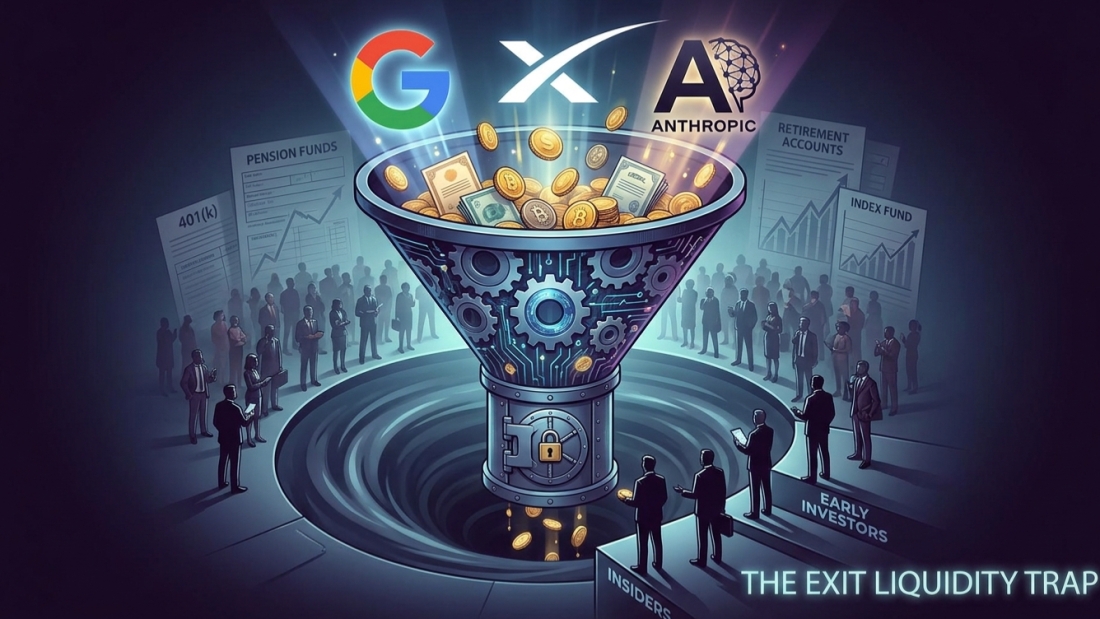
Google is selling $80 billion in stock while sitting on $126 billion in cash. SpaceX wants $75 billion at a valuation twice what Morningstar says it’s worth. Anthropic and OpenAI are queuing up another $100 billion behind them. Add it up. That’s a third of a trillion dollars in equity hitting the market in a single year — and the only question that matters is: who’s on the other side of that trade?
Stripped of Wall Street euphemisms, what’s happening is simple: someone is converting speculative equity into real, liquid cash — and someone else is handing over that cash in exchange for the speculative equity. The first group includes the most sophisticated financial operators in human history. The second group is you. Your 401(k), index fund, state pension. The entire passive investment infrastructure that has spent thirty years training Americans to buy and hold without asking questions. This isn’t a prediction. It’s a description of a mechanism already in motion. The capital raises are announced. The S-1s are filed. The Nasdaq has literally rewritten its rulebook. Let’s walk through it.
The Avalanche
Start with the numbers — not the narratives, not the pitch decks. Just the numbers. Alphabet announced on June 1, 2026 the largest equity fundraising in corporate history: $80 billion. The structure: a $10 billion private placement from Berkshire Hathaway, a $30 billion underwritten public offering ($15 billion common plus $15 billion mandatory convertible preferred), and a $40 billion at-the-market program beginning Q3 2026, roughly $30 billion of which addresses tax obligations on employee equity vesting. Shares dropped 4% the next morning.
For scale: the three largest IPOs in history — Saudi Aramco ($25.6 billion), Alibaba ($21.8 billion), SoftBank Mobile ($23.5 billion) — don’t match it combined. The Guardian called it unprecedented.
1) SpaceX targets a June 12 listing on Nasdaq under “SPCX,” raising $75 billion at $135 per share — a $1.75 trillion valuation, the largest IPO in history by a factor of three. A 15% greenshoe could push the raise to $86.25 billion. Roughly 30% goes to retail investors — available on Robinhood, Fidelity, Schwab, SoFi, and E*TRADE — compared to the 5–10% industry standard. That retail overweight is not generosity.
2) Anthropic filed a confidential S-1 targeting an October listing at $965 billion — up from $380 billion in February, a 154% markup in a single quarter, propelled by a $65 billion Series H. No European public capital participated — a detail worth noting.
3) OpenAI filed its own confidential S-1 targeting September at a valuation exceeding $1 trillion. Goldman Sachs and Morgan Stanley are leading. Expected raise: approximately $60 billion.
Add the column. Alphabet’s $80 billion. SpaceX’s $75–86 billion. OpenAI’s $60 billion. Anthropic’s IPO raise likely $20–40 billion. Conservative total: $250 billion. Factor in greenshoe exercises, secondary effects, and forced index rebalancing, and the realistic number pushes past $330 billion. Most of it within a single quarter.
The irony: Q1 2026 global VC funding hit a record $297–$330 billion, with 80–81% flowing to AI. Just a handful of companies — the same names on this list — accounted for 65–75% of all global venture capital. This isn’t broad investment in a technology sector. It’s a concentrated capital pipeline now asking public markets to absorb the risk.
“We Need the Cash” Is the Cover Story
Alphabet’s stated rationale: $180–$190 billion in 2026 capex, nearly double 2025 levels, to fund AI compute infrastructure. Fair enough. Infrastructure costs money. But Alphabet holds $126.84 billion in cash, generates $174.35 billion in trailing twelve-month operating cash flow, and already carries more than $100 billion in outstanding debt. Even after the full capex target, operating cash flow covers the vast majority. The gap could be funded through debt at investment-grade rates. Instead, they chose equity dilution. At peak valuations. In the most visible way possible.
This is not the behavior of a company that needs money. It’s the behavior of a company that recognizes its equity is expensive and wants to harvest the premium before the market reassesses it. Every CFO on Earth understands this calculus — you issue stock when your stock is overpriced, and you buy it back when it’s cheap. Alphabet spent years buying back shares at lower prices. Now they’re issuing at historical highs. The arithmetic is self-explanatory.
Analysts have characterized this as a structural shift — from “capital-light cash flow machines” to “highly capital-intensive infrastructure entities.” That’s accurate and damning simultaneously. The market is being asked to re-underwrite these companies at infrastructure economics while paying software multiples. The last time investors accepted that contradiction at scale was 2000, and the companies were WorldCom and Global Crossing.
There’s a strategic dimension too. By absorbing $80 billion now, Alphabet is pre-emptively draining the pool that SpaceX, OpenAI, and Anthropic will be fishing from over the next six months. Greg Abel — Berkshire’s CEO — is making one of the firm’s most significant technology bets in history with the $10 billion placement. Whether that’s conviction or a negotiated discount that guarantees a flip, the retail investors buying the remaining $70 billion don’t get the same terms.
The Max Q Trap
SpaceX structured its IPO as all-primary — no insiders selling at the offering. Musk carries a 366-day lockup. Other insiders face a staggered release: 20% after Q2 earnings, an additional 10% if the stock trades 30%+ above IPO, rolling 7% tranches at 70–135 days, 28% after Q3 earnings, full expiration at 180 days — December 2026.
Wall Street will frame this as alignment. Reframe it through market mechanics and the picture inverts. Retail buys at the offering, trades in the secondary market, builds the order book depth that enables large blocks to sell without crashing the stock. Then — six months later — insiders sell into exactly the demand structure retail spent half a year constructing.
Morningstar initiated coverage with a fair value estimate of $780 billion — less than half the IPO target. The xAI segment — absorbed through a merger that was not conducted at arm’s length — was probability-weighted at $17–$170 billion, with Morningstar noting a “material threat of value destruction.” The company is priced at 266 times its 2025 EBITDA. It posted a $4.94 billion net loss in 2025 and $4.28 billion in Q1 2026 alone.
Morningstar borrowed a term from rocketry: “Max Q” — maximum dynamic pressure during ascent, when catastrophic failure peaks. In SpaceX’s financial context, Max Q arrives around December 2026, when lockup expirations flood the market with insider shares. History is unambiguous. Facebook (2012): IPO at $38, cratered to $19.83 on first lockup — 48% decline. By November, 777 million additional shares hit the market. Uber (2019): stock fell 37.7% from offering by lockup expiration. Rivian (2022): plunged 22% in a single day on lockup expiry. The pattern is structural. IPO Hub’s research documents routine 2–10% declines following expirations, with anticipatory selling beginning weeks before. SpaceX’s staggered lockup doesn’t eliminate this dynamic — it extends it into a months-long slow bleed.
They’re Forcing the Buy
On May 1, 2026, Nasdaq implemented rule changes critics call “Lex SpaceX.” Companies in the top 40 by market cap can now join the Nasdaq-100 after just 15 trading days, down from roughly one year. The 10% minimum free-float requirement is gone. For companies with less than 20% float, a multiplier of up to 3x inflates index weighting. Simultaneously, S&P Dow Jones Indices initiated consultations to halve its seasoning requirement and waive GAAP profitability for mega-cap IPOs.
The consequence: index-tracking ETFs and pension funds must hold index constituents — not by choice, by mandate. When SpaceX enters the Nasdaq-100, every tracking fund must buy shares, selling existing holdings to generate the cash. Conservative estimates put forced buying at $15–$30 billion. More aggressive modeling that includes robo-advisors and target-date funds pushes toward $200 billion — all compressed into 15 trading days. That’s not investment. That’s a manufactured demand shock.
The American Federation of Teachers — representing 1.8 million workers — formally petitioned SEC Chair Paul Atkins demanding “extraordinary scrutiny.” President Randi Weingarten called SpaceX an “overvalued high-risk bet” forced on retirement accounts before adequate price discovery can occur. Governance provisions include dual-class shares concentrating 80–84% of voting power in Musk, provisions making him effectively unfireable, and mandatory arbitration for shareholder claims. CalPERS and pension officials described the governance as “the most management-favorable ever brought to U.S. public markets.” Denmark’s Akademikerpension has already barred SpaceX entirely.
When a teachers’ union is begging federal regulators to protect retirement funds from a single IPO, the deal isn’t as sweet as the roadshow slides suggest.
The AI Burn Rate Problem
Set aside the structural mechanics. Are these companies actually making money? Overwhelmingly, no. OpenAI projects a net loss of $14 billion in 2026 — tripling its 2025 losses. Cumulative projected losses through 2028: $44 billion. Profitability isn’t expected until 2029, and only at roughly $100 billion in annual revenue. HSBC estimates the company may need $207 billion in additional capital through 2030. Meanwhile, only 5.5% of users pay.
xAI — now inside SpaceX — burned $6.36 billion in 2025 on $3.2 billion in revenue. Q1 2026: $2.47 billion operating loss on $818 million revenue. Morningstar called the financials “reckless.” Monthly burn: approximately $1 billion.
Anthropic’s Burn Rate
Anthropic reports an annualized run rate of $47 billion, driven largely by Claude Code, with 1,000+ enterprise customers above $1 million annually. But revenue is reported on a gross basis — before cloud partners take their cut. And the valuation jump from $380 billion to $965 billion in four months means Amazon’s original $8 billion investment is nominally worth $74.2 billion on paper. Paper gains only become real when someone provides the liquidity to cash them out. That someone is the IPO buyer.
CEO Dario Amodei described the growth as exceeding internal forecasts by 8x, calling it “crazy” and an “emergency.” When the CEO of a company approaching a trillion-dollar valuation describes his own growth rate as an emergency, the question isn’t whether the growth is real. It’s whether the valuation has already priced in a decade of it.
We’ve covered the structural profitability crisis in major AI companies before. The math hasn’t changed: the industry needs $650 billion in annual revenue by 2030 to justify current infrastructure spending, and the gap between infrastructure investment and software revenue sits at roughly 20:1. As we’ve explored in our analysis of the emerging AI government bailout dynamic, the pressure to socialize these losses is already building.
The Capital Sponge
There’s a finite amount of investable capital in the world. When AI and space companies absorb $330 billion-plus in a single year, the money comes from somewhere. Every dollar flowing into SpaceX or Anthropic is a dollar not flowing into small-cap equities, municipal bonds, or non-AI venture funding.
The crowding-out is visible. Non-AI startups face a capital drought — fintech, climate tech, and traditional SaaS companies are struggling for follow-on funding as investors concentrate capital in a handful of AI plays. Market concentration has reached its highest level in half a century, with the top five companies holding 30% of the S&P 500. The Shiller CAPE ratio hovers around 38–40 — close to the dot-com peak of 44.19.
Collectively, these IPOs and raises will inject roughly $3.7 trillion in new market capitalization into public exchanges. Institutional investors must rotate out of existing holdings to accommodate the new entrants, potentially pushing tech sector weight in the S&P 500 beyond 48%. Hyperscalers are projected to spend $800–$900 billion on infrastructure in 2026, with 2027 estimates exceeding $1 trillion — before equivalent AI software revenue materializes.
Liquidity doesn’t materialize from the ether. It gets redirected. And when it gets redirected at this scale, the things it leaves behind fracture in ways that don’t show up until it’s too late.
Heads They Win, Tails You Lose
Forget the individual tickers. Look at the game board. If AI delivers — the insiders win. They own the largest stakes, negotiated preferred terms, liquidation preferences, and super-voting shares that guarantee their control regardless of public shareholders. If AI doesn’t deliver — the insiders still win. They raised at the top. They converted speculative paper wealth into liquid cash through primary offerings and lockup-expiration mechanics. The cash is theirs. The equity risk is yours.
If the market corrects to Morningstar’s estimates — SpaceX loses roughly $970 billion in market cap. The $135-per-share buyer owns stock worth $67.
The only scenario where the retail IPO buyer wins requires that all of these valuations are underpriced simultaneously — that SpaceX at $1.75 trillion is a bargain, Anthropic at $965 billion is cheap, OpenAI at a trillion-plus with $14 billion in annual losses is obvious, and Google selling $80 billion in stock while sitting on $126 billion in cash is routine.
Consider: the people who built these companies — who possess more information than any analyst or retail investor ever will — looked at this moment and decided the optimal move was to sell equity at the highest prices in their companies’ histories. That signal doesn’t require a Bloomberg terminal to interpret.
🚨 EL MAYOR IPO DE LA HISTORIA PODRÍA SER UNA ENORME TRAMPA DE LIQUIDEZ.
— SantinoCripto® (@SantinoCripto) June 1, 2026
SpaceX sale a bolsa con una valoración de 1,75 BILLONES de dólares, superando incluso a Microsoft.
Pero hay un problema:
📉 La compañía perdió 4.280 millones de dólares en un solo trimestre.
Y eso no es… pic.twitter.com/vbhOZTMd73
Google is raising $80 billion of equity a week before SpaceX is trying to raise $75 billion a few months before Anthropic and OpenAI are trying to raise $100 billion from investors and you’re laughing???
— litquidity (@litcapital) June 2, 2026
This is a cataclysmic exit liquidity avalanche pic.twitter.com/0OqXgwDUkA
Who’s Laughing Now?
“If you don’t know who the patsy at the table is, it’s you.”
The patsy is anyone whose capital is deployed — voluntarily or mechanically — on the buy side of a $330 billion equity issuance orchestrated by sellers who control the timing, pricing, governance, and exit windows. The index fund that must buy within 15 days under freshly rewritten rules. The pension fund whose beneficiaries never voted to allocate retirement assets to a company valued at 266 times EBITDA with an unfireable CEO. The Robinhood user who sees a 30% retail allocation and mistakes a distribution mechanism for generosity.
This is not a conspiracy. Every participant is acting rationally within their incentive structure. Alphabet is rationally harvesting an equity premium. SpaceX is rationally structuring lockups for index inclusion. Nasdaq is rationally modifying rules to attract the largest listing in history. The problem isn’t that anyone is breaking the rules. The problem is that the rules create a mechanism that systematically transfers risk from those who have information to those who don’t, from those who set the terms to those who accept them.
When the most sophisticated financial operators in human history are simultaneously converting equity into cash at historically unprecedented scale — with structures designed to lock buyers in, delay insider selling, and guarantee billions in forced passive buying — the question isn’t whether you should be skeptical. It’s the one we started with: who’s on the other side of that trade? They already know the answer. And they’re not laughing.
This post reflects the author’s skeptical analysis and opinion. It is not financial advice. Do your own research and consult a financial professional before making investment decisions.
Leave A Comment