

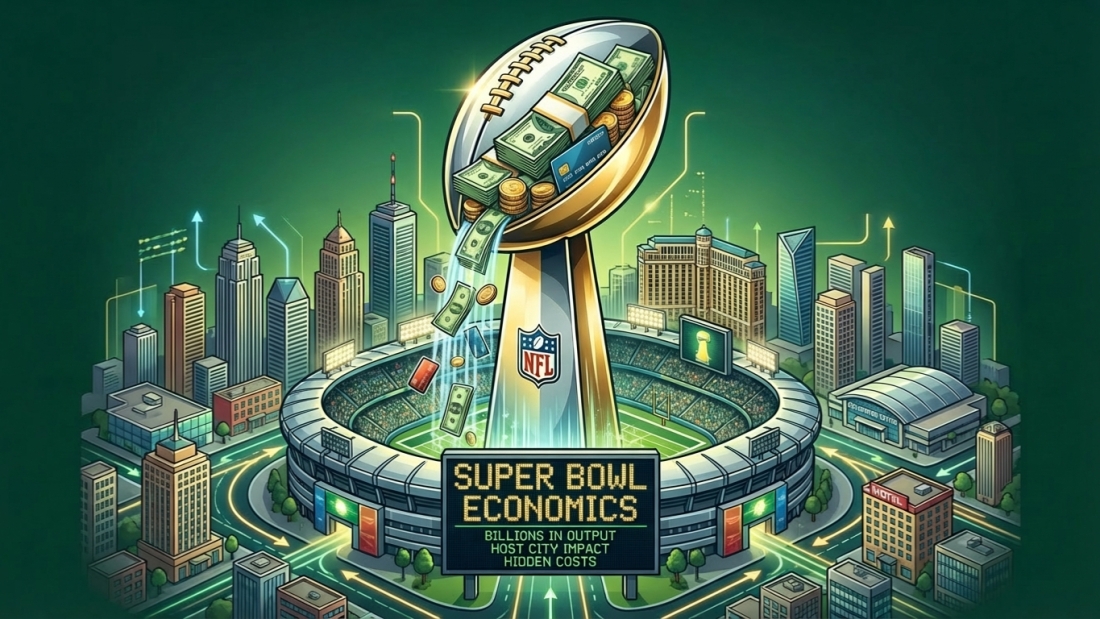
The Super Bowl isn’t just the biggest sporting event in America—it’s a billion-dollar economic engine that transforms host cities into temporary financial powerhouses. When the Kansas City Chiefs and Philadelphia Eagles faced off in New Orleans for Super Bowl LIX in February 2025, the game generated an estimated $1.25 billion in total economic output for Louisiana—more than double the impact of the city’s 2013 Super Bowl and the second-largest economic impact in NFL history.
But here’s the uncomfortable truth the NFL doesn’t advertise: while the league and its owners pocket billions, host cities often struggle to break even. The $600 million figure that gets thrown around? It’s real—but it’s also misleading.
The Billion-Dollar Weekend
Super Bowl LIX brought 115,000 people to New Orleans, with approximately 100,000 traveling from out of state. These weren’t budget tourists. Visitors who attended the game spent an average of $5,553 each, while those who came for the festivities but skipped the stadium still dropped $4,246 per person. The spending breakdown reveals where the money flows:
- Gambling: $1,292 per game attendee (the single largest category)
- Accommodations: $1,439 per game attendee
- Meals and bars: $905 combined
- Shopping: $375
- Local transportation: $153
Combined visitor and vendor spending hit $658.4 million, with the host committee, media, and sponsors contributing an additional $180.3 million. The event generated $395 million in earnings for Louisiana workers and created nearly 10,000 jobs.
For comparison, Las Vegas’s Super Bowl LVIII in 2024 generated $1 billion in economic impact, while Arizona’s Super Bowl LVII in 2023 hit a record $1.3 billion. The economic impact for host cities typically ranges from $300 million to $1.3 billion annually, depending on the city’s size, infrastructure, and ability to absorb the influx.
The Hidden Costs Cities Don’t Talk About
Here’s where the narrative gets complicated. While the headline numbers look impressive, economists have been calling bullshit on Super Bowl economic impact claims for years.
Mike Edwards from NC State points out that much of the money “leaks out” to national hotel chains, corporate sponsors, and businesses outside the host city. The net direct income to local residents is often far smaller than the billion-dollar figures suggest—sometimes as low as $30 million to $150 million. Cities incur massive costs that rarely make the promotional materials:
- Security and emergency services: Extra policing, fire, and medical personnel
- Infrastructure upgrades: Roads, drainage, lighting, and beautification projects (New Orleans spent over $70 million on 500+ initiatives)
- Stadium subsidies: Taxpayers contributed an average of $250 million for seven NFL stadiums built between 2006 and 2017
- Tax exemptions: The NFL demands host cities waive taxes on ticket revenue and related events—or reimburse the league if exemptions can’t be secured
The 2015 Super Bowl cost Glendale, Arizona between $579,000 and $1.2 million. After hosting Super Bowl XLII in 2008, Glendale’s mayor reported the city lost over $1 million, spending $3.4 million while earning only $1.2 million in taxes from direct spending.
Who Actually Wins?
The NFL is the undisputed financial champion. The league collects:
- 100% of ticket revenues (which are shared among all teams, not the host city)
- Billions from broadcasting deals (NBCUniversal pays approximately $2 billion annually for its NFL package)
- Tens of millions from merchandise sales
- $8 million per 30-second ad spot in 2025 (up from $7 million in 2024)
The NFL doesn’t pay to use the stadium for the Super Bowl. They control the revenue streams while cities foot the bill for infrastructure and services. National hotel chains, corporate sponsors, and out-of-state vendors capture a disproportionate share of visitor spending. When a fan from Pennsylvania books a Marriott, eats at a national chain restaurant, and buys official NFL merchandise, most of that money flows out of the local economy.
The Tax Revenue Reality
New Orleans collected an estimated $82.7 million in state and local taxes from Super Bowl LIX—$28.4 million local and $48.1 million state. Las Vegas generated $33.6 million in tax revenues from Super Bowl LVIII, including room taxes, sales taxes, and gaming-related taxes. These figures sound substantial until you compare them to the costs. The $560 million renovation of the Caesars Superdome included $90 million in government subsidies. Las Vegas allocated $750 million in public funding for Allegiant Stadium. The math rarely works in the city’s favor when you account for:
- Displaced regular tourism (hotel rooms booked for the Super Bowl can’t be sold to other visitors)
- Opportunity costs (resources diverted from other economic development)
- Long-term debt service on stadium construction
The Intangible Benefits (And Whether They Matter)
Cities don’t host the Super Bowl purely for short-term revenue. The intangible benefits include:
Global Exposure: Super Bowl LIX reached nearly 128 million viewers across TV and streaming platforms. Louisiana leveraged this with the 14,000-square-foot Louisiana NOW Pavilion, which hosted over 4,000 business leaders and generated over $6 million in publicity value.
Civic Pride: Hosting the Super Bowl fosters community engagement and showcases a city’s culture to a global audience. New Orleans matched Miami’s record for hosting the Super Bowl 11 times, reinforcing its status as a premier event destination.
Future Tourism: The exposure can lead to increased long-term tourism, though this is difficult to quantify. Louisiana officials noted that the Super Bowl helped attract companies like Hyundai, which later announced a $5.8 billion investment in the state.
But here’s the question: Do these intangible benefits justify the financial risk and public subsidy? For cities already struggling with infrastructure deficits, education funding, and public services, the answer is increasingly unclear.
The Broader Economic Ripple
The Super Bowl’s economic impact extends far beyond the host city. The U.S. Chamber of Commerce estimated that the Kansas City metro area saw $123.3 million in spending related to Super Bowl LIX, while the Philadelphia metro area saw $346.8 million—despite neither city hosting the game. Americans spent a projected $17.3 billion on Super Bowl-related products and services in 2024, with 2025 figures expected to exceed $18 billion. This includes:
- 1.4 billion chicken wings consumed
- Over 120,000 tons of avocados imported from Mexico (worth over $300 million)
- 5% of annual U.S. beer sales occurring during Super Bowl weekend
The halftime show alone generates massive economic activity. Rihanna’s 2023 performance led to a 600% spike in music streams, while Usher saw a 390% increase in sales after his 2024 show.
Is It Worth It?
For the NFL and its owners, the Super Bowl is an unqualified financial triumph. For host cities, the calculus is far more complex. Cities that already have the infrastructure—stadiums, hotels, transportation networks—can leverage the Super Bowl for a net positive impact, especially if they negotiate favorable terms and minimize public subsidies. New Orleans, with its 11th Super Bowl, has the institutional knowledge and existing infrastructure to maximize benefits.
But for cities that build new stadiums or make massive infrastructure investments specifically to attract the Super Bowl, the financial return is often disappointing. The economic impact studies commissioned by host committees and the NFL tend to overstate benefits and undercount costs.
The real winners are:
- The NFL (billions in revenue, zero stadium costs)
- National corporations (hotel chains, restaurant franchises, media companies)
- Wealthy team owners (franchise values continue to soar)
The real losers are often:
- Taxpayers (who subsidize stadiums and infrastructure)
- Local small businesses (who can’t compete with corporate sponsors)
- Displaced residents (gentrification from stadium construction)
The Super Bowl generates $600 million for a city—that part is true. But whether that $600 million represents a good deal for taxpayers, or just another example of corporate welfare for billionaire owners, depends entirely on who’s counting and what they’re counting.
New Orleans officials are already discussing hosting another Super Bowl, with the earliest possible return being 2030. The question isn’t whether the city can host another successful event—it’s whether the financial benefits justify the public investment, or whether cities are simply subsidizing the NFL’s most profitable weekend of the year.
Leave A Comment