

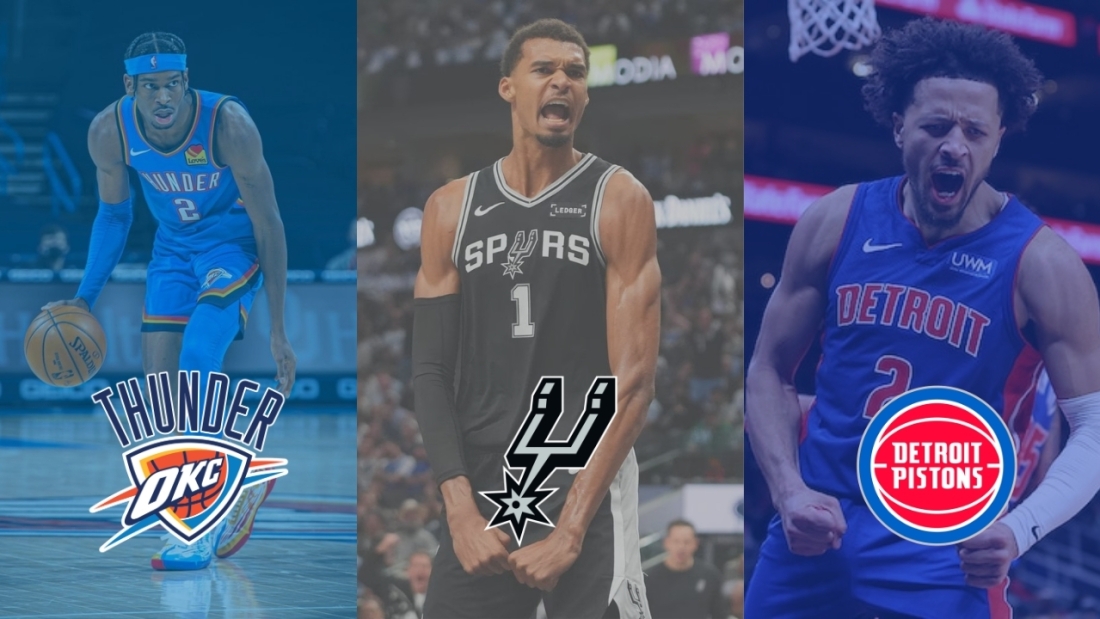
Phil Jackson, the 11-time NBA champion head coach, didn’t win rings by accident. His teams dominated regular seasons before dominating playoffs. From this experience emerged one of basketball’s most reliable predictive metrics: the 40-20 rule. The premise is simple—a true NBA title contender reaches 40 wins before accumulating 20 losses. Since the 1999-2000 season, 22 of 25 NBA champions have met this threshold. The rule’s 88% success rate isn’t a coincidence. It’s a reflection of what championship DNA looks like across an 82-game grind.
As we approach the 2026 playoffs, the standings have clearly separated the contenders from the pretenders. The Oklahoma City Thunder, Detroit Pistons, and San Antonio Spurs have all crossed the 40-20 threshold. We had been monitoring two teams on the bubble—the Spurs and the Boston Celtics. The Spurs came through, securing their 40th win before their 20th loss. The Celtics did not. Boston with a resilient 38-20 record, just came up short, joining the Cleveland Cavaliers, Denver Nuggets, New York Knicks, and Minnesota Timberwolves in the mathematical graveyard of 40-20 elimination. The question now isn’t just who meets the rule, but why these three teams are built differently—and what fatal flaws will doom the others when playoff pressure intensifies.
Understanding the 40-20 Rule
The 40-20 rule isn’t arbitrary. It quantifies the sustained excellence required to win a championship. Since the NBA adopted its current playoff format, only four teams have won championships without hitting 40 wins before 20 losses:
- 2003-04 Detroit Pistons: Started 33-16 before a mid-season slump, then acquired Rasheed Wallace and went on to upset the Lakers.
- 2005-06 Miami Heat: Began 11-10 before Pat Riley replaced Stan Van Gundy as head coach and Dwyane Wade carried them to a title.
- 2020-21 Milwaukee Bucks: A shortened 72-game COVID season skewed the math, but Giannis still delivered.
Each exception involved extraordinary circumstances—a transformative trade, a coaching change, or a pandemic-altered schedule. Without such interventions, 90% of champions since 1980 have crossed the threshold. The data is even more compelling when you examine playoff depth:
- 27% of all playoff teams reach 40-20
- 47% of conference semifinalists meet the standard
- 68% of conference finalists pass the test
- 76% of NBA Finalists hit the mark
- 90% of NBA Champions have achieved 40-20
The rule isn’t about arbitrary win totals. It’s about identifying teams that dominate consistently—that don’t have prolonged slumps, that close out games they should win, and that have the depth to weather injuries.
The Three Contenders
Oklahoma City Thunder
The Thunder aren’t just passing the 40-20 test—they’re humiliating it. Their +11.1 net rating is the best in basketball, a chasm separating them from the field. The formula is devastatingly simple: Shai Gilgeous-Alexander averaging almost 32 points on 55% shooting paired with the league’s most suffocating defense.
That defense isn’t an abstraction. Oklahoma City posts above a 106 defensive rating—best in the NBA—while limiting opponents to just 11.9 fastbreak points per game, also league-best. When Alex Caruso is on the floor, the Thunder’s defensive rating plummets to an absurd 99.9, a number that would rank among the greatest defensive units in modern NBA history. Their 117.6 offensive rating ranks second league-wide, meaning they’re elite on both ends—not just one.
The depth is obscene. Chet Holmgren anchors the interior with 8.8 rebounds and elite rim protection, posting a 103.9 defensive rating that anchors their interior. Jalen Williams provides All-Star caliber secondary scoring and defensive versatility. Isaiah Hartenstein gives them another dimension of physicality. Oklahoma City’s 35 bench points per game ensures the starters never have to carry unsustainable loads into June.
In clutch situations—last five minutes, margin within five points—Oklahoma City is 17-10, a testament to their closer in Gilgeous-Alexander. The reigning MVP and Finals MVP doesn’t shrink in big moments—he expands. His +15.5 on-court net rating this season is the highest of any qualified player. This is a team that takes your heart and buries it.
Detroit Pistons
The most improbable rise in recent NBA memory. Just two seasons ago, Detroit was the league’s laughingstock, stumbling through the longest losing streak in professional sports history. Now they’re the Eastern Conference’s apex predator, and Cade Cunningham is the reason.
Cunningham has evolved from promising prospect to legitimate MVP candidate, averaging 25.4 points and 9.8 assists per game—second in the league in assists—while shooting 45.9% from the field. His 31 double-doubles this season demonstrate a mastery of pace and playmaking that few point guards possess. His Player Efficiency Rating of 22.3 and 6.6 Box Plus/Minus mark him as one of the league’s most impactful players.
But Detroit’s identity is forged in the fire of close games. The Pistons lead the NBA with 25 clutch wins against just 9 losses. This isn’t variance. This is a team that thrives under pressure, that makes winning plays when every possession is magnified. The defense is relentless. Detroit holds opponents to the lowest effective field goal percentage in the league at 51.6%, and forces the lowest opponent assists-to-turnover ratio (1.354). Their +7.9 average scoring margin ranks second in the NBA. They dominate the paint, scoring 57.4 points inside per game (second) while limiting opponents to just 42.6 (third). Isaiah Stewart’s 1.7 blocks per game protects the rim, while Ausar Thompson’s 1.9 steals per game terrorizes opposing ball-handlers on the perimeter.
Jalen Duren’s emergence—18.2 points and 10.6 rebounds per game on a staggering 63.6% shooting—has given them an interior presence that punishes smaller lineups. The Pistons might have found their championship DNA, and the rest of the East is scrambling to catch up.
San Antonio Spurs
Victor Wembanyama is no longer a prospect—he’s a problem. At 7’4″, he’s averaging 24.0 points, 11.2 rebounds, and 2.9 blocks per game, but those numbers only hint at his gravitational pull on every possession. The Spurs’ defensive rating with Wembanyama on the floor is 101.7—the best in basketball. Without him? It balloons to 115.9. That 14-point swing is the difference between a championship-caliber defense and a lottery team. His 8.6% block percentage means opponents must completely alter their shot selection when attacking the paint. Driving lanes that exist against other teams simply disappear against San Antonio.
San Antonio’s offense has found its rhythm. Their 117.0 offensive rating ranks seventh league-wide, while their 6.7 net rating sits third overall. The 55.1% effective field goal percentage ranks tenth, and their 13.6% turnover rate (seventh-lowest) shows a team that values possessions. Stephon Castle’s arrival has given them a legitimate playmaker (6.9 assists per game), and the midseason acquisition of De’Aaron Fox added a scoring punch and veteran presence they desperately needed.
In clutch situations, the Spurs are 20-10, demonstrating that Wembanyama’s defensive presence doesn’t diminish in pressure moments—it amplifies. Their bench leads the league at 44.1 points per game, providing a level of depth that allows Wembanyama to dominate without exhaustion. Head coach Gregg Popovich has seen this movie before. He knows how it ends.
The Common Thread: What All Three Share
Championship teams aren’t accidents. Oklahoma City, Detroit, and San Antonio share three critical DNA markers that separate contenders from pretenders:
Elite Defense That Travels
Regular season offense can deceive you. Playoff defense never lies. All three 40-20 teams rank in the top 10 in defensive rating. The Thunder’s 106.4 leads the league. San Antonio’s 110.3 anchored by Wembanyama sits third. Detroit’s stifling opponent efficiency and league-best opponent eFG% prove that defense—not offense—separates contenders from pretenders when playoff intensity ratchets up and every possession becomes a war.
Clutch Performance Under Pressure
Combined, these three teams are 62-29 in clutch situations, a .674 winning percentage. They don’t fold when the moment demands more. They respond. Oklahoma City has Gilgeous-Alexander. Detroit has Cunningham. San Antonio has Wembanyama’s defensive presence that turns every late-game possession into a labyrinth. Each has proven they can win when the margin for error disappears.
Depth That Doesn’t Drop Off
The Spurs’ 44 bench points, Detroit’s 40, and Oklahoma City’s 35 mean these teams can absorb injuries, foul trouble, and playoff rotations without collapsing. Championship runs are marathons, not sprints. These teams have the legs to reach June at full strength while their competitors limp to the finish line on exhausted starters.
40 of the last 44 champs met the "40-20 rule" by legendary coach Phil Jackson. The gold standard for NBA champions.....
— NBA Dracos 🐉🏀 (@NBADracos) February 28, 2026
Which two teams will we see in the Finals? 🤔 pic.twitter.com/yMjdw6zHQj
Phil Jackson famously stated that a championship team needs to win 40 games before losing 20.
— NBA Retweet (@RTNBA) February 28, 2026
This season, only 3 teams have done this. The Thunder, Pistons & Spurs.
They all have one thing in common - they were built, not bought.
In the past 5 years, each team has been one of… pic.twitter.com/JSgyHTjbJz
The Fallen Five: Fatal Flaws That Will Haunt Them
Boston Celtics
The defending champions didn’t just miss the mark; their foundation was shattered when Jayson Tatum ruptured his Achilles in the 2025 playoffs. Forced into a transitional “gap year,” Boston shipped out Jrue Holiday and Kristaps Porzingis while losing Al Horford. Jaylen Brown has valiantly assumed the alpha role, keeping the offense elite, and overall a very impressive season that fans should be proud about. Ultimately, will they have enough to make it to June?
Fatal Flaw: Without Tatum’s two-way brilliance, Boston is good, but can they overcome it all? Their front court depth could be exposed by true contenders in a seven-game series.
Cleveland Cavaliers
Cleveland pushed their chips in at the February deadline, swapping Darius Garland for James Harden. Offensively, the Harden-Donovan Mitchell pairing is a historic juggernaut, posting a 100th-percentile offensive rating. Before Harden fractured his thumb, they looked dominant. With Evan Mobley and Jarrett Allen thriving since the acquisition the Cavs looked like they could be one the exceptions listed above. Now with his injury, more questions loom heading down the stretch.
Fatal Flaw: Playoff Harden & Mitchell. Fans are skeptical knowing Harden’s history and Donovan not making it out of the 2nd round. As a team, now remaining tight on the perimeter defensively, and giving up too many offensive rebounds.
Denver Nuggets
Nikola Jokić continues to post video-game numbers, orchestrating an offense that has produced three different 50-point scorers this season. Yet, Denver’s 21st-ranked defense is a fatal anchor. The culprit is a devastating string of injuries, most notably Aaron Gordon’s recurring hamstring issues. Without Gordon and Christian Braun to provide athletic, point-of-attack defense, the Nuggets’ lineups bleed points. New head coach David Adelman is praying for health, but the structural damage to their defensive identity is already evident.
Fatal Flaw: You cannot win a title with a bottom-tier defense. Aaron Gordon’s fragile health is a ticking time bomb that will inevitably detonate Denver’s championship aspirations.
New York Knicks
Under new head coach Mike Brown, the Knicks boast a top-three offense fueled by Jalen Brunson and Karl-Anthony Towns. They even captured the NBA Cup. But their profile comes with a massive, disqualifying asterisk: they are a completely different team outside of Madison Square Garden. While dominant at home (22-8), New York is barely a .500 team on the road, where their three-point shooting inexplicably plummets by nearly 10 percent. Their brutal stretch following winning the NBA cup took them outside of this conversation, and everything exposed during that stretch could possibly haunt them this spring.
Fatal Flaw: Championship runs require winning in hostile environments. When the playoffs force the Knicks to win on the road against elite competition, their shooting collapses and their identity on both ends of the floor can evaporate on any given night.
Minnesota Timberwolves
Anthony Edwards has ascended to true superstar status, and the Timberwolves boast top-10 units on both sides of the ball. However, a glaring spacing crisis threatens to derail their postseason. When Rudy Gobert and Julius Randle share the floor, the half-court offense clogs, suffocating Edwards’ driving lanes. Compounding the issue is an aging Mike Conley and a lack of reliable point guard depth behind him. Furthermore, when Gobert sits, the team’s defensive rating completely craters.
Fatal Flaw: The clunky Gobert-Randle fit destroys offensive flow against elite playoff defenses. Combined with a shallow backcourt and a lack of backup rim protection, Minnesota lacks the versatility required for a deep May run.
We Will See This Spring
History doesn’t whisper—it screams. Since 1979, all but four champions cleared 40-20. The exceptions—the 1995 Rockets, 2004 Pistons, 2006 Heat, and 2021 Bucks—all made significant midseason acquisitions or played shortened schedules.
Boston, Cleveland, Denver, New York, and Minnesota didn’t fail the 40-20 test because of bad luck. They failed because of structural flaws—defensive vulnerabilities, depth issues, shooting inconsistency, and fatigue management—that don’t disappear when the playoffs begin. They metastasize. The same weaknesses that cost them regular season games will cost them playoff series. The 2026 NBA champion will be Oklahoma City, Detroit, or San Antonio. Everyone else is fighting for the privilege of losing to them.
Data sourced from NBA.com, Basketball-Reference, ESPN, StatMuse, The Athletic, The Ringer, and ClutchPoints.
Leave A Comment