

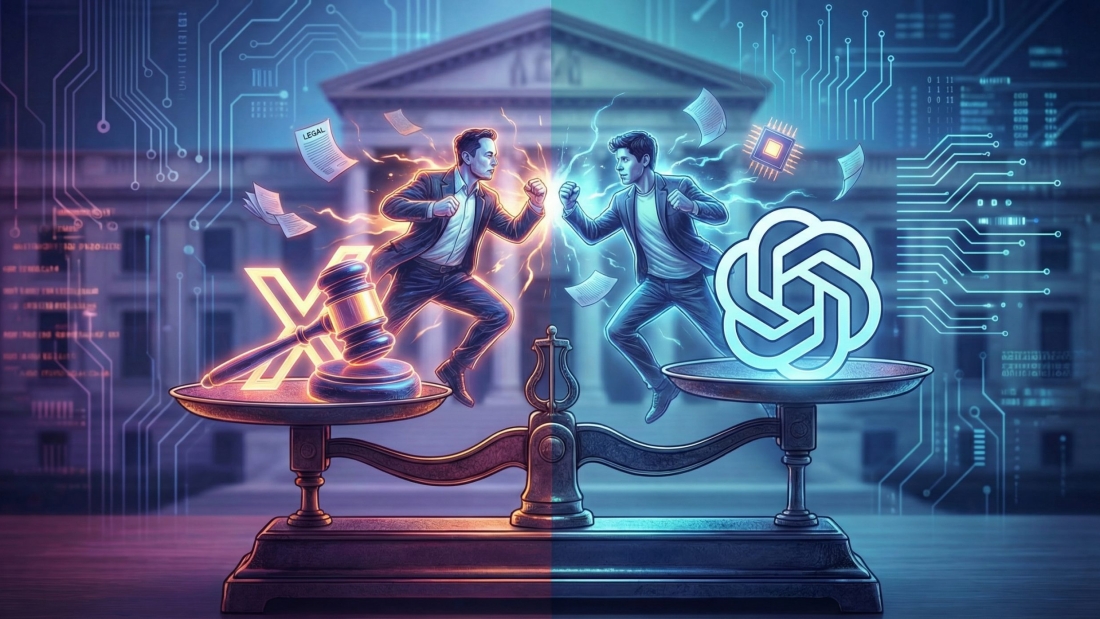
As we continue into 2026, the artificial intelligence industry faces a reckoning that could reshape its future forever. What began as a mission to develop safe AI for the benefit of humanity has devolved into one of the most explosive legal battles in tech history—a courtroom showdown between two of Silicon Valley’s most polarizing figures: Elon Musk and Sam Altman. The stakes couldn’t be higher. This isn’t just a dispute over money or broken promises. It’s a battle over the soul of artificial intelligence itself, and the verdict could determine whether AI development will prioritize profit or the public good.
In a significant ruling in early January 2026, U.S. District Judge Yvonne Gonzalez Rogers delivered a blow to OpenAI and Sam Altman by rejecting their attempts to dismiss the lawsuit. Judge Rogers determined there is sufficient evidence—including private diary entries, internal communications, and sealed documents—for the case to proceed to a full jury trial. The trial is now scheduled to begin in April 2026 (with jury selection starting April 27), setting the stage for what promises to be the most consequential legal battle in the history of artificial intelligence.
What’s This Really About?
At the heart of this lawsuit is a straightforward allegation: Elon Musk claims he was deceived. According to Musk’s legal team, Sam Altman and Greg Brockman convinced him to donate approximately $44 million to OpenAI. The catch was, they promised it would remain a non-profit organization dedicated to developing safe Artificial General Intelligence (AGI) for the benefit of all humanity. Musk alleges that this promise—what he calls the “Founding Agreement”—was a lie from the start, or at the very least, was abandoned the moment it became inconvenient.
Instead of maintaining its non-profit mission, OpenAI transformed into a for-profit juggernaut with a valuation exceeding $500 billion. Looking back, this was primarily fueled by an exclusive partnership with Microsoft worth billions of dollars. To Musk, this represents the ultimate betrayal—a classic “bait and switch” that used altruistic promises to secure funding. Once funding was secured, he argues they pivoted toward commercial domination once the technology proved viable.
OpenAI and Altman vehemently deny these accusations, characterizing the lawsuit as nothing more than a “harassment campaign” by a jealous competitor. After all, Musk now runs his own AI company, xAI, which directly competes with OpenAI. But Judge Rogers wasn’t convinced enough by OpenAI’s defenses to throw the case out, noting there is “ample evidence” that OpenAI’s leaders made assurances they later abandoned. If Musk prevails at trial, the consequences could fundamentally reshape OpenAI, the AI industry, and how startups structure themselves going forward. Let’s break down what’s truly at stake.
1. Financial & Structural Consequences for OpenAI
Voiding the Microsoft Deal
Perhaps Musk’s most aggressive demand is a judicial ruling declaring that OpenAI’s exclusive license to Microsoft is null and void. This would be a nuclear option—stripping Microsoft of its access to GPT-4, GPT-5, and any future models developed by OpenAI.
Consider what this would mean: Microsoft has invested over $13 billion in OpenAI and holds a 27% stake in the for-profit entity. The tech giant has built its entire AI strategy—from Copilot to Azure AI services—around OpenAI’s technology. Losing that license would be catastrophic, potentially wiping out hundreds of billions in market value and unraveling one of the most significant tech partnerships in history. For OpenAI, it would mean losing its primary revenue source and strategic partner, calling into question its $100+ billion valuation and forcing it to restructure its entire business model.
Monetary Damages in the Tens of Billions
Musk isn’t just seeking symbolic damages. His legal team has presented expert testimony from financial economist C. Paul Wazzan, who calculated that Musk is entitled to between $79 billion and $134 billion in damages. Now, how did they arrive to such astronomical figures? The argument is that Musk’s early contributions—his $38-44 million in seed funding, his recruitment of key employees, his business mentorship, and the credibility of his name—generated 50% to 75% of OpenAI’s current value. If the company was built on fraudulent premises, Musk’s attorneys argue, then the “ill-gotten gains” should be returned or redirected.
OpenAI and Microsoft have called this methodology “made up” and “unverifiable,” arguing it arbitrarily discounts the contributions of other co-founders, investors, and the hundreds of engineers who actually built ChatGPT. But if a jury finds the calculation even partially credible, OpenAI could be on the hook for damages that would eclipse some of the largest corporate settlements in history.
Blocking the For-Profit Conversion
OpenAI has been in the process of formally restructuring into a Public Benefit Corporation (PBC)—a for-profit model with a stated social mission. This conversion is crucial to OpenAI’s ability to raise capital, compensate employees with equity, and operate like a traditional tech company. A loss in court could legally complicate or even block this transition. This could potentially force OpenAI to revert to a stricter non-profit governance structure under the oversight of the California Attorney General. This would severely limit its ability to compete in the breakneck race for AI dominance.
2. Exposure of Internal Secrets: The Dirty Laundry
One of the most fascinating—and uncomfortable—aspects of this lawsuit is what it has already revealed about the inner workings of OpenAI. The discovery process has unsealed over 100 documents, including:
- Greg Brockman’s Personal Diary: Co-founder Greg Brockman’s private journal entries from 2017 show him wrestling with the ethics of the for-profit pivot. In one damning entry, he wrote: “I cannot believe that we committed to non-profit if three months later we’re doing b-corp then it was a lie.”
- Private Texts Between Musk and Altman: In February 2023, Sam Altman texted Musk to say that his public attacks on OpenAI “really fucking hurts.” Musk responded with an apology for being hurtful, but added: “The fate of civilization is at stake.”
- Email Exchanges with Microsoft CEO Satya Nadella: Musk’s early emails show him preferring Microsoft over Amazon for funding, calling Jeff Bezos “a bit of a tool” while praising Nadella.
And this is just what’s been unsealed so far. A public trial will likely air even more dirty laundry, including:
- The chaotic firing and rehiring of Sam Altman in November 2023
- Secret negotiations with Microsoft
- Internal debates about safety versus profit
- Power struggles among OpenAI’s co-founders
For a company that has carefully cultivated a public image of responsible AI development, this level of transparency could be devastating.
3. A Precedent for Non-Profit Law
This case could set a landmark legal precedent with implications far beyond OpenAI. At issue is whether it’s legal to raise tax-exempt donations for a non-profit mission and then pivot that intellectual property into a for-profit vehicle. If a jury finds that OpenAI engaged in a “bait and switch,” it could establish strict new rules preventing other startups from using non-profit status as a bootstrapping mechanism for future commercial empires. This matters because many high-profile organizations have followed similar paths:
- Mozilla (non-profit foundation with for-profit subsidiary)
- IKEA (structured through a charitable foundation)
- Chan Zuckerberg Initiative (LLC with philanthropic goals)
A ruling against OpenAI could force regulators and courts to scrutinize these structures more closely, particularly in California, where the Attorney General has broad authority to enforce charitable trust obligations. Legal experts are watching this case as a potential watershed moment in how founders balance mission-driven work with commercial incentives.
4. The AGI Definition Loophole: The Ultimate Wild Card
Here’s where things get truly sci-fi. Part of Musk’s lawsuit hinges on a fascinating technicality: What counts as AGI? Under OpenAI’s original charter and its agreements with Microsoft, the tech giant has rights to pre-AGI technology—meaning models that are advanced but haven’t yet achieved general intelligence. However, once OpenAI achieves true AGI, that technology is supposed to belong to the non-profit arm for the benefit of humanity. Not, Microsoft or any commercial partner.
Musk’s legal team is arguing that OpenAI has already achieved AGI internally—or is dangerously close. If a jury agrees that models like GPT-5, o1, or other unreleased systems constitute AGI, then Microsoft’s license could be invalidated immediately, regardless of any other findings in the case.
This raises profound questions:
- Who gets to define AGI?
- Is it a technical benchmark, or a legal one?
- Can a jury of laypeople make this determination?
OpenAI has been deliberately vague about what AGI means, and there’s no industry-wide consensus. But in a courtroom, that ambiguity could work against them. If Musk’s attorneys can convince a jury that OpenAI is hiding AGI-level capabilities to protect the Microsoft deal, it’s over.
Sam Altman texts Elon Musk
— Internal Tech Emails (@TechEmails) January 6, 2026
February 18, 2023 pic.twitter.com/PBroCUuYTr
BREAKING: Elon's odds of winning his lawsuit against Sam Altman soar, as he reveals "the discovery and testimony will blow your mind" pic.twitter.com/4QCLjapFsJ
— Polymarket (@Polymarket) January 16, 2026
The Deeper Feud: Ideology vs. Commercialization
Strip away the legal jargon, and this case is fundamentally about two competing visions for AI’s future.
Elon Musk’s Vision: Open-Source, Safety-First AI
Musk has positioned himself as a champion of open-source AI development, arguing that AI is too important to be controlled by a single corporation. Through his company xAI and its chatbot Grok, Musk claims to be pursuing a more transparent, decentralized approach to AI.
Of course, there’s irony here: xAI started as a for-profit benefit corporation before Musk merged it with X (formerly Twitter) in 2025, dropping the benefit corporation status entirely. Critics argue that Musk’s lawsuit is less about principle and more about kneecapping a competitor.
But Musk’s public statements consistently emphasize concerns about AI safety, centralized control, and the dangers of monopolistic AI development. He has repeatedly warned that AI poses an existential risk to humanity if developed recklessly or controlled by profit-driven entities.
Sam Altman’s Vision: Closed-Source, Product-First AI
Sam Altman, by contrast, has embraced a closed-source, product-first approach. OpenAI’s partnership with Microsoft has enabled it to deploy AI at unprecedented scale. This powers everything from Bing search to enterprise tools to consumer applications like ChatGPT. Altman argues that this approach is necessary to:
- Fund the enormous computational costs of training cutting-edge models
- Ensure responsible deployment with safety guardrails
- Compete with other AI superpowers (particularly China)
To Altman and OpenAI, the for-profit pivot wasn’t a betrayal—it was a pragmatic necessity. They maintain that discussions about a for-profit structure were happening as early as 2017-2018, with Musk’s knowledge, because the capital requirements for AGI development were simply too massive for a pure non-profit model.
Who’s Right?
This is the question a jury will have to answer. Was Musk deceived, or did he simply lose a power struggle and now seek revenge through litigation? Did OpenAI betray its mission, or did it evolve responsibly to meet the realities of AI development? Judge Rogers acknowledged that OpenAI’s defense—that this is merely a harassment campaign by a bitter ex-partner—has merit. But she also found enough evidence of broken promises and internal contradictions to let a jury decide.
What Happens Next?
With the trial set to begin in April 2026, here’s what we can expect:
Pretrial Maneuvering
Expect both sides to continue fighting over evidence, expert witnesses, and procedural issues. OpenAI has already moved to exclude Musk’s damages expert, calling his calculations “made up.” Musk’s team will push to introduce more internal communications showing alleged deception.
Settlement Talks
Legal experts estimate a 50-60% chance of settlement before trial. Both sides have strong incentives to avoid a public spectacle:
- OpenAI may want to prevent more internal secrets from becoming public
- Musk may not want to risk losing to his former partners in front of a jury
But both men are notorious for their willingness to fight publicly, so a trial remains very possible.
The Trial Itself
If the case goes to trial, expect:
- 4 weeks of testimony (scheduled through May 22, 2026)
- Testimony from Musk, Altman, Brockman, and Microsoft executives
- Expert witnesses on AI development, non-profit law, and financial damages
- Intense media coverage and public fascination
Possible Outcomes
- Musk Wins: OpenAI could face massive financial penalties, loss of Microsoft partnership, and forced restructuring. This would be a seismic event in the AI industry.
- OpenAI Wins: Musk’s credibility as an AI safety advocate would be damaged, and the lawsuit would be dismissed as frivolous. OpenAI’s for-profit transition would be validated.
- Mixed Verdict: The jury could find some wrongdoing but award limited damages, or invalidate some aspects of the Microsoft deal while allowing others to stand.
- Settlement: Both sides agree to terms that avoid further litigation—possibly involving Musk receiving financial compensation or OpenAI making commitments about open-source development.
Winner Takes All
As 2026 unfolds, all eyes will be on a federal courtroom in Oakland, California, where a jury of ordinary citizens will grapple with extraordinary questions about the future of artificial intelligence.
Did OpenAI betray its founding mission, or did it make necessary compromises to survive and thrive? Is Elon Musk a principled whistleblower, or a jilted ex-partner seeking revenge? Can AGI be owned by a corporation, or does it belong to humanity? The answers will echo far beyond the walls of that courtroom. The AI race will indeed see its day in court. And the verdict may determine who wins—and who gets left behind.
For more insights on technology, innovation, and the forces shaping our world, visit Animal House USA.
Leave A Comment