

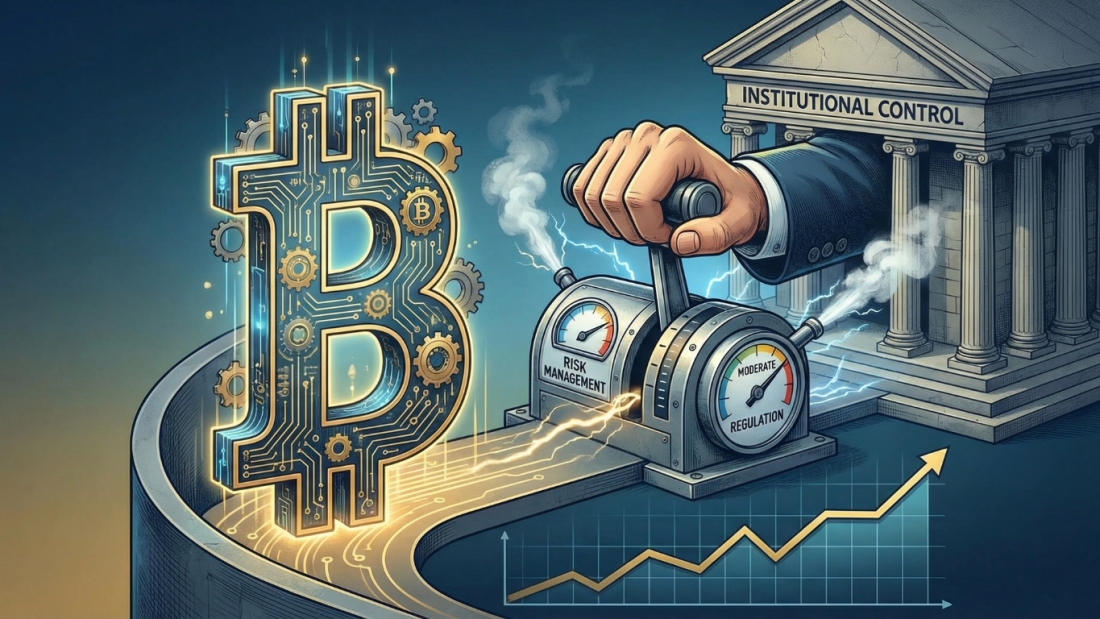
For fifteen years, Bitcoin has been dismissed, mocked, accepted, embraced, institutionalized, and regulated often all at once. But one thing has become increasingly clear: the modern financial system can tolerate Bitcoin growing, but it cannot tolerate Bitcoin exploding.
This is the heart of what I’m calling The Institutional Throttle Theory a framework explaining why governments, central banks, asset managers, and financial institutions don’t necessarily want Bitcoin to fail, but they absolutely cannot allow it to reprice the global monetary order too quickly.
This is not a conspiracy theory. It’s system dynamics.
And once you understand how large-scale financial systems maintain stability, the logic becomes almost unavoidable.
Bitcoin Isn’t Outside the System Anymore
The theory begins with one fact: Bitcoin has been absorbed into the regulated financial system.
Spot Bitcoin ETFs are approved. BlackRock, Fidelity, and major custodians hold billions in BTC. Advisors allocate to it. Banks and brokers have indirect exposure through client flows.
Bitcoin is no longer shadow money it’s becoming a sanctioned asset class.
But once an asset becomes integrated in this way, its price no longer only affects Bitcoin holders. It affects bank balance sheets, collateral chains, derivatives markets, pension allocations, household wealth, and regulatory risk models. In other words, Bitcoin has entered the bloodstream of global finance. And highly connected systems cannot survive violent shocks in core variables.
The Real Threat Isn’t $500,000 Bitcoin—It’s How Fast We Get There
A slow grind higher is tolerable. A vertical spike is not.
Think of Bitcoin going from $100k → $400k in twelve months.
This would trigger three destabilizing forces:
A. Balance Sheet Chaos
A sudden repricing invalidates existing risk models, triggers short squeezes and margin calls, forces institutions to liquidate traditional assets to cover BTC-side losses or hedging, and breaks correlations that portfolios rely on.
In a world as tightly leveraged as ours derivatives, collateral reuse, rehypothecation, yield strategies rapid new wealth creation in one corner forces liquidity stress everywhere else.
We saw this in the 2008 housing unwind, the 2020 coronavirus shock, and the 2022 UK pension (LDI) crisis. A crowded asset moves too fast → everything cracks.
Now imagine that asset is Bitcoin.
B. A Political Crisis in Fiat Confidence
Fiat is not just money. It is the foundation of state legitimacy. A violent Bitcoin repricing signals the opposite of what policymakers need the public to believe. If BTC goes vertical while inflation is sticky, deficits explode, Treasury bond performance stagnates, and savings accounts bleed purchasing power, a simple narrative emerges:
“Bitcoin is rising because fiat is failing.”
That narrative, once widely believed, is existential. It threatens demand for government bonds, central bank control over money, and political stability itself. States can coexist with a rising Bitcoin. They cannot coexist with a Bitcoin that appears to be outrunning them.
C. Social Stability Under Pressure
If Bitcoin moons too quickly, you get a new ultra-wealthy cohort minted overnight, a middle class watching their savings get destroyed by inflation, a political class accused of “letting the alternative money win,” a sudden youth-vs-establishment wealth gap, and accelerating capital flight from fiat savings into BTC.
The system cannot politically absorb a rapid monetary transition. Slow change is digestible. Fast change is revolution.
How Institutions “Throttle” Bitcoin Without Killing It
The key to this theory is understanding something subtle:
Institutions don’t need to crash Bitcoin. They only need to dampen the speed at which capital flows into it. They have many tools to do that none of which require conspiracies, secret meetings, or illegal manipulation.
A. Regulatory Pace Control
Regulators can modulate adoption by altering custody rules, capital requirements, tax treatment, ETF approvals, exchange compliance, and banking access. One announcement is enough to cool a mania. One headline can slow inflows.
B. Market Structure Levers
Big players can shape volatility by selling upside through call options, hedging flows that lean against parabolic spikes, widening spreads during disorderly periods, and maintaining conservative BTC allocation targets.
The message from major allocators “we cap BTC at X%” acts as a soft adoption ceiling.
C. Narrative Management
Institutions shape perception through IMF papers on crypto risk, BIS warnings, Fed speeches, mainstream media framing, and research shops highlighting dangers. Narratives don’t suppress long-term value but they do affect the rate of capital inflow.
Why Slowing Bitcoin Is a Feature, Not a Bug
If Bitcoin is truly a superior store of value, it will win eventually. But from the system’s standpoint, the timing matters more than the destination.
A fast repricing destabilizes credit markets, threatens the bond market’s primacy, encourages global de-dollarization, exacerbates institutional leverage vulnerabilities, and accelerates political pressure to adopt Bitcoin at the sovereign level.
A slow repricing allows risk models to adapt, enables regulators to build frameworks, avoids political panic, keeps fiat legitimacy intact, lets large institutions accumulate BTC cheaply and quietly, and permits a controlled transition to a new monetary equilibrium.
In other words:
The system can handle Bitcoin’s rise—it just can’t handle a spike so fast that it looks like a vote of no confidence in fiat.
That is the essence of the Institutional Throttle Theory.
Bitcoin’s Future: The S-Curve, Not the Moonshot
The best mental model isn’t a rocket. It’s an S-curve: slow early adoption, accelerated middle phase, then a leveling toward equilibrium. Institutions want to shape the curvature of that “S.” Not suppress it smooth it.
In that world, Bitcoin becomes global digital gold. Institutions accumulate over decades, not quarters. Retail doesn’t revolt. Fiat maintains political legitimacy. Leverage systems don’t crack. Central banks buy time to evolve.
This is not about control it’s about system survival.
The Throttle Is Rational
Bitcoin is the first asset in history that directly competes with sovereign money while existing inside the sovereign financial system.
That creates a paradox:
If it rises too slowly, it fails to matter. If it rises too fast, it threatens the monetary order.
Thus, institutions have a rational incentive to throttle the speed of Bitcoin’s repricing not its long-term trajectory.
This is not manipulation. This is not conspiracy.
It is the predictable behavior of a complex, highly leveraged global system trying to protect itself from a sudden transition in the nature of money. And ironically, that throttling may give Bitcoin exactly what it needs to win:
Time.
Leave A Comment