

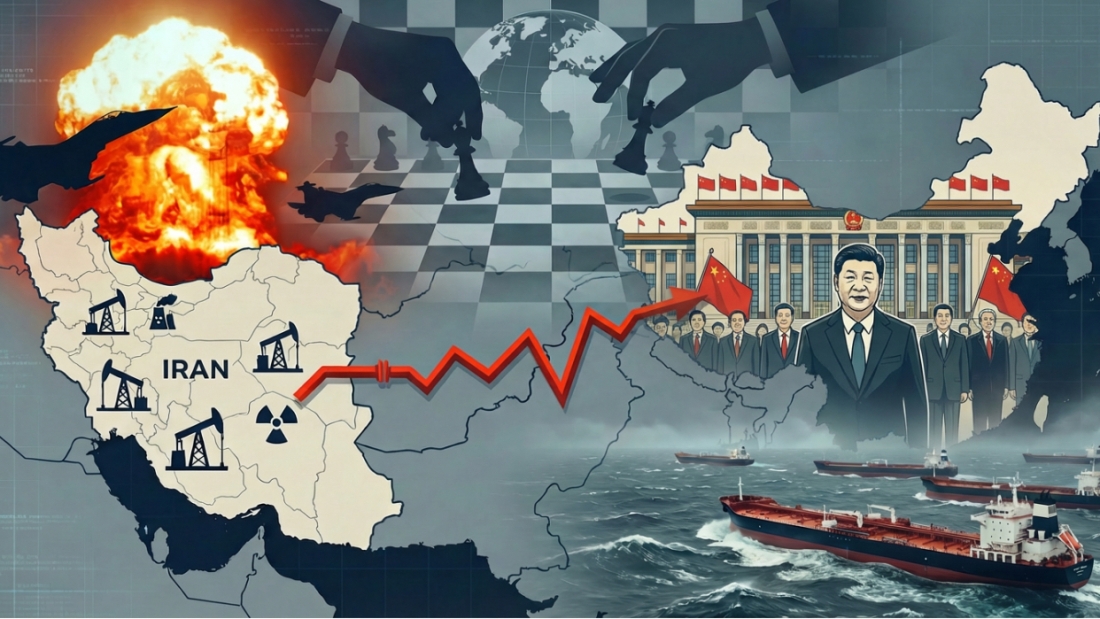
The bombs that fell on Tehran weren’t just targeting Iranian nuclear facilities. They were targeting Beijing’s energy supply. Let’s cut through the official rhetoric about “eliminating nuclear threats” and “supporting the Iranian people” and look at what actually happened here. The United States and Israel launched “Operation Epic Fury” and “Operation Roaring Lion,” a coordinated assault that killed Supreme Leader Ali Khamenei, destroyed critical military infrastructure, and threw one of China and Russia’s most important strategic partners into chaos. This isn’t just Middle East policy. This is trade war escalation by other means.
The Official Story vs. The Bigger Picture
The stated justification for the strikes is straightforward enough: Iran was pursuing nuclear weapons, posed an existential threat to Israel, and the regime needed to be neutralized. President Trump announced that the goal was to eliminate Iran’s ability to threaten the region. And sure, all of that is true. Iran’s nuclear program was advancing. The regime did support proxy forces throughout the Middle East. The 12-day war in June 2025 demonstrated that direct conflict was increasingly likely.
But if you stop at the surface-level explanation, you’re missing the forest for the trees. Because here’s what else is true: Iran is China’s primary source of sanctioned oil. Iran is a critical node in Russia’s North-South Transport Corridor. And Iran is one of the few countries willing to sell discounted energy to America’s two biggest geopolitical rivals while telling Washington to kick rocks. Now that oil supply is in jeopardy. That transport corridor is compromised. And China and Russia are watching one of their key partners get dismantled in real time. Coincidence? Come on.
— Karli Bonne’ 🇺🇸 (@KarluskaP) February 28, 2026
Trump’s attack on Iran takes a big economic bite out of one of America’s chief rivals: China.
— POLITICO (@politico) March 2, 2026
Almost all of Iran’s exported oil, and more than half of Venezuela’s, went last year to China.
📈 5 charts that show China’s oil dilemma after U.S. strikes: https://t.co/ue8oSXJTUr pic.twitter.com/XxWxxAUjJS
The Energy War Nobody’s Talking About
China imports massive quantities of Iranian oil—millions of barrels that bypass U.S. sanctions through what’s called the “shadow fleet”: off-the-books tankers that operate outside normal shipping channels. Russia does the same thing. Together, these sanctioned oil flows have allowed China to access cheap energy while funding Iran’s military capabilities.
The Strait of Hormuz—through which approximately 20% of the world’s oil flows—is now effectively closed due to Iranian retaliation. That’s not just a problem for Middle Eastern economies. That’s a global energy crisis in the making. Oil prices are spiking. And the countries most affected aren’t just the Gulf states—they’re the nations that depended on Iranian oil to fuel their economies while avoiding American sanctions. China and Russia just lost their discount energy buddy. And the timing couldn’t be worse for either of them.
The Trade War Goes Kinetic
Here’s the part that should make you sit up and pay attention. The U.S.-China trade war has been grinding on for years now. Tariffs. Export controls. Chip bans. Investment restrictions. Both sides have been fighting an economic cold war through every lever available short of actual military action.
What happens when you can’t win an economic war with tariffs alone? You start targeting the supply chains your adversary depends on. Iran was a weak link. A country already under crippling sanctions, isolated from the Western financial system, but still managing to supply cheap oil to China and serve as a logistics hub for Russian trade. Taking out the Iranian regime doesn’t just “free the Iranian people”—it physically disrupts the flow of resources to America’s primary strategic competitor. It’s sanctions enforcement by airstrike.
The Ripple Effects Are Just Beginning
The immediate aftermath is already catastrophic. Iranian retaliation has hit targets across the region:
Multiple Israeli cities struck, with civilian casualties
U.S. military bases throughout the Middle East targeted
Gulf Arab states—UAE, Saudi Arabia, Bahrain, Kuwait—suffering hits to civilian and economic infrastructure
Dubai’s Fairmont hotel in flames
Regional airspace closed
Energy markets in dissaray
And that’s just the short-term damage. The longer-term question is what happens next. History gives us some pretty clear warnings about what happens when the U.S. eliminates a government in the Middle East without a plan for what comes after. Iraq taught us that regime change is the easy part. It’s the decade of chaos afterward that gets you. Afghanistan taught us the same lesson. Libya too.
So what’s the plan for Iran? A country of 85 million people, fractured along ethnic and religious lines, with a Revolutionary Guard that’s been preparing for this moment for decades? The regime leadership is dead, but the institutions that held the country together are in shambles. If you think Iraq was messy, imagine that times three.
China and Russia’s Dilemma
Here’s where it gets interesting. Neither China nor Russia is going to directly intervene. China’s priority is economic stability and avoiding a direct confrontation with the U.S. Russia is too tied down in Ukraine to open another front. But that doesn’t mean they’re happy about watching their ally get dismantled. China’s options are limited:
Condemn the strikes (already done, predictably)
Increase support to whatever regime emerges (likely, to maintain influence)
Accelerate efforts to reduce dependence on Middle Eastern oil (the smart long-term play)
Russia’s options are even more constrained:
Continue supplying advanced weapons to whoever’s left fighting (already reported to have supplied fighter jets and air defense systems)
Use the chaos to distract from Ukraine (the cynical play)
Watch a key strategic partner collapse while unable to do much about it
The irony is that a weakened Iran might become more dependent on China, not less. When your economy is shattered and your leadership is dead, you take whatever lifeline you can get. Beijing might end up with more influence in the region, not less—just over a much weaker partner.
The Uncomfortable Questions
Let’s ask the questions that nobody in Washington seems interested in answering: What’s the endgame? You’ve killed the Supreme Leader. You’ve destroyed the nuclear facilities. Now what? Who governs 85 million Iranians? The protesters in the streets? A transitional military government? A power vacuum that gets filled by the same IRGC commanders who survived the strikes?
What happens to global energy markets? The Strait of Hormuz is compromised. Oil prices are spiking. How long before that hits American consumers at the pump? Before inflation reignites? Before the economic costs of this “victory” start showing up in polling numbers? What happens when the next government needs friends? Whoever ends up running Iran is going to need trading partners. If the West keeps them isolated, where do they turn? Right back to China and Russia. Same cycle, different faces.
Did we just make China’s position stronger, not weaker? Short-term, yes, we disrupted their oil supply. Long-term, we might have just handed them a desperate new client state willing to do whatever it takes to survive.
The Real Story
Here’s what we think is actually happening. The U.S. is fighting a multi-front economic war with China. Tariffs haven’t worked as well as advertised. Export controls are leaky. Chinese industrial capacity keeps expanding. So you open a new front. You target the physical infrastructure that keeps your adversary’s economy running. Then, make their sanctioned oil supply a lot less reliable. You demonstrate that American military power can reach anywhere, anytime, and there’s nothing China or Russia can do about it.
Is it effective? In the short term, probably. China’s energy security just got a lot more complicated. Is it sustainable? That’s the trillion-dollar question. Because the Middle East has a way of sucking in American resources and attention for decades at a time. And every dollar and every soldier committed to “stabilizing” Iran is a dollar and a soldier not available for the Pacific theater. China might be happy to watch the U.S. get bogged down in another Middle Eastern quagmire while they build their position in Asia.
Where This Goes
The bombs have already fallen. Khamenei is dead. The Strait of Hormuz is contested. Oil prices are spiking. The region is on fire. What happens next depends on whether this administration has learned anything from the last twenty years of Middle Eastern intervention. (Early signs: not great.)
The Iran strikes aren’t just about Iran. They’re about energy, trade and sending a message to Beijing that their supply chains aren’t safe. Whether that message leads to strategic advantage or another decade-long quagmire remains to be seen. But one thing’s for sure: the trade war just went kinetic. And the consequences are going to be felt far beyond Tehran.
Leave A Comment