

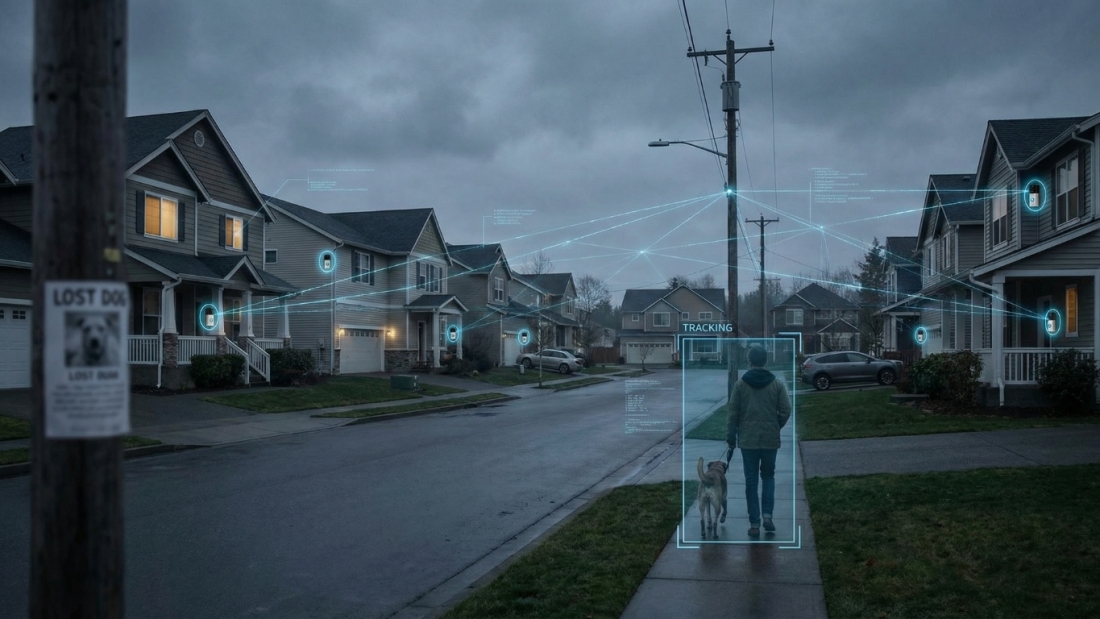
It’s something some of us haven’t stopped thinking about since the Super Bowl. When that 30-second Ring commercial aired during Super Bowl LX, showing a lost dog named Milo being tracked through a neighborhood by a network of AI-powered cameras, millions of Americans felt a collective chill run down their spines. What Amazon presented as heartwarming—a family reunited with their missing pet—looked to the rest of us like something straight out of a dystopian nightmare.
The backlash was swift and rightfully so, that within days, Amazon was forced to cancel a major surveillance partnership and face renewed scrutiny from senators, privacy advocates, and terrified customers who suddenly realized they’d voluntarily installed Orwell’s telescreen on their front doors. Recent developments regarding Amazon’s Ring cameras have triggered significant criticism, with privacy experts, lawmakers, and users describing the company’s trajectory as genuinely Orwellian—a total delivery of dystopia, wrapped in the friendly veneer of “community safety.”
The combination of AI-driven facial recognition, expanding law enforcement partnerships, and mass data collection has created a surveillance apparatus that operates outside constitutional protections, powered by millions of unwitting homeowners. This isn’t conspiracy theory. This is documented reality, confirmed by the U.S. Senate, privacy organizations, and Amazon’s own announcements.
The Super Bowl Ad That Backfired
On February 9, 2026, during one of the most-watched television events of the year, Ring premiered its “Search Party” feature to over 100 million viewers. The ad showed a young girl whose lost dog, Milo, was located through Ring’s network of cameras using artificial intelligence. One tap in the Ring app, and suddenly every Ring camera in the neighborhood was scanning for the missing pet. Ring founder Jamie Siminoff, who appears in the commercial, called it a way for people to “be a hero in your neighborhood.” The feature, he emphasized, was “available to everyone. For free. Right now.”
The public saw something very different.
Within hours, social media erupted with horror. Terms like “creepy,” “disturbing,” and “dystopian” flooded Twitter, Reddit, and Facebook. Democratic Senator Ed Markey called the ad confirmation of “public opposition to Ring’s constant monitoring and invasive image recognition algorithms.”
The Electronic Frontier Foundation (EFF) put it bluntly: “No one, including our furry friends, will be safer in Ring’s surveillance nightmare.” Because here’s the thing everyone immediately understood: if the AI can track a lost dog, it can track humans. If it can scan neighborhood cameras to find Milo, it can scan neighborhood cameras to find you. Your kids. Protesters. Undocumented immigrants. Political dissidents. Anyone.
The Flock Safety Partnership Cancellation
The outrage intensified when people remembered that just months earlier, in October 2025, Ring had announced a partnership with Flock Safety—a police surveillance tech company that operates thousands of automated license plate readers across the United States. Flock Safety is controversial for good reason. The company’s cameras capture billions of photos of license plates each month, and while Flock claims it doesn’t directly partner with Immigration and Customs Enforcement (ICE), independent reporting has shown that local police using Flock’s systems have conducted searches on behalf of federal agencies, including ICE, for immigration-related investigations. The planned integration would have allowed approximately 5,000 local law enforcement agencies to request Ring footage through Flock’s platforms. Ring emphasized that sharing footage would be “optional” for users, but privacy advocates pointed out the obvious: once the infrastructure exists, it will be used.
On February 12, 2026—just three days after the Super Bowl ad disaster—Ring abruptly canceled the Flock Safety partnership. In a carefully worded statement, Ring claimed the cancellation was a “joint decision” based on the integration requiring “significantly more time and resources than anticipated.” Both companies emphasized that the integration never launched and no Ring customer videos were ever sent to Flock Safety.
But the timing tells the real story. The backlash worked. Consumer outrage forced one of the world’s largest tech companies to retreat. Ring customers reportedly began destroying their cameras, with viral videos circulating online of people smashing their doorbells or demanding refunds.
It was a rare victory—but it doesn’t change the fundamental problem.
The AI Surveillance Arsenal Already in Place
The “Search Party” feature that horrified Super Bowl viewers is just one piece of Ring’s expanding surveillance toolkit. The company already deploys AI-powered facial recognition through its “Familiar Faces” feature, which was quietly rolled out in January 2026. “Familiar Faces” allows homeowners to catalog and receive alerts about recognized individuals at their door. Sounds harmless, right? Except the camera scans every face that enters its view—delivery drivers, neighbors, children, joggers, visitors—and processes their biometric data through Amazon’s servers without their knowledge or consent.
Senator Ed Markey’s October 2025 letter to Amazon CEO Andy Jassy condemned this practice, stating that Ring’s system “forces non-consenting bystanders into a biometric database without their knowledge or consent.”
The EFF warns that combining “Familiar Faces” with “Search Party” would create a neighborhood-wide facial recognition network: “Amazon Ring already integrates biometric identification, like face recognition, into its products via features like ‘Familiar Faces’ which depends on scanning the faces of those in sight of the camera and matching it against a list of pre-saved, pre-approved faces. It doesn’t take much to imagine Ring eventually combining these two features: face recognition and neighborhood searches.”
And why wouldn’t they? The technology exists. The infrastructure is in place. Millions of cameras are already installed. The only thing preventing it is public awareness and outrage—which, as we’ve seen, can fade quickly.
Default Settings Favor Surveillance, Not Privacy
Here’s the most insidious part: the “Search Party” feature is turned on by default. You have to actively go into your settings to disable it. Most Ring owners won’t. Most won’t even know it exists until it’s too late.
This is surveillance by design. Ring structures its products so that privacy and functionality are mutually exclusive. Want end-to-end encryption? You’ll have to give up person detection, facial recognition, 24/7 recording, pre-roll recording, and AI video search. The entire product philosophy assumes you’re okay with being part of the panopticon unless you actively object—and even then, you’re penalized for choosing privacy.
Law Enforcement Access: The Pipeline Remains Open
While Ring canceled its Flock Safety partnership, the fundamental relationship between Ring and law enforcement remains intact. Ring still operates its “Community Requests” program with other partners, including Axon (the company that makes Tasers and body cameras).
Through these programs, police can request footage from Ring users in specific geographic areas for active investigations. Ring claims users can opt out and that sharing is voluntary—but critics point out that once you share footage with police, you lose all control over how it’s used. It can be shared with other agencies, submitted as evidence, or kept indefinitely.
The company also states it complies with law enforcement requests when “legally required”—meaning warrants or court orders. But it also reserves the right to share footage without user consent in “emergency” situations that Ring determines could involve danger to someone’s life or safety.
Who defines “emergency”? Ring does.
And there’s a darker dimension. A 2026 case involving Nancy Guthrie and a Google Nest camera revealed that law enforcement might be able to access “residual data” from disconnected cameras—footage that users believed had been deleted but remained accessible through cloud storage systems.
If Google Nest has this vulnerability, how confident should we be that Ring doesn’t?
The History They’d Rather You Forget
This isn’t Ring’s first rodeo with privacy violations. In 2023, the Federal Trade Commission (FTC) ordered Ring to pay $5.8 million due to claims that employees and contractors had extensive, unrestricted access to customer videos for years. Workers were caught watching private footage—bedrooms, bathrooms, intimate moments—because Ring failed to implement basic access controls. The EFF has been documenting Ring’s privacy problems for years, including:
- Providing warrantless access to law enforcement
- Building direct partnerships with over 2,000 police departments
- Normalizing surveillance in residential neighborhoods
- Creating the infrastructure for mass biometric tracking
Ring’s response to the FTC settlement? A promise to “do better” while simultaneously rolling out more invasive AI features and expanding law enforcement partnerships.
The Founder’s “Surprise” at the Backlash
In a February 16, 2026 interview, Ring founder Jamie Siminoff expressed surprise at the negative reaction to the Super Bowl ad. He emphasized the company’s commitment to privacy and stated he didn’t anticipate such a strong response. This is either breathtaking naiveté or calculated gaslighting.
How could the founder of a surveillance company—one that has faced FTC sanctions, senator scrutiny, and years of privacy advocacy warnings—be “surprised” that Americans don’t want their neighborhoods turned into AI-powered tracking networks? The answer is he’s not surprised. He’s disappointed that we noticed.
What This Means for Your Freedom
If you own a Ring camera, you are participating in the construction of a surveillance state. Full stop. Your camera is:
- Scanning and analyzing every face that passes by, whether you’ve enabled specific features or not
- Processing biometric data through Amazon’s servers without bystander consent
- Contributing to a network that can be used for mass tracking—and eventually will be
- Accessible to law enforcement through “Community Requests,” legal orders, or undefined “emergencies”
- Monitored by Amazon employees who have repeatedly violated privacy policies
You are not just protecting your home. You are funding and maintaining the infrastructure of authoritarianism. And the people walking past your house? They never consented to having their faces scanned, their movements tracked, or their biometric data processed by one of the world’s largest corporations. But thanks to default settings and opt-out policies, they have no meaningful choice.
Someone didn't read the room
— CaptainRon (@ZeeCaptainRon) February 13, 2026
Imagine running an ad that chases off 1/3rd of your customers for privacy issues.
I will never own a ring camera. pic.twitter.com/jwjLkCvPcf
Ring was by far the best Super Bowl commercial because they basically said "Yeah we're creating a 24/7 gigantic black box mass surveillance tool stuck on your front door that you have no control over, but you can use it help your neighbor Melanie find her lost dog" and then… pic.twitter.com/h1HyXt1KX6
— IcoBeast.eth🦇🔊 (@icobeast) February 9, 2026
The Bigger Picture: Normalizing Total Surveillance
Ring’s trajectory represents something larger than one company’s product decisions. It’s about the normalization of pervasive surveillance in American life. We’re moving toward a future where:
- Walking down a residential street means having your face scanned by hundreds of AI-powered cameras
- Law enforcement can access footage from millions of private cameras without warrants or meaningful oversight
- Corporations build facial recognition databases on non-consenting bystanders and market it as a “safety feature”
- Privacy becomes a luxury good available only to those who can afford alternatives or have the technical knowledge to protect themselves
- The infrastructure of authoritarianism is crowdsourced—built, funded, and maintained by ordinary citizens who were told they were just “keeping their families safe”
This is how democracies die. Not through sudden military coups, but through incremental surrenders. One convenient feature at a time. One partnership at a time. One normalized intrusion at a time.
Amazon’s Ring cameras have gone full Orwellian. The Super Bowl ad just made it impossible to ignore.
What You Can Do Right Now
The surveillance state doesn’t arrive overnight. It arrives one “convenient” feature at a time, one heartwarming Super Bowl ad at a time, one normalized intrusion at a time. Ring is counting on your complacency. On your willingness to trade freedom for the illusion of safety.
On your assumption that “I have nothing to hide” will protect you when the cameras are turned against causes you care about. We haven’t stopped thinking about that Super Bowl ad because it showed us the future Amazon is building—a future where privacy is extinct, anonymity is impossible, and every move you make is tracked, analyzed, and stored.
The question is: are we going to let them?
Leave A Comment