

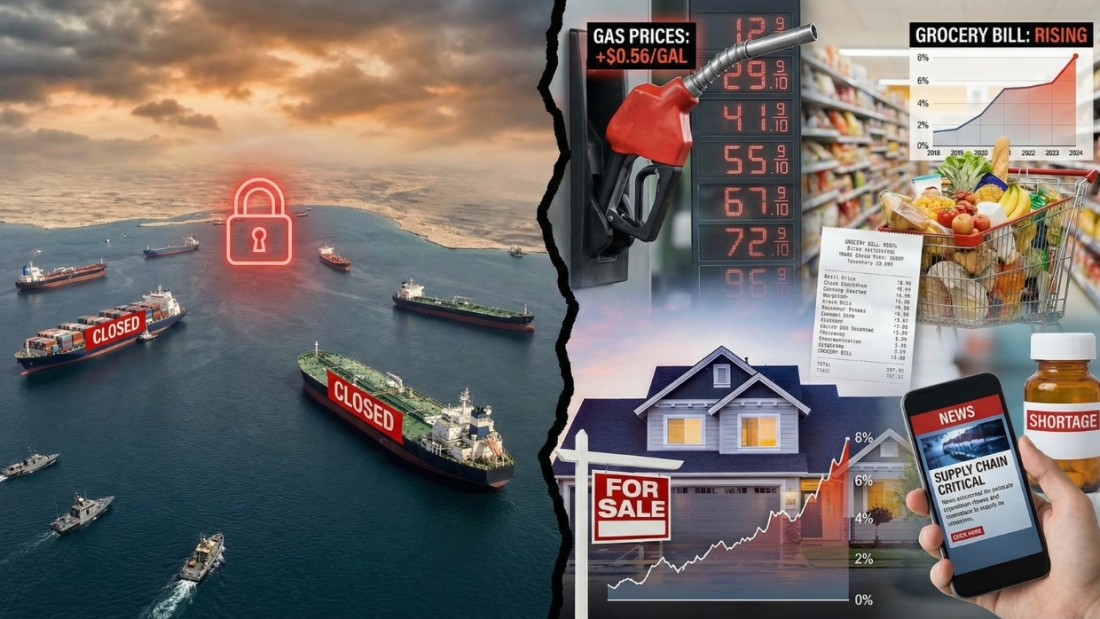
Somewhere between the cable news maps and the Pentagon briefings, you’re supposed to understand that the Strait of Hormuz matters. But nobody’s telling you why it matters to you—not to “the markets,” not to “global stability,” but to you, personally, the next time you fill your gas tank, buy groceries, or look at your mortgage statement. So let’s do that.
The Strait of Hormuz, a 21-mile-wide passage between Iran and Oman, is effectively closed as of March 2026. Iran’s Revolutionary Guard has been attacking tankers, warning ships that passage is “not allowed”, and ship-tracking data shows a 70-90% reduction in traffic with over 350 vessels stranded. Major shipping lines like Maersk and Hapag-Lloyd have suspended transits entirely.
President Trump says this “doesn’t really affect” the United States. That claim is, by every available data point, wrong. Here’s what’s actually flowing through that chokepoint—and what happens to your household budget now that it’s not.
What Flows Through the Strait (It’s Not Just Oil)
Most people hear “Strait of Hormuz” and think oil. That’s correct but wildly incomplete. Here’s what the world’s most critical maritime chokepoint actually carries:
Commodity | Volume Through Strait | Share of Global Supply | Why You Should Care |
Crude Oil | ~20% of global consumption | Gas prices, heating oil, jet fuel | |
LNG | Major share from Qatar | Electricity costs, heating bills | |
Urea Fertilizer | Critical for food production | Grocery prices within 60 days | |
Sulfur | Essential fertilizer input | More grocery inflation | |
Aluminum | Significant regional production | Cars, construction, cans | |
Polyethylene | Key plastic feedstock | Packaging, consumer goods | |
Helium | ~33% of global supply (Qatar) | Critical for chips & MRIs | Semiconductor delays, medical imaging |
That’s not “foreign policy.” That’s the supply chain for modern American life.
Your Gas Tank: +56 Cents Per Gallon and Climbing
The most immediate hit. Within weeks of the escalation in March 2026:
- Brent crude surged past $100/barrel
- The average U.S. gallon of regular gasoline jumped approximately 56 cents—a 19% increase
- Diesel prices spiked significantly, raising transportation costs for every product that moves by truck—which is essentially every product
That 56 cents per gallon? For a family filling a 15-gallon tank once a week, that’s roughly $436 extra per year just in gas. And diesel price increases get baked into the cost of literally everything that arrives at a store on a truck.
Experts are warning this could get three times worse than the 1970s oil shocks if the closure drags on. That’s not hyperbole.
Your Grocery Bill: The Fertilizer Problem Nobody’s Talking About
Here’s the part the cable news chyrons skip. This isn’t just an oil story. It’s a food story. One-third of the world’s traded urea fertilizer and nearly half the global sulfur supply transit the Strait of Hormuz. Both are now stranded. Urea prices have already surged over 30%. This creates a brutal double blow for American agriculture, hitting right as spring planting season begins:
- Higher input costs: Farmers pay more for the fertilizer they need. Anhydrous and urea prices have jumped roughly 30%.
- Reduced yields: Some farmers will use less fertilizer to manage costs, producing smaller harvests later in the year.
- Transportation markup: Everything costs more to ship because diesel is up.
The result: experts project significant grocery price increases within 60 days. Not months. Days. The food you’re buying in May will reflect the Strait closing in March. And this isn’t theoretical. Fox Business, CNBC, and agricultural economists are all pointing at the same timeline. Grocery prices will be among the first consumer categories to spike.
Your Mortgage: Yes, Really
This is the connection most people miss entirely. Geopolitical chaos drives investors out of risky assets and into safe havens like U.S. Treasury bonds. That demand pushes Treasury yields around, and yields on the 10-year Treasury note are a key benchmark for mortgage rates. The volatility from this crisis has pushed mortgage rates to over 6.11%—their highest level in over a month. On a $400,000 mortgage, the difference between 5.8% and 6.11% is roughly $75 more per month, or about $27,000 over the life of a 30-year loan. A waterway you’ve never visited just made your house more expensive.
Your Medicine Cabinet and Your Electronics
The disruption reaches into places you wouldn’t expect:
- Generic drugs: The conflict has caused air freight rates to jump 50%, creating what analysts call a “critical supply cliff” for generic medications and active pharmaceutical ingredients from India, many of which transit the region.
- Semiconductors: Chemical feedstocks for chip manufacturing and helium—essential for semiconductor production and medical imaging—have been severely disrupted. Qatar produces roughly a third of the world’s helium.
- Aluminum: Producers like Aluminium Bahrain have declared force majeure, halting shipments. Aluminum prices hit multi-year highs, driving up costs for cars, aircraft, construction materials, and beverage cans.
- Plastics: An estimated 85% of polyethylene exports from the Middle East use this route. Expect shortages and price hikes for everything from food packaging to clothing.
Fact-Checking the “Doesn’t Affect Us” Claim
Trump’s assertion that the Strait closure “doesn’t really affect” the U.S. isn’t baseless—it’s just dangerously incomplete.
The data he’s probably referencing:
- The U.S. imported only about 500,000 barrels per day through the Strait in 2024
- That’s just 7% of total U.S. crude imports and roughly 2% of total petroleum consumption
- Direct reliance is at a nearly 40-year low, thanks to domestic production and Canadian imports
What that framing ignores:
Oil is a global, fungible commodity. It doesn’t matter if zero barrels of Hormuz oil reach American shores. When 20% of the world’s supply is threatened, every buyer on earth competes for the remaining barrels, and the global price skyrockets. American producers sell at global prices. American refineries buy at global prices. To put it plainly: the price at your local gas station is set by the global market, not by where your specific barrel came from.
And the “doesn’t affect us” claim doesn’t even attempt to account for the non-oil impacts: fertilizer, aluminum, plastics, pharmaceuticals, semiconductors. Those supply chains are global, and they’re all running through a chokepoint that is currently on fire.
The Economic Forecast: Inflation, Recession, and No Good Options
Economists are not mincing words:
- Inflation is projected to hit 3.5% to 4% by mid-2026, driven by sustained energy prices and cascading supply chain costs
- Recession signals are intensifying as consumer budgets get squeezed from every direction
- The IEA and U.S. have authorized massive releases from strategic petroleum reserves, but that’s a band-aid, not a solution—reserves can cushion the shock for months, not years
- The LSE Business Review called it plainly: this is “a global inflation, shipping, and growth story,” not a regional oil story
Pain in the Short-Term
The Strait of Hormuz closure isn’t a foreign policy abstraction. It’s a line item on your household budget, and it’s getting more expensive by the week. Your gas is up and groceries are about to follow within 60 days. The mortgage rates just ticked higher. Your medication supply chain is under stress. The plastics in your food packaging, the aluminum in your car, and the helium in your hospital’s MRI machine all flow through a 21-mile-wide passage that is currently under military blockade.
The claim that this “doesn’t really affect” the United States requires you to ignore how global commodity markets work, how supply chains function, and how prices are set in a connected economy. The data doesn’t support it. Your next credit card statement won’t either.
Leave A Comment