

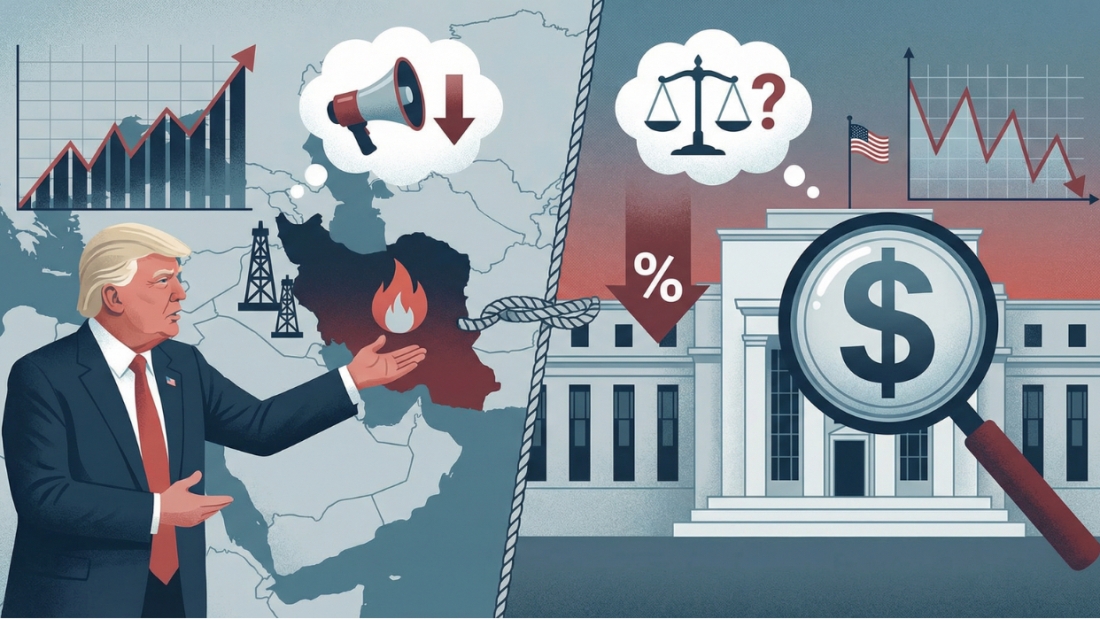
The bombs have already fallen on Tehran. Supreme Leader Ali Khamenei is dead. The Strait of Hormuz is contested. Oil prices are spiking. And if you think Donald Trump isn’t going to use this crisis to renew his pressure campaign on the Federal Reserve for lower interest rates, you haven’t been paying attention.
Trump has a long, well-documented history of demanding lower interest rates. During his first term, he frequently and publicly pressured Federal Reserve Chair Jerome Powell to cut rates, arguing that cheaper borrowing costs would supercharge the U.S. economy and stock market. He called Powell and his colleagues “boneheads” and a “golfer who cannot putt.” He even launched a criminal investigation into Powell over congressional testimony about Federal Reserve building renovations—a move Powell called “unprecedented” and designed to coerce the Fed into aligning with the President’s economic agenda.
Now, with the Middle East in flames and global energy markets in chaos, Trump has the perfect excuse to demand what he’s always wanted: substantially lower interest rates. And the Federal Reserve is about to face one of the most difficult decisions in its history.
The “Uncertainty” Argument: Trump’s Playbook
Geopolitical conflicts, especially those involving Iran and the broader Middle East, inject massive uncertainty into global markets. Trump’s argument to the Fed (and the public) will be straightforward and politically potent: “The U.S. economy needs a cushion against this global instability.”
He’ll argue that lowering interest rates is necessary to:
Protect American businesses from the economic fallout of a Middle Eastern war
Maintain stock market momentum (which he views as a direct reflection of his economic success)
Prevent a conflict-driven economic slowdown that could hurt American consumers
This isn’t speculation. It’s entirely consistent with Trump’s past playbook. He’s already stated that he expects Kevin Warsh, the new Federal Reserve Chair, to facilitate “very substantial” rate cuts. He’s introduced “THE TRUMP RULE,” asserting that interest rates should decrease even when the market performs well, criticizing the mechanism where good economic news leads to expectations of higher rates. Using an external crisis as leverage to renew this pressure is the most predictable move in the world.
The Oil Price Paradox: The Fed’s Nightmare Scenario
Here’s where it gets interesting—and where the Federal Reserve’s independence is about to be tested like never before. Tensions with Iran typically threaten the Strait of Hormuz, a narrow shipping route through which approximately one-fifth of the world’s oil exports and a significant portion of global liquefied natural gas (LNG) supplies pass. The recent strikes have already caused tanker traffic to stall, with at least 150 tankers dropping anchor in open waters outside the strait.
The immediate impact on energy prices has been dramatic:
Brent crude oil surged by as much as 13% to $82.37 a barrel, before settling around $77.79
West Texas Intermediate (WTI) crude rose by over 12% to $75.33
European benchmark gas prices jumped 50% on Monday, before closing 39% higher, after Qatar halted LNG production following “military attacks” on its facilities
Asian LNG prices surged by almost 39%
If the Strait of Hormuz were completely blocked for a month, oil prices could jump by as much as $15 a barrel. A prolonged closure could see Brent crude prices soar to $90-$100 per barrel. Some analysts predict prices could reach $120 or even $150 if Saudi capacity is directly hit. A top Iranian Revolutionary Guards general even predicted Brent crude could reach “$200 within days” if the strait were closed. This creates a massive dilemma for the Federal Reserve:
The Fed’s View:
Higher oil prices cause inflation. To fight inflation, the Fed usually wants to keep interest rates high (or at least not cut them). The Fed’s preferred inflation measure, the Personal Consumption Expenditures (PCE) price index, was at 2.8% in January 2026—still above its 2% long-term target. A $10 increase in oil prices could add roughly 0.2 percentage points to inflation, and up to 40 basis points (0.4%) to consumer inflation.
Trump’s View:
High interest rates hurt economic growth. He’ll argue that the inflation is supply-driven (because of Iran), not demand-driven, so keeping rates high only punishes American consumers twice—once at the gas pump and once on their mortgages, credit cards, and business loans. This is the oil price paradox. And it sets up a massive clash between the White House and the Federal Reserve.
The Political Motivation: Visible Economic Wins
Lower interest rates generally lead to a booming stock market and cheaper mortgages—highly visible economic indicators that voters care about. By blaming any economic friction on Iran and demanding the Fed lower rates to “fix it,” Trump positions himself as the defender of the American consumer’s wallet. It’s politically brilliant, even if it’s economically questionable.
Here’s the reality: The Fed has held its key interest rate steady at a range of 3.5% to 3.75% after three consecutive rate cuts in the latter half of the previous year. The Fed’s rationale for holding rates steady includes:
Elevated inflation still above the 2% target
Solid economic activity expanding at a solid pace
Stabilizing job market with unemployment showing signs of stabilization
The Fed’s Federal Open Market Committee (FOMC) remains divided on the path forward. While most policymakers expect further rate reductions later in the year, many want to see more evidence of inflation moving closer to the 2% target before approving additional cuts. Futures markets in early 2026 were pricing in at most two rate reductions for the year, with none expected in 2027. But Trump doesn’t care about the Fed’s data-driven approach. He wants lower rates. And now he has a crisis to justify it.
The Fed’s Independence Under Siege
The Federal Reserve operates independently for a reason: to make monetary policy decisions based on economic evidence rather than political preferences. But that independence is under unprecedented assault. Jerome Powell, whose term as Fed Chair ended in May 2026, faced a criminal investigation by the Justice Department into his congressional testimony regarding the $2.5 billion renovation of the Federal Reserve headquarters.
Powell publicly revealed this investigation, calling it “unprecedented” and asserting that it was a pretext designed to coerce the Fed into aligning with the President’s economic agenda. He stated that the threat of criminal charges was a “consequence of the Federal Reserve setting interest rates based on our best assessment of what will serve the public, rather than following the preferences of the President.” The investigation drew strong reactions:
All three living former Federal Reserve chairs—Alan Greenspan, Ben Bernanke, and Janet Yellen—along with five ex-Treasury Secretaries and other prominent economic figures, issued a joint statement condemning the DOJ’s actions, characterizing the probe as an “unprecedented attempt to use prosecutorial attacks to undermine” the Fed’s independence.
A group of top central bankers worldwide, including the heads of the European Central Bank and the Bank of England, expressed “full solidarity” with Powell.
Several members of Congress, including Republicans like Senator Thom Tillis and Senator Lisa Murkowski, voiced concerns about the politicization of the Justice Department and the erosion of the Fed’s independence.
A New Fed Chair
Powell consistently defended the Federal Reserve’s independence, emphasizing that the Fed’s monetary policy decisions would be based on economic evidence and conditions, not political pressure or intimidation. He warned that if the public lost faith in the Fed’s impartiality, it would be difficult to restore the institution’s credibility.
Now, with Kevin Warsh as the new Fed Chair, the question is whether the Fed will maintain that independence—or whether Trump’s pressure, combined with the Iran crisis, will finally break the dam.
The 30 year fixed mortgage dropped below 6% for the first time since 2022.
— Daniel Baldwin (@baldwin_daniel_) February 28, 2026
I asked President Trump what his message would be to young Americans who hope to buy a home.
“Save a little money, wait a little longer…you’re going to get a mortgage for a very low rate.” pic.twitter.com/MuVkEIm4eu
Mortgage rates have fallen to 5.98%, the first sub-6% level since September 2022.
— Stephen Moore (@StephenMoore) March 1, 2026
Outside the zero-rate era, today’s rates remain historically moderate and well below the double-digit levels seen in past decades.
Kids these days complaining about high interest rates have no… pic.twitter.com/fKiEWcsGBq
The Inflationary Consequences Nobody’s Talking About
Here’s what makes this situation so dangerous: If the Fed caves to political pressure and cuts rates while oil prices are spiking, it could unleash a wave of inflation that makes the 2021-2023 period look tame. Higher oil and gas prices quickly translate into increased costs for consumers and businesses:
-
Fuel costs affect transportation
-
Transportation costs impact food prices and the cost of goods on supermarket shelves
-
Energy costs hit manufacturing, airlines, and chemical plants
This fresh spike in energy costs comes at a challenging time for policymakers who were just beginning to see inflation stabilize after previous shocks. If oil prices remain elevated for weeks or months, it could push inflation higher. Some economists warn that prolonged conflict could lead to “stagflation,” a scenario where higher prices coincide with slower economic growth.
The current inflationary moment is fraught, coming after five consecutive years of inflation above the Federal Reserve’s 2% target. If the Fed cuts rates in this environment, it’s essentially pouring gasoline on an inflationary fire. But if it doesn’t cut rates, Trump will blame the Fed for any economic slowdown, and voters will feel the pain at the pump and in their wallets.
It’s a lose-lose scenario for the Fed.
The Broader Economic Ripple Effects
The Iran situation isn’t just about oil prices and interest rates. It’s about the broader economic consequences of a Middle Eastern conflict:
Global Financial Conditions:
-
Increased demand for safe assets, alongside higher energy prices and falling stock markets, could tighten global financial conditions
-
This would make credit more expensive, delay investment decisions, and make consumers more cautious, potentially slowing economic growth
Market Reactions:
-
Stock markets reacted negatively to the uncertainty, with major indices falling
-
Investors moved into “safe-haven” assets, with gold prices rising and increased demand for traditionally defensive currencies like the US dollar and Swiss franc
Central Bank Dilemma:
-
The conflict could delay anticipated interest rate cuts across multiple central banks
-
The odds of a rate cut by the Bank of England fell after the escalation
Trump’s Trade War Complication:
-
Trump’s trade war policies, characterized by increased tariffs to 15% on imports from all countries, have been identified as a factor complicating the Fed’s decisions on interest rates
-
The inflationary effects of tariffs, combined with potential fiscal stimulus from tariff refunds, create a “headache” for the Federal Reserve, making it harder to justify rate cuts
The Core Tension: Who Controls Monetary Policy?
What we’re watching is a preview of the AI governance battles to come, but for monetary policy: Who controls the Federal Reserve? Private institutions? Elected governments? The President? Trump has drawn a line. The Fed has historically resisted. But the Iran crisis gives Trump the perfect political cover to demand what he’s always wanted. The lesson isn’t “stand up for principles”—it’s “say yes without looking like you said yes.” Or, in the Fed’s case, find a way to justify rate cuts without admitting you’re bowing to political pressure.
A Now Continuing Conflict
Here’s how to frame this situation:
Trump will lobby for lower interest rates using the Iran crisis as justification. He’ll argue that the U.S. economy needs protection from global instability, that high interest rates are punishing American consumers who are already paying more at the gas pump, and that the Fed should act to prevent a recession. The Federal Reserve operates independently. The core tension of this story is whether the Fed bows to the political pressure of the “Iran uncertainty” narrative, or if they hold firm to fight the inflation caused by rising oil prices.
The stakes are enormous. If the Fed cuts rates while oil prices are spiking, it risks unleashing runaway inflation. If it doesn’t cut rates, Trump will blame the Fed for any economic slowdown, and voters will feel the pain. The outcome will define the Fed’s independence for a generation. If Trump succeeds in pressuring the Fed to cut rates in this environment, it will set a precedent that political pressure can override economic data. If the Fed holds firm, it will face relentless attacks from the White House and potentially lose public support as consumers struggle with high energy costs and high borrowing costs simultaneously.
War Rolls On
The bombs have fallen. Oil prices are spiking. Inflation is rising. And Donald Trump is about to use this crisis to demand what he’s always wanted: lower interest rates. The Federal Reserve is about to face one of the most difficult tests in its history. And the American economy is caught in the middle. Whether the Fed bows to political pressure or holds firm on its independence will determine not just the trajectory of interest rates, but the credibility of the institution itself.
One thing’s for sure: Trump isn’t going to let this crisis go to waste.
Leave A Comment