

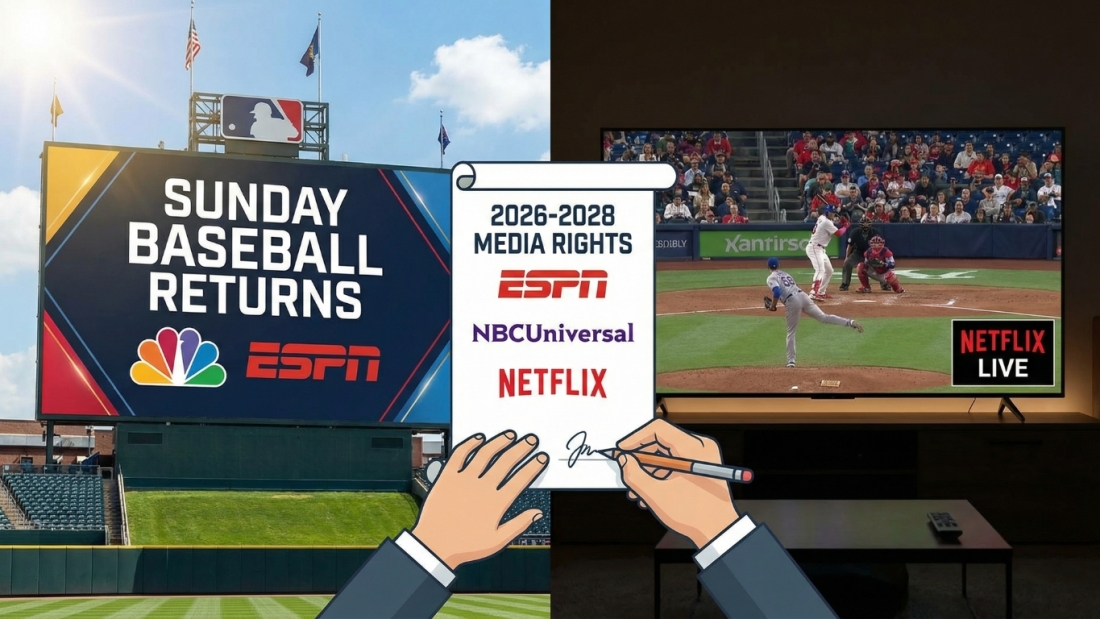
The beginning of 2026 will be the year of the MLB’s new media reality. The massive, streaming-heavy national TV deal that Rob Manfred and the owners inked after walking away from ESPN has kicked in, the money is flowing, and how you watch baseball has fundamentally changed. If you’re still trying to figure out where your games are, why some matchups are easier to find than others, or whether you need yet another streaming subscription — you’re not alone. The transition has been messy, confusing, and uneven depending on where you live and which team you follow. So as we head into 2026, let’s cut through the PR spin and lay out what MLB fans actually need to know about this new TV landscape: what’s working, what’s still broken, and why your viewing experience might look completely different from the fan sitting three states over.
The New Setup: A Quick Refresher
If you’ve been confused about where to find games over the past year or so, here’s the condensed version of what changed (based on reporting from outlets like The Athletic, Sports Business Journal, and others): MLB moved away from the old ESPN/TBS national model and signed a long-term deal worth multi-billions over a decade-plus.
Traditional broadcast partners like FOX remain central, especially for the postseason. But the big shift is streaming: Amazon Prime Video and potentially other streaming giants now carry exclusive regular-season and playoff games. This is all happening on top of the separate chaos with local TV and regional sports networks, which continue to implode in real time. If you read our earlier piece on MLB expansion & division realignments, this deal represents the same core strategy: MLB trying to solve its scheduling, ratings, and exposure problems with one massive structural change. Now, let’s break down what that actually means for you as a fan in 2026.
What’s Actually Better Now
More Nationally Accessible Games (If You Know Where to Look)
For years, MLB’s national presence felt scattershot — a random ESPN game here, a TBS window there, FOX playoff coverage buried between college football promos. The new deal has delivered on one key promise: more games are nationally available, with a bigger slate on FOX and major broadcast channels, plus a significant chunk on Amazon Prime Video, which millions already subscribe to for non-sports reasons. For the casual fan who doesn’t live and breathe one team, this matters. Baseball finally feels more “on” again, similar to how the NFL dominates weekends. You can stumble onto a good Tuesday night matchup without needing a detective agency and three login passwords.
Streaming That Fits How People Actually Watch in 2026
When MLB.TV launched in the early 2000s, it was ahead of its time — then immediately kneecapped by blackout rules and clunky interfaces. The new setup treats streaming as primary, not secondary. Amazon Prime Video’s infrastructure means better apps, smoother streams, and a user experience that doesn’t feel like it was designed in 2009.
If you’re under 40 and cut the cord years ago, this is how you already consume everything: NFL on Prime, NBA on various streaming bundles, movies on the same platforms. Baseball joining that ecosystem is overdue. MLB took a scalpel to the on-field product with the pitch clock and rule changes. This TV deal is the media equivalent: an acknowledgment that how people watch sports has completely changed.
Better Production and New Viewing Options
One underrated benefit of the ESPN breakup — which we covered in MLB and ESPN set to part ways — is that ESPN wasn’t really investing in baseball anymore. It had a contractual obligation, not passion. Streaming-first partners, by contrast, build custom experiences: unique graphics, advanced stats overlays, alternate commentary feeds.
Look at how the NFL’s Thursday Night Football evolved on Prime: alternate broadcasts, stats-heavy feeds, more experimentation. MLB is sitting on mountains of data that fans previously only saw on Twitter. In 2026, we’re starting to see partners surface it properly. Some broadcasts now offer options: a traditional feed, an analytics-heavy version, even commentary tailored toward newer fans. Baseball’s pacing, once considered a liability, can become a feature with creative presentation.
Financial Stability That Actually Matters
Yes, billionaire owners crying poverty is tiresome. But there are real stakes to MLB’s financial structure. National money is guaranteed, unlike local TV money that evaporates when an RSN files bankruptcy. This stable national cash helps small- and mid-market teams survive the RSN collapse and prevents MLB from becoming entirely a two-city sport.
As we laid out in our MLB expansion breakdown, expansion fees and new media money are reshaping the league. The new TV deal is the backbone of that project: maintain strong revenue while restructuring outdated systems. You don’t need to feel sympathy for owners to recognize that a broke league is bad for everyone. But here’s the thing: a well-funded league with terrible access is also bad — which brings us to what’s still broken.
Here are highlights of MLB’s continuing partnerships with FOX, TBS, Apple TV, and MLB Network https://t.co/g9cB11215O pic.twitter.com/0KvKmKtayh
— MLB (@MLB) November 19, 2025
So much misinformation out there about what new MLB TV deal means for watching Padres. Bottom line: In 2026, you’ll be able to watch them same way you did in 2025, either on linear TV or streaming. Could change in 2027, but don’t know yet. This is from a story on MLB’s website. pic.twitter.com/EOdB4XuNAa
— Jay Posner (@JayPosnerSD) November 20, 2025
RIP my free MLB. Tv T-Mobile deal https://t.co/PFmbW1qWSI
— Nick Lee (@NickLee51) November 19, 2025
What’s Still a Mess (And Getting Worse for Some Fans)
The “Where Is My Game Tonight?” Problem
Yes, MLB put more games in obvious national windows. But your experience as a fan isn’t just national games. It’s local broadcasts, national TV, out-of-market streaming, and extra packages layered on top of each other. In 2026, a typical night looks like this: your team is on your local outlet… unless they’re picked up for a national exclusive… unless that exclusive is on a streamer you don’t subscribe to.
This is the same headache we’re seeing across sports: NFL games split between Amazon, Peacock, ESPN+, and cable. MLB is fully there now, just with 162 games per team to scatter around.
What this feels like for fans: a constant hunt. You used to ask, “Is the game on ESPN or FOX?” Now it’s: “Is it on FOX? Prime? Some random streamer? Blocked locally? Still on my nearly-bankrupt RSN?” The deal’s branding sounds clean and futuristic. The day-to-day reality feels exhausting.
Blackouts Are Still MLB’s Self-Inflicted Wound
The national deal didn’t fix MLB’s single worst problem: blackouts. In-market fans often still can’t watch their own team on MLB’s own streaming products. If your local RSN rights remain tangled, you can be physically in your team’s city and blocked from watching on national or league apps.
MLB has talked about a unified direct-to-consumer future — but the legal and contractual knots don’t magically untangle because they signed new national partners. We wrote about how geographic alignment and smarter TV windows could boost viewership in the expansion piece. The new deal aligns with that logic for national games. But on blackouts? For many fans, it’s the same pain, just on newer platforms.
Local TV Is Still Collapsing (And Your Experience Depends on Your Zip Code)
Here’s the uncomfortable truth beneath all this national deal optimism: local TV is breaking in real time. Regional sports networks continue collapsing. Some teams have pivoted to streaming-only local packages, over-the-air channels paired with separate apps, or year-to-year patchwork deals. Others are waiting for MLB’s eventual “one app to rule them all.”
From a fan’s perspective, where you live and who you root for determines whether your 2026 experience is seamless or maddening. Two fans watching the same sport can have wildly different levels of friction, cost, and access simply based on their team’s ownership decisions. As we discussed in our expansion & realignment breakdown, geography and media are now married. This TV deal doubles down: your location matters more than ever for how you watch.
The Subscription Stack Is Out of Control
Let’s say you’re a diehard who wants full access. In 2026, you realistically might need:
- A cable or live TV bundle (for FOX and other partners)
- Amazon Prime Video for exclusive games
- An MLB-specific streaming package for out-of-market teams
- A separate local streaming solution if your team went direct-to-consumer post-RSN collapse
Individually, each markets itself as “just $10–15 a month.” Stack them, and you’re facing a stealth luxury purchase just to follow one sport with depth.
This is exactly what we covered in our ESPN–Penn–DraftKings story: sports media rights are now tied to betting, streaming, and bundles prioritizing ARPU (average revenue per user) over simplicity. Translation: MLB wants every fan paying as much as their wallet can stand without canceling.
Casual Fans Are Getting Squeezed Out
Hardcore fans will chase their team across five apps. Casual fans won’t. Think about what baseball actually needs: younger fans, new viewers, people who might watch casually and slowly get hooked. Those people aren’t hunting down exclusive windows on unfamiliar streamers, signing up for multiple services for a couple games a month, or reading media rights explainers.
They’re picking whatever’s easy: NFL, NBA, college football, TikTok, YouTube. Anything else.
MLB walking away from ESPN, as we outlined in the ESPN split piece, was about finding partners who actually care about baseball. That’s defensible. But there’s still a massive visibility gap if new partners don’t flood social feeds with highlights, offer easy-to-access big events, and create non-paywalled entry points. The risk: baseball’s core experience becomes premium and gated while its broader cultural presence shrinks.
What This Means for You in 2026
If You’re a Cord-Cutter Under 40
You’re probably in the best position. If you already have Prime, you’ve got a big chunk of nationally exclusive games covered. Streaming apps work smoothly, and you’re comfortable navigating multiple platforms. Your biggest annoyance: potentially needing MLB.TV for out-of-market access, and blackouts if you’re trying to watch your home team.
If You’re an Older or Less Tech-Savvy Viewer
This is rough. The “one channel for everything” era is gone. You’re being asked to manage multiple apps, logins, and subscriptions. Some local teams have moved entirely off traditional cable, forcing even more transitions. The league isn’t building this for you, and that’s a problem MLB isn’t taking seriously enough.
If You’re a Casual Fan or Potential New Fan
You’re the most at risk of being left behind. Baseball needs you, but the new structure assumes you’ll hunt across platforms for games. You won’t. Unless MLB and its partners flood accessible spaces with highlights, storylines, and easy entry points, you’ll drift to sports that meet you where you already are.
If You’re Rooting for a Small- or Mid-Market Team
Your experience varies wildly based on whether your ownership embraced the new model or is limping along with outdated local deals. Some teams have nailed the transition with clean streaming options and smart local partnerships. Others are still a mess, and you’re stuck in the middle.
The Big Picture: MLB’s Real Test Isn’t the Money — It’s the Relationship
The billions from this deal will be framed as a victory for baseball. In some ways, it is. But fans don’t care about media rights line items. They care about:
- Can I watch my team?
- Is it easy?
- Is it affordable?
- Does the league actually want me watching?
From expansion to realignment to the ESPN breakup, MLB is clearly trying to build a smarter future around geography, TV windows, and digital reach. But the new TV deal is a test of something simpler:
Can baseball reinvent how it reaches fans without making those fans feel like the game is drifting just out of reach?
If MLB gets this balance right — if the apps work, if blackouts get fixed, if new fans can easily discover the sport, if the subscription stack doesn’t spiral into absurdity — this deal will look brilliant five years from now. But if they don’t? All those extra billions won’t matter nearly as much as the empty seats, silent TVs, and fans who gave up trying to find their team and went elsewhere.
That’s where we are in 2026. The deal is done, the money is flowing, and the future of baseball viewership is being written right now — one confusing login screen, one blacked-out game, one frustrated fan at a time.
Leave A Comment