

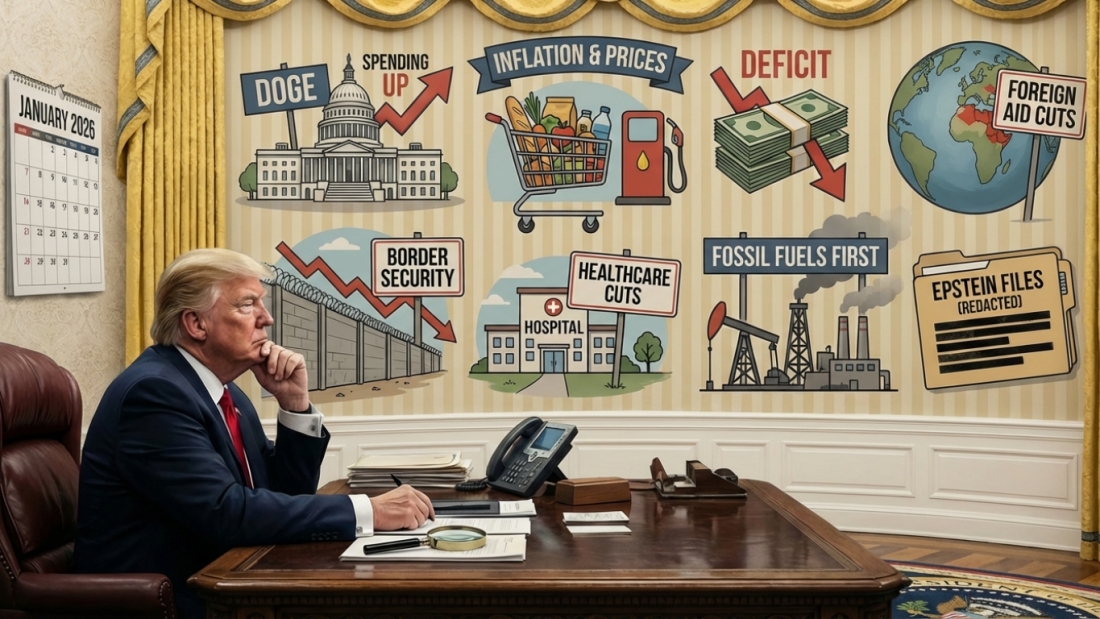
One year in. The People pulled the lever in November 2024, or maybe you didn’t vote at all but watched as Trump won decisively. Either way, we’re here now—nearly twelve months into the second Trump administration. The promises were big. “Make America Great Again” wasn’t just a slogan; it was supposed to be a blueprint. Drain the swamp. Cut the waste. Put America First. Bring back prosperity.
So here’s the question that should be sitting heavy as we flip the calendar to 2026: What has really gotten better in your life? Not what the talking heads say. Not what the press releases claim. What has actually changed for you—for your wallet, your family, your sense of security, your belief that this country is heading in the right direction? Let’s take an honest look at year one.
The DOGE Experiment: Somehow More Spending at the End
When Elon Musk walked into Washington to lead the newly created Department of Government Efficiency (DOGE) in January 2025, the promises were audacious. Cut $2 trillion from the federal budget. Root out fraud. Modernize IT. Make government work like a Silicon Valley startup. The reality? Federal spending actually increased by nearly 6% in 2025, climbing from $7.135 trillion to $7.558 trillion. That’s right—up, not down.
To be fair, DOGE did accomplish something tangible: it slashed the federal workforce by approximately 9%, cutting over 270,000 positions. That’s the largest peacetime workforce reduction since World War II demobilizations. Bureaucracy took a hit, and for those who believe government should be lean, that’s a win. But here’s the catch: most federal spending isn’t payroll. It’s entitlement programs—Social Security, Medicare, Medicaid. These programs run on autopilot, and Congress alone has the power to cut them. DOGE couldn’t touch them, no matter how many contracts Musk’s team terminated or how many grants they canceled.
The claims of savings were also problematic. The New York Times found that DOGE’s 13 largest claimed cuts were either incorrect or entirely false. Two Defense Department contracts listed as “terminated” and worth $7.9 billion in savings? Still active. Eighty percent of the claimed savings were $1 million or less—rounding errors in a $7 trillion budget. Musk himself left DOGE in May 2025, later admitting the project was only “somewhat successful” and saying he wouldn’t do it again. By November, officials confirmed DOGE no longer existed. Give credit for the effort and the workforce cuts. But when spending goes up while you’re promising to slash waste? That’s a problem. Consider this a L.
Inflation: Still Running, Still Costing You
Remember when inflation was supposed to come down fast once the “right policies” were in place? We’re still waiting. As of November 2025, the annual inflation rate stood at 2.7%, down from 3.0% in September. That’s progress, technically. But let’s be real: prices aren’t going backward. They’re just rising slower than before.
Your grocery bill? Food prices increased 2.6% annually in November 2025. Meat, poultry, fish, and eggs were up 4.7%. Energy costs rose 4.2%. Shelter costs—whether you’re renting or paying a mortgage—climbed 3.0%. These aren’t abstract numbers. They’re the difference between affording the same lifestyle you had two years ago and cutting corners every month.
The Federal Reserve’s target is 2% inflation. We’re not there yet. And with tariffs driving up costs for goods from Mexico, China, and Canada, many economists expect inflationary pressure to persist into 2026. Inflation isn’t a political talking point. It’s a lived experience. And for most Americans, that experience is still painful.
The Deficit: A Numbers Game
President Trump claimed his tariffs helped “slash the deficit by more than 25%” in 2025. PolitiFact rated this claim false. The actual deficit for fiscal year 2025 was $1.775 trillion, a reduction of just $41 billion from 2024—a 2.3% decrease, not 25%. Tariff revenue did increase significantly, jumping from $165.4 billion to $309.2 billion. But that increase alone didn’t come close to offsetting overall spending growth.
Meanwhile, the “One Big Beautiful Bill Act” passed by Congressional Republicans is projected to add $2.4 trillion to deficits over the next decade, primarily by extending the 2017 tax cuts. The Committee for a Responsible Federal Budget estimates that cumulative deficits could reach $22.7 trillion over the next ten years, with the debt-to-GDP ratio climbing from 100% to 120% by 2035.
Interest payments on the national debt now exceed $970 billion annually—the third-largest federal expenditure after Social Security and Medicare. Fiscal conservatism was supposed to be a cornerstone of this administration. So far, the numbers don’t match the rhetoric.
Foreign Policy: Ongoing Wars
If you voted for Trump expecting a pull-back from endless foreign entanglements and a focus on America First, there’s been movement—but not the kind that delivers peace.
Foreign Aid Cuts
The administration dismantled USAID entirely, terminating 82% of its programs (roughly 5,200 out of 6,200) and cutting approximately $54 billion in ended programs. The U.S. also withdrew from the World Health Organization and ceased funding to UNRWA (UN Relief and Works Agency for Palestine Refugees). The philosophy? “Trade over aid, opportunity over dependency.” In theory, it’s about making foreign assistance more strategic and less wasteful.
Critics argue these cuts undermine U.S. soft power and cede global influence to China and Russia. Whether you see this as fiscal responsibility or moral failure depends on your worldview. But one thing is clear: the U.S. is pulling back from its traditional role as the world’s largest aid donor (only in some areas we suppose).
The Ukraine Question
Nearly four years into the war, peace remains elusive. In late December 2025, Trump hosted Ukrainian President Zelenskyy at Mar-a-Lago, claiming they were “closer than ever before” to a deal, with a draft agreement “95% done.” The sticking point? Territory. Specifically, Russia’s control of Ukraine’s eastern Donbas region. Putin shows no signs of dropping maximalist demands, and Russian forces continue advancing.
Trump’s involvement is genuine—he’s mediating talks, coordinating with European leaders, and pushing for security guarantees. But a peace deal isn’t a peace deal until it actually happens. And so far, American taxpayers continue to fund a war with no end in sight. For those who wanted America out of foreign wars, this isn’t the victory you were promised.
Border Security: A Rare Win?
If there’s one area where the administration can claim tangible results, it’s border security. According to the Department of Homeland Security, illegal border crossings were down 93% year-over-year in 2025. In November, total nationwide encounters were 30,375—a 92% decrease from the peak under the Biden administration. For seven consecutive months from May to November, U.S. Border Patrol reported zero releases of undocumented immigrants into the country’s interior.
The administration reinstated the “Remain in Mexico” policy, resumed border wall construction with over $5 billion in new contracts, and deployed thousands of troops to the southern border. More than 2.5 million undocumented immigrants left the U.S., including 1.9 million self-deportations and over 622,000 official deportations.
For voters who prioritized border security, this is a legitimate achievement. The administration followed through on a core campaign promise and delivered measurable results. Of course, immigration policy isn’t just about numbers—it’s also about families, labor markets, and the long-term economic impact of reduced immigration. But if you wanted a secure border, you got one.
Healthcare: Help with Strings Attached
Healthcare policy in 2025 was a mixed bag—some targeted support, but also significant cuts that will hit millions of Americans.
In December 2025, the administration launched a $50 billion Rural Health Transformation Program, distributing funds to states over five years to support struggling rural hospitals. The catch? Twelve billion dollars of that funding is tied to states implementing policies aligned with the administration’s “Make America Healthy Again” initiative—things like nutrition education for healthcare providers, school participation in the Presidential Fitness Test, and banning SNAP benefits for “junk foods.” States that don’t comply? The administration can “claw back” the funds.
Critics argue that $50 billion is inadequate to offset the projected $1.2 trillion cut from Medicaid over the next decade, which could lead to an estimated $137 billion loss for rural hospitals and put up to 300 rural hospitals at risk of closure.
ACA Subsidies and Medicaid Cuts
The administration’s decision to end federal subsidies that helped approximately 20 million people afford insurance on the Obamacare marketplaces is expected to cause millions to lose coverage due to skyrocketing premiums. Congressional Republicans also agreed to cut over $850 billion from the 10-year budgets of Medicaid and the Children’s Health Insurance Program (CHIP) to fund tax cuts. These cuts are projected to leave approximately 15 million Americans without health insurance. If you’re in a rural area, there’s some targeted help—with conditions. If you rely on Medicaid or ACA subsidies, you’re likely facing higher costs or losing coverage altogether.
Energy: Fossil Fuels First
The administration’s energy policy in 2025 was unambiguous: maximize domestic production of oil, natural gas, and coal while rolling back support for renewable energy. The “Unleashing American Energy” executive order on January 20, 2025, declared a national energy emergency, reversed Biden-era climate initiatives, and eliminated the Interagency Working Group on the Social Cost of Greenhouse Gases.
The administration fully committed to the coal industry, issuing 16 emergency orders to keep coal, natural gas, and hydro-powered plants online. It also launched a “next American Nuclear Renaissance,” aiming to expand nuclear energy capacity from approximately 100 GW to 400 GW by 2050. Meanwhile, offshore wind farms were halted, wind energy permits were revoked, and billions in grant funding for low-income solar installations and carbon-capture projects were terminated. The tax breaks for clean energy were dramatically rolled back in a July 2025 Congressional bill.
Proponents point to record energy production and lower gas prices. Critics argue the policies increase pollution, cede clean energy leadership to China, and ignore the long-term economic shift toward renewables. Interestingly, despite the rollbacks, solar and battery storage continued to boom in 2025, accounting for 85% of new power added to the grid in the first nine months of Trump’s second term, driven by strong economics and high demand. If cheap gas was your priority, the policy delivered. If you cared about the long-term energy transition, you’re likely disappointed.
Government Corruption: The Epstein Files Fiasco
If you voted for Trump expecting swamp-draining and transparency, the Epstein files release in December 2025 should make you furious. Despite the “Epstein Files Transparency Act” mandating full disclosure of all unclassified material by December 19, 2025, the documents released by the Department of Justice were heavily redacted—many pages almost entirely blacked out.
Representative Ro Khanna, a co-author of the law, stated the DOJ’s release did not comply with the spirit or letter of the law. Senator Chuck Schumer called it a potential “biggest cover-up in American history.” Adding insult to injury, at least 15 newly released files disappeared from the DOJ’s website shortly after their initial release, including photos of Trump with Epstein and Ghislaine Maxwell. The DOJ announced the discovery of over a million more documents potentially related to the case, further delaying a complete release.
Internet users quickly discovered that some redactions could be bypassed using simple techniques—highlighting, copying, and pasting obscured text—revealing information about financial irregularities, payments to young women, and witness tampering. Government corruption exposure in 2025 was at an all-time high—but not because the administration was draining the swamp. It was because the swamp fought back, redacted, delayed, and obstructed. For those who wanted accountability and transparency, this was a gut punch.
The ‘America First’ Movement: Not Thrilled
Let’s talk about the vibe. The MAGA base that propelled Trump to victory in 2024 isn’t celebrating. Border security? Yes, that’s a win. But on the bigger questions—spending, deficits, foreign wars, government transparency—the needle barely moved, or moved in the wrong direction.
“America First” seems lost. The U.S. is still deeply involved in Ukraine, still sending taxpayer dollars overseas, still running massive deficits, still struggling with inflation. The swamp wasn’t drained; it adapted. DOGE, the most visible attempt at reform, disbanded after modest results. Elon Musk himself walked away. The Epstein files were buried under redactions. Healthcare cuts hit working families. Energy policy favored big oil over innovation. And through it all, the same question lingers: What has really gotten better in your life?
So, What Will You Do For The Common Person in 2026, Mr. President?
Year one is over. The excuses are thinner. The promises are older. The patience is running out. Did we drain the swamp—where’s the accountability? They said you’d cut spending—why did it go up? The end of foreign wars? Why are we still negotiating with Putin while funding Ukraine? Why are the Epstein files still hidden?
To be clear, there were wins. Border security is dramatically improved. Federal workforce bloat was addressed. Energy production is up. These aren’t small things. But they’re not enough.
Americans—especially the ones who voted for you—aren’t asking for perfection. They’re asking for progress. Real progress. The kind you can feel in your wallet, in your community, in your sense that the country is moving in a better direction.Year two is here. The clock is ticking. The question isn’t what you promised in 2024. It’s what you’ll deliver in 2026.
Because talk is cheap. And we’re all paying too much already.
Leave A Comment