

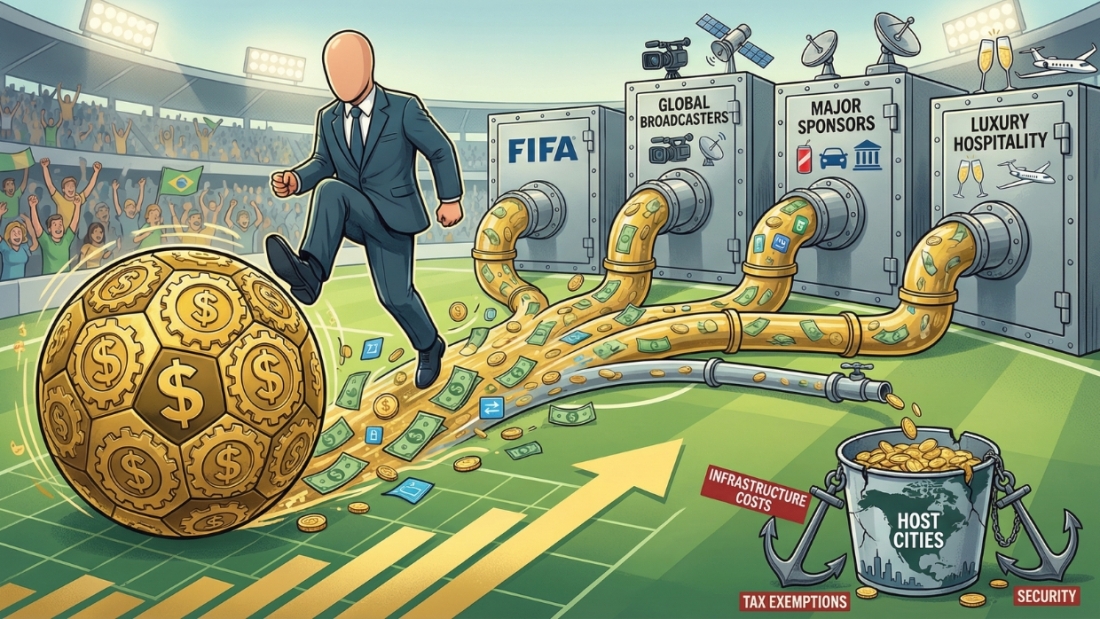
The 2026 FIFA World Cup is being sold as a historic celebration of soccer across North America—48 teams, 104 matches, 16 cities, three nations united by the beautiful game. FIFA projects the tournament will generate somewhere between $11 billion and $14 billion in total revenue for the 2023-2026 cycle, with $8.9 billion coming directly from the 2026 tournament itself.
But here’s the question nobody in the promotional videos is asking: Who’s actually getting rich off this thing?
Spoiler alert: It’s not the cities footing the bill.
The Revenue Breakdown: Follow the Money
Let’s start with where FIFA’s projected $8.9 billion is actually coming from:
Broadcasting Rights: $3.92 Billion
This is the big one. FIFA has locked in $3.92 billion from broadcasting deals worldwide—a roughly 30% increase from the $2.96 billion they pulled in for Qatar 2022.
Who’s paying?
- Fox Sports: $480 million for English-language U.S. rights (including a $180 million bonus for U.S. hosting)
- Telemundo: $465 million for Spanish-language U.S. rights (with a $115 million hosting bonus)
- BBC & ITV (UK): Over $350 million for the 2026-2030 cycle
- M6 (France): $150 million
- ARD & ZDF (Germany): $120 million
The expanded 48-team format means 104 matches instead of 64—more content, more ad inventory, more money. Fox Sports and Telemundo have nearly sold out their ad inventory more than a year in advance, with knockout matches commanding CPM rates equivalent to the Super Bowl.
Who profits? FIFA. Broadcasters. Advertisers. Not the cities.
Sponsorships: $2.69 Billion
FIFA operates a three-tier sponsorship system:
FIFA Partners (global rights to all FIFA events)
- Adidas, Coca-Cola, Hyundai-Kia, Visa, Aramco, Lenovo, Qatar Airways
- These deals often exceed $70 million, with some paying $70-100 million annually
World Cup Sponsors (global rights for 2026 only)
- Anheuser-Busch InBev, Bank of America, Frito-Lay, McDonald’s, Verizon, Hisense
- Typical spend: $65-95 million
Regional Supporters
- The Home Depot, Valvoline, Airbnb, American Airlines
- More limited marketing rights, lower price tags
Total sponsorship revenue is projected between $2.5 billion and $3 billion. For U.S. and Canadian host cities specifically, SponsorUnited projects a $4.5 billion sponsorship economy. Who profits? FIFA. Global corporations. Not the cities.
Ticketing & Hospitality: $3 Billion
This is the fastest-growing revenue category. FIFA expects to pull in $3 billion from ticket sales and premium hospitality packages. On Location, a subsidiary of TKO, is exclusively managing the hospitality program. Packages range from thousands to tens of thousands of dollars per match. The North American market’s “sophisticated corporate hospitality culture” is basically code for “we can charge obscene amounts and people will pay.” Who profits? FIFA. TKO. Luxury hospitality companies. Not the cities.
Licensing & Merchandising: $669 Million
Jerseys, collectibles, digital engagement—FIFA projects $669 million from licensing deals. Who profits? FIFA. Adidas. Licensed manufacturers. Not the cities.
What the Host Cities Actually Get
Now let’s talk about what the 16 host cities are actually seeing from this financial bonanza. Each host city is expected to realize between $160 million and $620 million in direct economic impact, depending on match allocation and tourism draw. Major hubs like New York/New Jersey, Los Angeles, Dallas, and Miami are projected at the higher end.
Specific examples:
- Los Angeles County: Up to $892 million in direct economic impact, plus $230 million in long-term tourism benefits from global media exposure—totaling over $1.1 billion
- Seattle’s Lumen Field: Projected to inject a minimum of $929 million into King County’s economy
- Toronto: Expects a CA$940 million boost, including CA$520 million in GDP growth
The tournament is expected to create more than 40,000 temporary jobs across the three nations, injecting over $1 billion in aggregate wages into local economies. For the U.S. alone, approximately 185,000 full-time equivalent jobs are expected. Sounds great, right? Now let’s talk about the costs.
The Hidden Costs Nobody Advertises
Public Investment: Cities are expected to shoulder between $100 million and $200 million in costs related to infrastructure, security, and logistics. These investments focus on “soft infrastructure” and operations to meet FIFA’s requirements:
- Installing temporary natural grass pitches (because FIFA demands it, even in artificial turf stadiums)
- Upgrading media facilities
- Expanding corporate hospitality areas
- Security and crowd management
Tax Exemptions: Here’s where it gets ugly. FIFA requires host cities to exempt sales tax on ticket prices. Let’s break down what that means:
- Missouri: Could lose $1.9 million per game, totaling over $11 million for Kansas City’s six matches
- Florida: Expects to lose around $7.4 million for Miami games
- Georgia: Up to $25 million for Atlanta games
So FIFA collects billions in ticket revenue, and local governments lose millions in tax revenue they would have collected from any other event. Cool system.
Tourism Displacement: Regular tourists may avoid host cities due to price spikes. Hotel room rates in host cities like Los Angeles are projected to rise by up to 90%. That’s great for hotels, terrible for normal tourism, and potentially a wash for overall visitor spending.
Historical Context: Many past World Cups have resulted in financial losses for host countries. The last three World Cups had an average return on investment of negative 31 percent.
The 2026 Model: Better, But Still Rigged
To FIFA’s credit, the 2026 model is smarter than previous tournaments. By utilizing existing stadiums instead of building new ones, the tournament avoids the “white elephant” problem that plagued Brazil, South Africa, and Russia—countries that spent billions on stadiums that now sit mostly empty. FIFA’s operational costs for the 2026 World Cup are budgeted at $2.5 billion, covering logistics, stadium management, broadcasting production, and VAR technology. But those costs are covered by the revenue streams above. FIFA isn’t losing money here. The macroeconomic projections are impressive:
- Boston Consulting Group projects a $5-6 billion incremental GDP lift across the United States, Canada, and Mexico
- FIFA and the World Trade Organization estimate the tournament will boost U.S. gross domestic output by $47 billion and create nearly 300,000 jobs (including the 2025 Club World Cup)
But here’s the thing about GDP boosts: they measure economic activity, not profit. A city can see a GDP increase while still losing money on the deal if the costs exceed the tax revenue generated.
Who’s Really Winning?
Let’s be clear about who’s cashing in:
FIFA
- $8.9 billion in direct tournament revenue
- Zero stadium construction costs
- Tax exemptions from host cities
- Complete control over sponsorships, broadcasting, ticketing
Global Corporations
- Broadcasters paying billions for rights, then selling ads at Super Bowl rates
- Sponsors paying $70-100 million for global exposure
- Hospitality companies charging tens of thousands per premium package
- Hotel chains jacking up rates by 90%
National Economies (Sort Of)
- Temporary job creation
- Tourism spending (though potentially offset by displacement)
- Long-term “brand value” from global exposure (hard to quantify, easy to exaggerate)
Host Cities (Maybe)
- Economic impact between $160 million and $620 million (if projections hold)
- Minus $100-200 million in public investment
- Minus millions in lost tax revenue
- Minus opportunity costs from displaced regular tourism
- Plus intangible benefits like “civic pride” and “global exposure”
The math only works if you believe the optimistic projections and ignore the costs. And history suggests you shouldn’t.
Let the Games Begin
The 2026 FIFA World Cup is going to be a financial juggernaut. Billions will change hands. Millions of fans will attend. The spectacle will be undeniable. But when the final whistle blows and the confetti is swept up, the real winners will be the same as always: FIFA, global broadcasters, multinational sponsors, and luxury hospitality companies. The host cities will get a temporary economic bump, some jobs, and a lot of promotional videos talking about “legacy” and “community impact.” And they’ll be left holding the bill for infrastructure upgrades, tax exemptions, and the opportunity costs of a system designed to enrich everyone except the people who actually host the damn thing.
Soccer’s biggest event is coming to North America. Just don’t expect your city to get rich off it.
Leave A Comment