

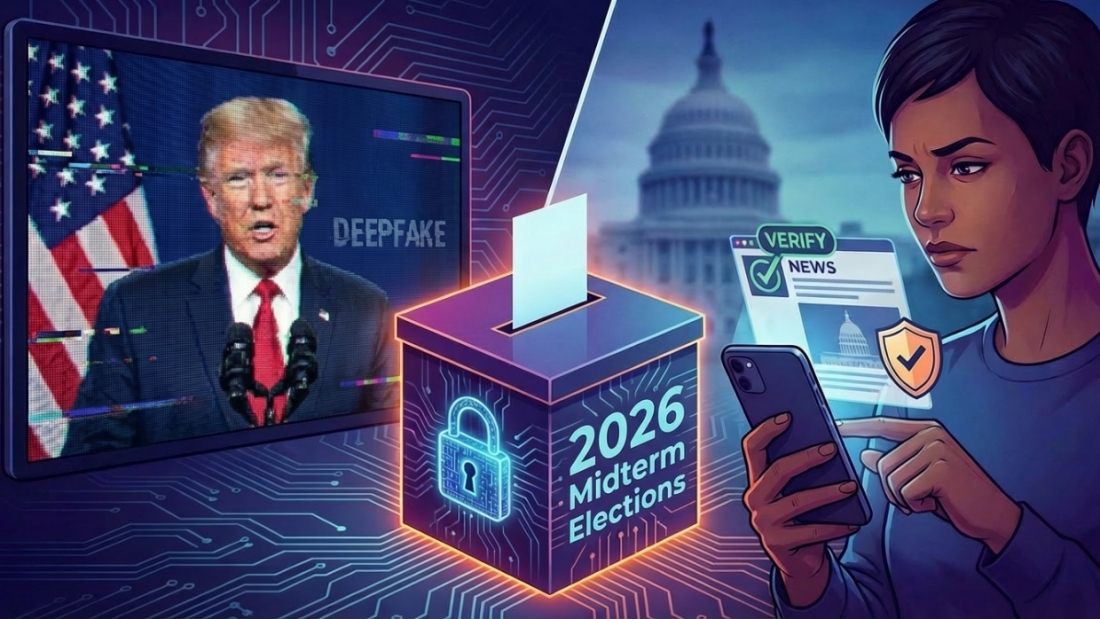
The 2026 midterm elections are shaping up to be the most technologically fraught in American history. Not because of voting machines or ballot security—those battles are old news. The new threat is invisible until it isn’t: synthetic media so convincing that your own eyes become unreliable witnesses.
Deepfakes have graduated from internet curiosity to geopolitical weapon. And as Americans prepare to head to the polls this November, the question isn’t whether AI-generated disinformation will appear—it’s whether we’re remotely prepared to deal with it when it does.
The Threat Is No Longer Theoretical
Forget the grainy fake videos of a few years ago. Today’s deepfakes are terrifyingly sophisticated, and they’re already being deployed in elections worldwide. In October 2025, just hours before Ireland’s presidential election, a deepfake video falsely announced a candidate’s withdrawal from the race. It was designed to look exactly like a bulletin from RTÉ News, complete with AI-generated versions of actual TV presenters.
In Ecuador’s February 2025 election, AI-generated content mimicking CNN and France 24 falsely implicated candidates in scandals. In Germany, a fake announcement purportedly from MI6 spread lies about bomb threats and poisoned ballots. These aren’t isolated incidents. They’re a pattern. And that pattern is accelerating.
The numbers are staggering:
- Deepfake-driven fraud resulted in over $200 million in financial losses in Q1 2025 alone
- One security firm reported a 900% year-over-year increase in deepfake creation
- 26 states have now enacted legislation regulating AI in elections, with at least five more considering bills
The Anatomy of an Election Deepfake
What makes election deepfakes particularly dangerous isn’t just their realism—it’s their timing and targeting. The most effective attacks come in the final hours before polls open, when there’s no time for fact-checkers to respond. They target swing states, specific demographics, and exploit existing political divisions. And increasingly, they’re not just videos.
Poisoned Chatbots: The New Frontier
Here’s something that should keep election officials up at night: data-poisoning attacks on AI chatbots. Bad actors are publishing misleading articles specifically designed to be scraped by AI systems. When voters ask chatbots questions about candidates or polling locations, they get manipulated information. In Australia’s May 2025 federal election, a Russian-linked network published fake news specifically to corrupt chatbot outputs. This isn’t science fiction. It’s happening now.
The Voter Suppression Play
The most insidious use of deepfakes isn’t spreading lies about candidates—it’s preventing people from voting at all.
- Hours before Buenos Aires city elections in May 2025, deepfakes falsely claimed a candidate had withdrawn
- In South Korea, YouTubers uploaded AI-generated news anchors declaring premature victories and defeats
- Following Poland’s presidential election, AI-generated images went viral alleging voter fraud—without any disclosure labels
The goal isn’t always to change minds. Sometimes it’s simply to create enough chaos and confusion that people stay home.
What’s Being Done (And Is It Enough?)
Let’s be clear: we’re not defenseless. Governments, tech companies, and security researchers have mobilized. The question is whether their efforts match the scale of the threat.
In early 2024, major tech companies—including Adobe, Amazon, Google, IBM, Meta, Microsoft, OpenAI, and TikTok—signed a voluntary accord to combat election deepfakes committed to:
- Detecting and labeling misleading political deepfakes
- Sharing best practices across platforms
- Providing “swift and proportionate responses” when deceptive content spreads
- Educating users on how to identify AI fakes
Sounds great on paper. The problem? It’s entirely voluntary. There are no binding requirements, no enforcement mechanisms, and no penalties for non-compliance. Pro-democracy activists have rightfully called it “virtue signaling.”
The Legislative Patchwork
State legislatures are trying to fill the gap. Twenty-six states have passed laws regulating deepfakes in elections, typically requiring labels on AI-generated content or banning deceptive synthetic media within a certain window before elections.
Key state approaches:
- Texas (2019): Prohibits deepfake videos published within 30 days of an election
- California (2019): Bans deceptive media within 60 days unless disclosed as manipulated
- Minnesota (2023): Prohibits deepfake dissemination within 90 days of an election
- Michigan (2023): Requires disclosure for political ads “generated substantially by AI”
But here’s the catch: several attempts at regulation have been struck down as First Amendment violations. Courts are skeptical of broad prohibitions on political speech, even when that “speech” is fabricated.
Federal Action: Too Little, Too Late?
At the federal level, we have… not much. There’s no law explicitly banning election deepfakes. The FTC is trying to expand existing rules against impersonation. The FCC has declared AI-generated robocalls illegal. But deepfakes on social media? Largely unregulated. The bipartisan “Protect Elections from Deceptive AI Act,” introduced in September 2023, would prohibit distributing materially deceptive AI-generated media related to federal candidates. It’s still sitting in committee.
The Detection Arms Race
Technology got us into this mess. Can it get us out? The most promising defense is fighting fire with fire. Companies like BitMind are developing real-time deepfake detection tools that analyze content for subtle inconsistencies—unnatural blinking patterns, skin texture anomalies, lighting that doesn’t quite match. Biometric verification tools can conduct “liveness checks” that analyze facial movements and micro-expressions to flag synthetic content. These tools are getting better, but so are the deepfakes. It’s an arms race, and there’s no clear winner.
Content Credentials and Digital Provenance
Microsoft is developing “Content Credentials as a Service“—essentially a digital watermark that tracks media authenticity using encrypted metadata. The C2PA (Coalition for Content Provenance and Authenticity) standard aims to create a verifiable chain of custody for digital content.
The idea: if you can prove where a video came from and that it hasn’t been tampered with, deepfakes become much easier to identify. But this only works if the infrastructure is widely adopted—and we’re nowhere close to that.
“Cheap Fakes”
Here’s what the deepfake panic sometimes obscures: sophisticated AI isn’t required for effective disinformation. The News Literacy Project found that in 2024, “cheap fakes”—content manipulated through simple editing, out-of-context clips, or even video game footage—were used seven times more often than AI-generated content for misinformation. In Bangladesh, cheap fakes were over 20 times more prevalent than deepfakes.
The cost of creating deceptive content without AI? Often just a few hundred dollars. This doesn’t mean we shouldn’t worry about deepfakes. But it does suggest that technological solutions alone won’t solve a problem that’s fundamentally about human psychology—our tendency to believe what confirms our existing worldviews.
2026: Are We Ready?
The honest answer? Probably not.
What’s Working
- State legislation is creating at least some guardrails, even if enforcement remains challenging
- Platform policies are improving, with better detection and labeling of AI content
- Public awareness is growing—people are more skeptical of viral content than they were four years ago
- Detection technology continues to advance, offering real-time assessment capabilities
What’s Concerning
- Federal coordination is weakening. The Elections Information Sharing and Analysis Center has seen reduced funding, and CISA’s election security work has been scaled back
- Content moderation is loosening. Major platforms have relaxed their policies, making it easier for misinformation to spread
- The legal framework is fragmented. No federal baseline means vastly different protections depending on which state you’re in
- Detection lags generation. By the time a deepfake is identified, the damage may already be done
The Stakes Couldn’t Be Higher
We’re entering an era where seeing is no longer believing. Where a perfectly fabricated video can make a candidate say something they never said, or announce a withdrawal that never happened, or declare a victory before votes are counted.
The 2026 midterms will be a test—not just of our democracy, but of our collective ability to distinguish reality from fabrication. Current measures? They’re better than nothing. But “better than nothing” is a pretty low bar when the integrity of democratic elections hangs in the balance.
The tools exist to fight this threat. The question is whether we have the political will to deploy them—and whether we’ll do so before it’s too late. Because here’s the thing about deepfakes: the goal isn’t just to spread lies. It’s to make us doubt everything, including the truth. And in a democracy, that kind of doubt is poison.
Leave A Comment