

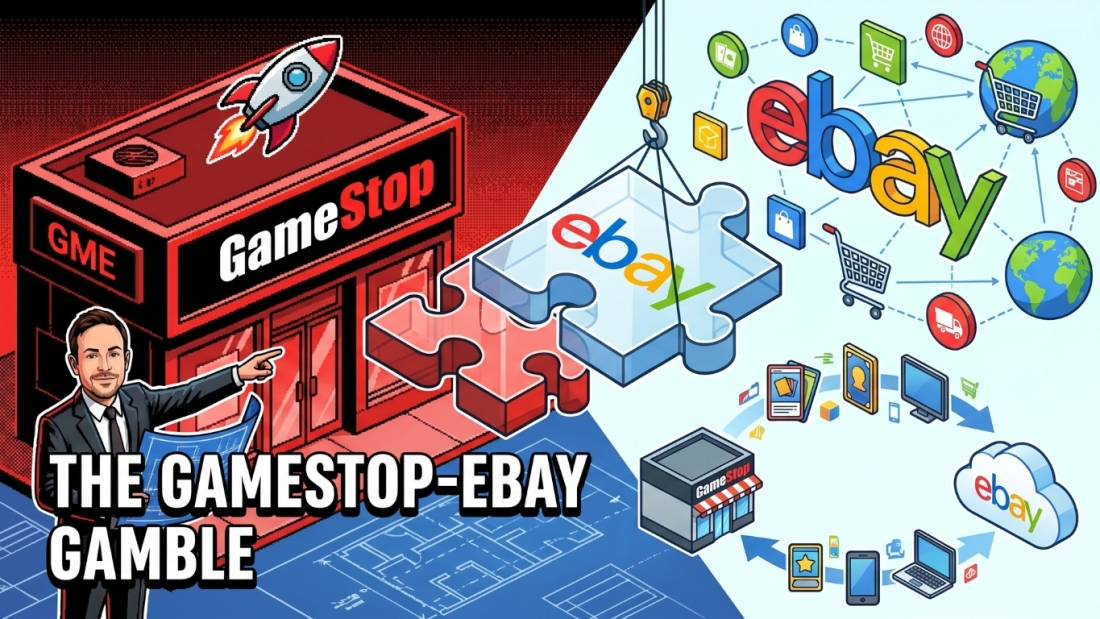
For most people, GameStop is still the meme stock that broke the internet. The company that turned Reddit threads into market-moving events and made “diamond hands” part of everyday investing vocabulary. But while everyone was still laughing about apes and rockets to the moon, Ryan Cohen has quietly restructured GameStop into something very different.
Now, with GameStop making a $56 billion offer to buy eBay, that transformation is impossible to ignore. This isn’t a meme. This is Cohen betting that while the world was distracted by the chaos of 2021, he was transforming a company with the cash, discipline, and ambition to make one of the boldest acquisition plays in modern retail history.
What’s Actually Happening Here?
GameStop has made an unsolicited, non-binding offer to acquire eBay for approximately $125 per share in a cash-and-stock deal, valuing the e-commerce giant at roughly $55.5 billion. To put that in perspective: eBay is about four times larger than GameStop by market cap.
This is not a normal acquisition where a giant swallows a smaller competitor. This is GameStop — the company many people thought was headed for bankruptcy just a few years ago — trying to buy one of the most recognizable names in online commerce.
According to reports from Reuters and CNBC, GameStop has already built about a 5% stake in eBay through a mix of shares and derivatives. Cohen has also made it clear he’s willing to take this fight directly to eBay shareholders if the board doesn’t play ball. This isn’t just a casual pitch — Cohen is trying to force a conversation about whether eBay is being undervalued, under-managed, and leaving billions on the table.
Why Ryan Cohen is Obsessed with This Deal
Ryan Cohen sees eBay the way he once saw GameStop: a famous brand with loyal users, valuable infrastructure, and a business that could produce way more cash if someone just ran it smarter. That’s the entire thesis in one sentence.
Cohen isn’t pitching eBay as a hyper-growth tech darling. He’s pitching it as a mature marketplace with universal brand recognition that’s spending too much money to go absolutely nowhere. eBay spent $2.4 billion on sales and marketing in fiscal 2025 while adding just one million net active buyers — less than 0.75% growth. For a brand as well-known as eBay, that’s borderline absurd.
Cohen’s argument is simple and brutal: if the spending isn’t producing meaningful growth, cut the spending. GameStop says it could slash around $2 billion in annual costs from eBay within a year of closing. That alone would boost eBay’s earnings per share from $4.26 to $7.79 in the first year, according to GameStop’s proposal. Cohen isn’t promising to reinvent eBay — he’s promising to stop lighting cash on fire.
This is exactly the playbook he used at GameStop. He took over a company Wall Street had written off, closed underperforming stores, cut expenses, simplified operations, and focused ruthlessly on profitability. GameStop isn’t a traditional growth story, but it’s also not the disaster everyone predicted. And now Cohen wants to prove he can do it again — at a much bigger scale.
GameStop’s Image Problem Became Its Advantage
Here’s the thing: the public still thinks of GameStop as a chaotic meme stock. But the company Ryan Cohen runs today is not the company that became a WallStreetBets legend in 2021. GameStop has spent years restructuring. It closed hundreds of stores, reduced headcount, built up a $9.4 billion cash position, and stopped chasing every flashy trend. Instead of trying to become the next Metaverse company or pivoting to NFTs at scale, Cohen focused on survival, and optionality.
That last word matters. Optionality. GameStop has spent years creating a position where it could do something bold. A clean balance sheet gives Cohen room to act. A loyal shareholder base gives him market relevance. A still-famous brand gives him cultural leverage. And now we’re seeing what all that optionality was building toward.
GameStop is using the market’s old perception against it. Everyone remembers the meme stock. Fewer people noticed that GameStop became a company with cash, discipline, and a CEO who believes he can squeeze more earnings out of sleepy consumer businesses. That’s why this eBay bid matters. It’s Cohen saying: if you think GameStop is still just a meme, you haven’t been paying attention.
Why eBay?
eBay is one of the internet’s original giants. It has massive brand awareness, a global marketplace, millions of buyers and sellers, and deep roots in categories like collectibles, trading cards, electronics, auto parts, luxury goods, and used merchandise. And here’s where it gets interesting: those categories overlap heavily with GameStop’s current customer base.
GameStop isn’t going to beat Amazon by selling new video games in mall stores. That version of the business has obvious limits. But GameStop does have a brand that still resonates with gamers, collectors, and enthusiast communities. eBay has the marketplace infrastructure and massive seller ecosystem. Together, Cohen seems to believe they could build something much more valuable.
One of the more fascinating aspects of GameStop’s pitch is the idea that its roughly 1,600 U.S. stores could become physical infrastructure for eBay. Those stores could potentially serve as:
- Drop-off and pickup locations
- Shipping hubs
- Authentication centers for collectibles and electronics
- Trade-in locations
- Live commerce studios
This is where Cohen’s vision starts to click. eBay is mostly digital, but trust is still one of the biggest problems in resale markets. Is the item real? Is the condition accurate? Will it ship? Can the seller be trusted?
GameStop stores could theoretically help solve part of that problem, especially in categories like trading cards, games, electronics, and collectibles. If eBay wants to go deeper into authentication and community-driven commerce, a national retail footprint isn’t a bad asset to have. Could this actually work at scale? That’s the big question. But the strategic logic isn’t crazy.
The Amazon Angle
Cohen has reportedly said that eBay could become a legitimate competitor to Amazon. That sounds wildly ambitious — maybe too ambitious — but it reveals how he’s thinking.
He’s not trying to turn eBay into an Amazon clone. Amazon is a logistics machine, cloud computing giant, advertising platform, subscription ecosystem, and retail empire all at once. eBay is not that. But eBay doesn’t need to become Amazon to become more valuable.
eBay’s strength has always been different. It’s less about same-day delivery of household essentials and more about unique inventory, used goods, collectibles, rare items, enthusiast categories, and marketplace discovery. That’s a different type of commerce — and one that could become more valuable as consumers look for deals, resale items, and hard-to-find products in an increasingly expensive economy.
Cohen likely sees eBay as a platform that’s lost some of its edge but not its relevance. If GameStop can cut costs, improve trust, use stores for authentication and fulfillment, and make eBay more exciting for younger buyers and collectors, the upside could be enormous.
That’s the bull case. The risk, of course, is also enormous.
The Reality Check: This Could Easily Fail
None of this means the deal will actually happen. There are serious questions about financing. GameStop is much smaller than eBay, and buying a company worth roughly four times as much requires a complicated mix of cash, debt, stock issuance, and possibly outside investors. GameStop has secured a $20 billion financing commitment from TD Securities, but even with that, the math is tight.
There’s also the question of whether eBay shareholders actually want this. eBay’s board has confirmed it’s reviewing the offer, but analysts have raised doubts. Morgan Stanley and Bernstein both questioned the strategic fit, noting eBay’s recent solid execution in its own turnaround efforts.
And then there’s execution risk. Cutting $2 billion in costs sounds great on paper, but marketplaces are delicate ecosystems. Cut too much from marketing, product development, trust and safety, or seller support, and you might boost short-term margins while weakening the long-term platform. A marketplace only works if buyers and sellers keep showing up.
That’s the tension in Cohen’s strategy. His cost-cutting discipline helped stabilize GameStop, but eBay is not GameStop. It’s larger, more complex, more global, and more dependent on network effects. Running it like a leaner machine could create value — or it could damage the very thing that makes eBay valuable in the first place.
Why This Moment Matters
Whether or not GameStop actually buys eBay, the offer itself is important because it changes the conversation around GameStop.
For years, GameStop has been covered through the lens of memes, Reddit, short sellers, and retail investor mania. That history still matters. We’ve written about the meme stock era — from the return of Roaring Kitty to the broader revival and the ongoing battles with short sellers. It’s part of why the company has such a strange and powerful place in market culture. But Cohen is now trying to shift the narrative from meme stock to capital allocator. That’s a very different story.
A meme stock is something people trade because of hype, community, and volatility. A capital allocator is someone who takes cash, stock, debt, and operating discipline and tries to build long-term enterprise value. Cohen wants investors to see GameStop not as a punchline, but as a platform for bold acquisitions and operational turnarounds. The eBay bid is the loudest version of that argument possible.
JUST IN: GameStop CEO Ryan Cohen says he's offering to buy eBay for about $56 billion pic.twitter.com/7hSmpgvNMv
— Morning Brew ☕️ (@MorningBrew) May 3, 2026
Ryan Cohen just dropped the full proposal.
— The Assembly (@InTheAssembly) May 4, 2026
GameStop wants to buy eBay at $125 a share, 46% premium, $55.5B deal.
Half cash, half GME stock.
GME has been quietly building a 5% stake since February 4.
TD Securities already handed them a highly-confident letter for up to $20B in… https://t.co/U1Rbvu3mUz pic.twitter.com/7no3KSOFQb
Summarizing the Opportunity
Cohen loves this opportunity because it combines almost everything he believes in:
- A famous consumer brand with loyal users
- A business he believes is spending too much for too little growth
- A marketplace with strong underlying network effects
- Categories that overlap with GameStop’s enthusiast customer base
- A chance to use GameStop’s physical stores in a new way
- A massive valuation reset if earnings improve under better management
- A chance to prove GameStop is more than a meme stock
Most importantly, eBay gives Cohen scale. GameStop alone can only become so big if it remains tied to physical gaming retail. eBay gives him a shot at something much larger: a global commerce marketplace with physical touchpoints, tighter cost discipline, and a renewed focus on enthusiast categories.
That’s why this bid feels so dramatic. It’s not just about eBay. It’s about what GameStop wants to become.
Completing the Transformation
The market still remembers GameStop as the meme stock. Ryan Cohen seems to be betting that this memory is exactly the opportunity. While everyone was focused on Roaring Kitty, Reddit threads, short squeezes, and the chaos of 2021, Cohen was quietly rebuilding GameStop into a leaner, cleaner company with enough cash and credibility to attempt something nobody expected.
Buying eBay would be a massive gamble. It may not happen, as resistance from eBay’s board, shareholders, regulators, and the market itself is plausible. It may prove too complicated to finance or too difficult to execute. But it shows that GameStop is no longer just trying to defend the past. Ryan Cohen is trying to buy his way into the future. And if he’s right, the company everyone remembers as a meme stock may end up becoming one of the strangest turnaround stories in modern commerce.
Leave A Comment