

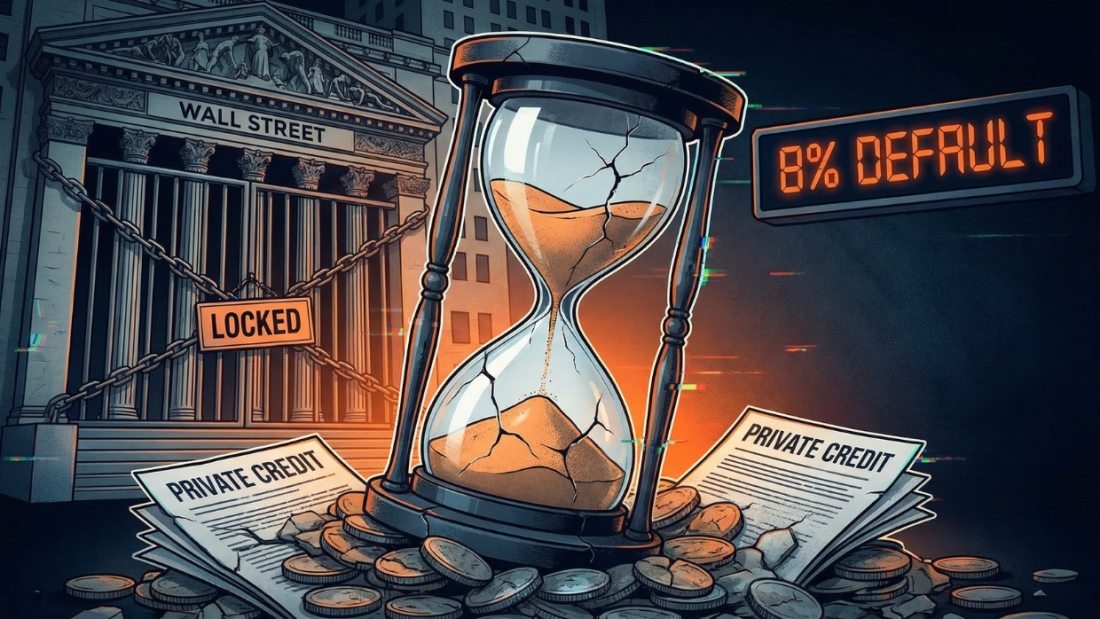
For years, Wall Street’s pitch to regular investors went something like this: “Why earn 4% in a savings account when you can earn 10%+ in private credit? It’s like lending money to companies, the yields are great, and you can get your money back whenever you want.” Millions of people bought it. Retail investors now hold an estimated $280 billion in private credit—nearly 13% of the market’s total assets, up from less than 1% in 2010. They were told it was a safe, high-yield alternative. A “democratization” of finance.
Now Morgan Stanley says default rates are heading to 8%. Over $265 billion in market cap has been wiped out from the major private equity firms. And when those retail investors tried to pull their money out? The funds locked the exits. This isn’t a correction. This is the part of the movie where people start realizing the door is bolted shut.
BREAKING: Ares Management capped withdrawals from its $10.7B private credit fund after redemption requests hit 11.6% in Q1
— Exec Sum (@exec_sum) March 24, 2026
Only $524M of $1.2B in requests were fulfilled
Apollo and BlackRock's HPS unit have made similar moves pic.twitter.com/KCcroSPsQz
The current private credit boom is unprecedented:
— The Kobeissi Letter (@KobeissiLetter) December 31, 2025
Private credit firms purchased or committed to buy a record $136 billion of consumer loans in 2025.
This includes credit cards, buy now pay later (BNPL), and other consumer finance products.
This is nearly +1,300% more than in… pic.twitter.com/MxixSZ71iF
The 8% Default Bomb
The catalyst everyone’s watching is Morgan Stanley’s projection that default rates in direct lending will hit 8%. That’s not a stress test. That’s their base case. The culprit is surprisingly specific: artificial intelligence is eating the software industry, and the software industry is private credit’s favorite borrower. Software companies were the darlings of private credit because they had predictable, recurring revenue. Lenders loved them. The result: software now makes up roughly 20% of direct lending portfolios, 26% of BDC portfolios, and 19% of private credit CLOs. That’s massive concentration in a single sector. Now AI automation is weakening these companies’ ability to service their debt. And the structural problems underneath make it worse:
- Sky-high leverage: Software loans carry the highest leverage and lowest interest coverage ratios of any major sector in private credit
- A maturity wall: 11% of direct lending software loans mature in 2027, another 20% in 2028—a refinancing wave hitting an industry that’s suddenly less creditworthy
- Bad valuations from the start: John Zito, co-president of Apollo Global Management, admitted openly that many software companies acquired between 2018 and 2022 were incorrectly valued
So you have overleveraged companies in a disrupted industry, with a mountain of debt coming due, and the guy running one of the biggest funds in the space says the original price tags were wrong. That’s not a risk factor, it is a confession.
$265 Billion in Smoke
The damage to the firms running these funds has been staggering. Fortune reported an historic selloff that wiped over $265 billion in market capitalization from the private equity sector. From their peaks:
Firm | Stock Decline from Peak |
Apollo | |
Blackstone | |
Ares | |
KKR |
These aren’t small caps. These are the titans of alternative investing, the firms whose names were supposed to be synonymous with smart money. When Blackstone loses nearly half its value, something structural has broken.
How They Sold This to Regular People
The marketing machine was relentless. Blackstone, Blue Owl Capital, KKR, and Ares Management worked with wealth management platforms to package private credit for individual investors, often highlighting the high yields while burying the illiquidity risk in the fine print. The vehicles they used:
- Business Development Companies (BDCs): Publicly traded companies that invest in the debt of small and mid-sized businesses. Attractive dividend yields, amplified by leverage. Easy to buy through a brokerage account.
- Interval Funds: Unlisted closed-end funds that offered daily share prices and periodic liquidity—typically allowing investors to redeem 5% to 25% of their shares quarterly. Sounds liquid. Isn’t.
- Wealth Management Products: Custom offerings from the big firms, sold through advisors who earned commissions placing clients in products most retail investors didn’t fully understand.
The pitch was always the same: stable, double-digit yields with the liquidity of a public market security. The problem is that was never true. The underlying loans are long-term, illiquid, and privately valued. The “liquidity” was a structural illusion that only worked as long as everyone didn’t try to use it at once. Everyone tried to use it at once.
The Exits Are Locked
When recession fears intensified—accelerated by the Iran conflict and the closure of the Strait of Hormuz—retail investors did what retail investors do in a panic: they tried to get out. What they found was that the door was bolted. The wave of redemption freezes reads like a crisis roll call:
- BlackRock capped withdrawals from its HPS Corporate Lending Fund at its 5% quarterly limit after investors tried to pull nearly double that
- Morgan Stanley’s North Haven Private Income fund limited withdrawals to 5%
- Cliffwater’s $33 billion Corporate Lending Fund saw redemption requests far exceeding its 7% discretionary limit
- Blue Owl Capital went further, permanently restricting withdrawals from a retail-focused fund and shifting to periodic payouts funded by asset sales
- Stonridge’s LENDX fund announced it would fulfill only 11% of redemption requests
- Blackstone’s BCRED faced a record 7.9% of assets in withdrawal requests—ultimately met only because Blackstone used its own capital and funds from senior leaders to cover them
Read that last bullet again. Blackstone had to use its own money to meet redemptions. That’s not a sign of a healthy market. That’s a sign of a bank run being papered over by the bank’s balance sheet.
You Can’t Even Short It
Here’s the part that should make retail investors furious: there is essentially no way for them to bet against this market. The underlying loans are private and don’t trade on an open exchange. You can’t buy puts. You can’t short sell.
JPMorgan and Goldman Sachs have recently started offering complex derivatives that allow hedge funds to gain short exposure to private credit. But for the average person holding a BDC or interval fund? Your only option is to sell your fund shares—assuming the redemption gates allow it, which, increasingly, they don’t. The big boys can hedge. You can watch.
The 2008 Echoes That Terrify Us
JPMorgan CEO Jamie Dimon and other prominent financiers are now openly drawing parallels to the 2008 crisis. The checklist is uncomfortably familiar:
Opaque valuations: Private credit loans are valued internally by the fund managers themselves—not by the market. This same opacity allowed mortgage-backed securities to look healthy right up until they weren’t.
Sudden corporate failures: Subprime auto lender Tricolor and auto-parts maker First Brands Group both went bankrupt—amid allegations of accounting irregularities. Dimon’s “cockroach” theory applies: when you find one, there are more behind the walls.
Contagion to the banking system: This is the big one. Private credit operates in the “shadows,” but it’s deeply intertwined with traditional banks. Banks provide essential credit lines to private credit funds. The Federal Reserve Bank of Boston found that private credit growth has been “funded largely by bank loans.” A wave of defaults or a simultaneous drawdown on these credit lines could transmit stress directly into the regulated banking system.
Reuters used the phrase “echo 2007 subprime warnings.” CNN asked outright: “Is the private credit boom the next 2008?” The New York Times editorial board ran an opinion piece titled “A Financial Crisis Is Coming. We Can See It From Here.”
The Iran Accelerant
The geopolitical timing couldn’t be worse. The Iran conflict and the effective closure of the Strait of Hormuz—choking 20% of the world’s oil supply—sent energy prices skyrocketing and recession fears into overdrive.
Analysts describe the combined effect as a “Davis Double Kill”: corporate earnings fall (because the economy is slowing) while asset valuations fall (because interest rates and risk aversion are rising). Both legs of the stool get kicked out at the same time. That’s the direct trigger for the retail panic and the subsequent run on private credit funds.
ZeroHedge and OilPrice.com are both running variations of the same headline: “How the Iran War Could Trigger a Global Credit Crunch.” They’re not wrong.
Everyone Can’t Fit Through the Exit
Here’s what happened: Wall Street built a $3 trillion market on illiquid loans, valued them internally, and then sold access to regular people using vehicles that promised liquidity that didn’t actually exist. The pitch worked as long as markets were calm, rates were low, and nobody tried to leave at the same time.
All three of those conditions are now gone.
Morgan Stanley says 8% defaults. Apollo’s co-president says the valuations were wrong from the start. $265 billion in market cap has evaporated. Funds are gating withdrawals. One fund is paying out 11 cents on the dollar in redemption requests. And retail investors—the people who were last to the party and were told this was safe—are trapped with no ability to hedge, no ability to short, and in many cases no ability to withdraw.
The parallels to 2008 aren’t something bears are manufacturing. Jamie Dimon is saying it. Reuters is saying it. The Federal Reserve Bank of Boston’s own research is showing the contagion pathways. The only people not saying it are the ones still collecting management fees on your locked-up money. Pay attention. This isn’t over. It’s starting.
Leave A Comment