

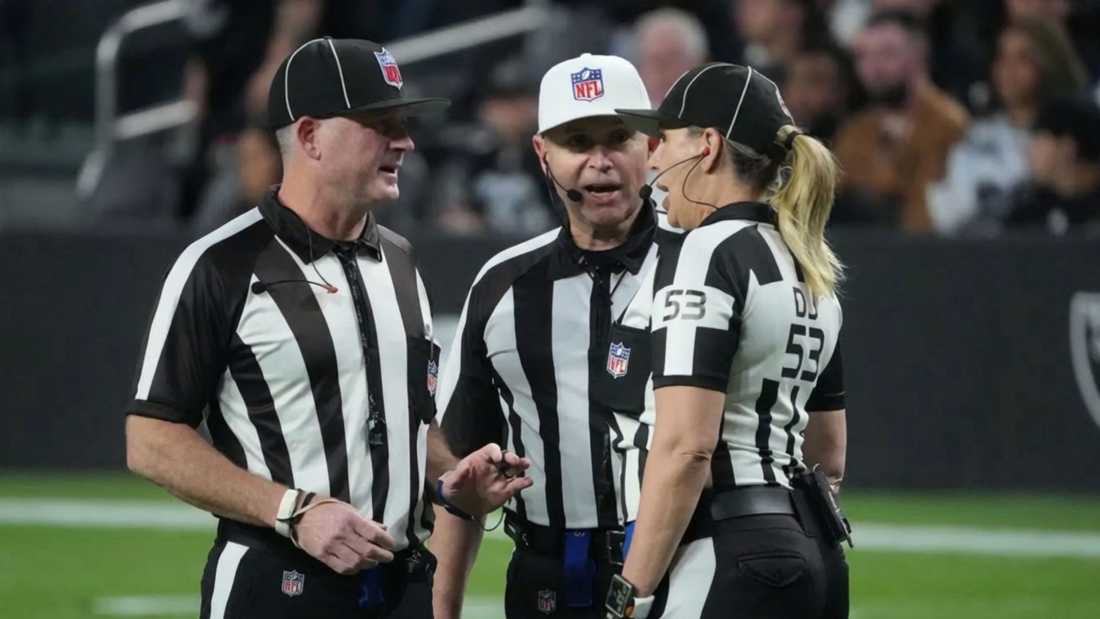
The person who threw the flag that cost a NFL team playoff seeding implications probably spent Monday morning reviewing a legal brief. The official who wiped out a game-changing interception might have had a financial planning meeting at 9 AM. The ref who called a phantom pass interference that gifted a team a win could’ve been grading exams the next day.
This isn’t a joke. An estimated 90% of the NFL’s 121 on-field officials hold other full-time jobs. The most-watched sport in America — a league that generated billions in revenue last year — is officiated by part-timers. Think about that.
The Lawyer, the Accountant, & the Aerospace Engineer Walk Into a Stadium
The NFL’s roster of officials reads less like a sports league payroll and more like a LinkedIn networking event. Clete Blakeman and Ron Torbert? Practicing attorneys. Shawn Hochuli? Financial advisor. Brad Allen? Non-profit CEO. Adrian Hill? Aerospace software engineer. Bill Vinovich? C.P.A. Retired refs? Even wilder. Ed Hochuli was a prominent civil litigator. Walt Coleman was a dairy farmer. Mike Carey founded a ski equipment company.
The rest of the roster is a mix of sales managers, high school administrators, college professors, and insurance agents. These are accomplished, intelligent people. Nobody’s questioning their credentials. The question is whether being a part-time official in a full-time league is a structure that still makes any sense.
They earn between $205,000 and $250,000 for what amounts to a 21-week season. That’s solid money. It’s also not “quit your day job” money when your day job is running a non-profit or arguing cases in federal court. Some officials report spending 30-50 hours per week during the season on game prep, film review, and travel — on top of their primary careers. They’re essentially working two demanding full-time jobs while being expected to make split-second calls that decide games watched by tens of millions of people. How is this a system anyone designed on purpose?
The Blown Calls Aren’t Random — They’re Structural
Fans love to scream about individual bad calls. But when you zoom out, the pattern tells a bigger story. The 2023-24 season alone was a highlight reel of officiating disasters:
- Lions vs. Cowboys (Week 16): Detroit scored what appeared to be a game-winning two-point conversion to tackle Taylor Decker. Officials nullified it, claiming Decker was an “ineligible receiver” — despite video showing he’d properly reported. Lions lost 20-19. Playoff seeding implications. Gone.
- Jets vs. Chiefs (Week 4): A late interception of Patrick Mahomes — the kind that swings a game — was wiped out by a questionable holding call on Sauce Gardner. Gardner and many observers felt the contact was minimal and inconsistent with how the game had been called to that point. Chiefs ran out the clock.
- Colts vs. Browns (Week 7): A pass interference penalty with 38 seconds left — on an overthrown, seemingly uncatchable ball — set up Cleveland’s game-winning touchdown. Final: 39-38.
- Bills vs. Giants (Week 6): A clear holding penalty in the end zone went uncalled in the final seconds. Giants lost 14-9 without getting the untimed down they deserved.
These aren’t ticky-tack calls in a blowout. These are season-altering mistakes in a league where legalized sports betting has made correct outcomes more important than ever. And here’s the part nobody talks about: the betting angle makes this exponentially worse. The NFL actively partners with sports books. It runs gambling advertisements during broadcasts. It profits directly from a system where the integrity of outcomes is the product. And then it lets the people responsible for those outcomes split their attention between the NFL and a day job as an accountant.
The rise of legalized sports betting hasn’t just raised the stakes for getting calls right — it’s fueled conspiracy theories and “rigged” debates that threaten public trust in the sport itself. When millions of dollars are riding on every game, “our refs are part-time” isn’t just a structural problem. It’s a credibility crisis. And the people making these calls spent the previous 48 hours working a completely different job.
Every Other League Figured This Out
Here’s the part that makes the NFL’s position indefensible: they’re the only major American sports league still running this model. The NBA has full-time referees. They attend mandatory training camps, participate in regular film sessions at league headquarters, and are evaluated on a game-by-game basis with a comprehensive grading system. NBA refs aren’t moonlighting as financial advisors. They’re professional officials, full stop.
MLB has full-time umpires. The umpiring system includes a structured minor league development pipeline where aspiring umpires spend years training before they ever step onto a major league field. It’s a career path, not a side hustle. The NHL has full-time officials. Even international soccer — a sport where officiating controversies are practically a cultural tradition — has invested heavily in professional referee development programs through FIFA and its member federations.
The NFL — the most-watched, most-bet-on, highest-revenue sport in America — is the outlier. It’s the one league that looked at the professionalization trend and said, “Nah, we’ll stick with the lawyers and the dairy farmers.”
And the results speak for themselves. The NBA’s full-time model produces refs who are graded, trained, and held accountable on a weekly basis during the season. When an NBA ref blows a call, the league issues a “Last Two Minute Report” acknowledging the error. The NFL doesn’t have an equivalent system — because you can’t hold part-time employees to full-time accountability standards without offering full-time support.
The comparison to MLB is even more damning. Baseball’s umpire development pipeline starts years before anyone reaches the majors. Aspiring umpires attend professional umpire school, work their way through the minor leagues, and spend years being evaluated before getting a shot at the big leagues. The NFL’s development system? Officiate college games on the side and hope someone notices.
The NFL’s “Solution”: Make 17 Guys Full-Time
The league knows it has a problem. Its proposed fix? Make 17 officials full-time — one per crew, specifically the crew chief. Seventeen. Out of 121. The idea is that these full-time chiefs would report to league headquarters weekly for intensive film review, then relay what they learn to their part-time crew members. The NFL also wants to shorten the three-month offseason “dark period” where they have zero contact with officials.
On paper, it’s a step forward. In practice, it’s a band-aid on a broken system.
You’re telling me that in a league worth tens of billions, the best you can do is professionalize 14% of your officiating staff? The crew chief can study film all week, but if the line judge who throws the flag on the crucial third-down play spent his morning reviewing insurance claims, that weekly headquarters visit isn’t fixing anything.
The Union Doesn’t Want It Either
Here’s where it gets down to business. The NFL Referees Association is “staunchly opposed” to the full-time proposal. The union is fighting against the creation of more dedicated, higher-profile jobs. Why? Because the vast majority of its members have built successful primary careers and don’t want to give them up. One source involved in the negotiations characterized the union’s position as wanting “full-time pay and part-time hours.”
The union’s executive director, Scott Green, argues that officials already work full-time hours during the season and should be compensated accordingly — without having to abandon their day jobs. He’s not entirely wrong. If refs are already spending 30-50 hours a week on NFL duties, calling them “part-time” is a fiction. But the answer isn’t to pretend the current system works. It’s to build a system that actually does.
Ok, so the refs want:
— Bruce Irons (@BruceIronsNFL) March 30, 2026
1. Ludicrous raises instead of merely awesome raises
2. No accountability for bad performance
3. Get playoff assignments for being old
I'm having a really hard time not siding with the league on this one. pic.twitter.com/3Szy8Rdj6W
Just in: NFL owners have approved a new rule that, if replacement refs are used this season, would allow the NFL Officiating Department in New York to correct clear and obvious misses that impact the game.
— Ari Meirov (@MySportsUpdate) March 31, 2026
So, for example, if the “Fail Mary” were to happen again with replacement… pic.twitter.com/nvxDqYzHv1
The Money Fight Behind the Scenes
The full-time debate is just one piece of a bitter labor dispute that could blow up the 2026 season. Here’s where the two sides stand:
Issue | NFL’s Position | NFLRA’s Position |
Annual raise | ||
Full-time officials | ||
Playoff assignments | Based on seniority | |
Accountability | Resist |
The current CBA expires May 31, 2026. The NFL is already hiring and training replacement officials — a pressure tactic that brings back haunting memories of the 2012 referee lockout and the infamous “Fail Mary” that embarrassed the league into settling. If you don’t remember the 2012 lockout, here’s the short version: the league tried replacement refs. It was a disaster. The breaking point came on a Monday Night Football game between the Packers and Seahawks when replacement officials awarded Seattle a game-winning touchdown on what was clearly an interception.
The play was so obviously wrong that it became a national punchline and forced the NFL back to the negotiating table within 48 hours. The league is betting it can use the threat of replacements as leverage without actually having to deploy them. But they said that in 2012, too. The NFLRA says its members are “substantially under-compensated” compared to full-time officials in other leagues. The NFL says they’re part-time employees asking for full-time money. Both sides have a point. Neither is asking the real question.
The Real Question Nobody’s Asking
Forget the CBA, the raises and the replacement refs. The question is this: Why does the most valuable sports league on Earth refuse to fully professionalize the people who enforce its rules? The NFL obsesses over every detail of player performance. It tracks speed, acceleration, heart rate, and sleep patterns. They fine players for untucked jerseys and unapproved cleats or even suspend guys for substance violations measured in nanograms. But the officials? The people who determine whether a touchdown counts, whether a drive continues, whether a season ends? They’re splitting their attention between the NFL and a day job as an accountant.
The league’s own proposal — 17 full-time refs out of 121 — is an admission that the current system doesn’t work. But it’s also an admission that the league isn’t willing to actually fix it. A real solution would look like what every other major sports league has already built: a fully professionalized officiating department with year-round training, structured career development, and the kind of accountability that comes from making this your one and only job.
Instead, the NFL is offering a half-measure that satisfies nobody, fighting with a union that doesn’t want change, and quietly training replacement officials in case the whole thing falls apart. As long as the person making a season-altering call is thinking about a legal brief or a sales target the next morning, the NFL will keep getting what it’s paying for: part-time attention from a part-time workforce, delivering full-time mistakes on the biggest stage in American sports. The blown calls aren’t the disease. They’re the symptom. And the NFL just showed you it has no intention of treating the cause.
Leave A Comment