

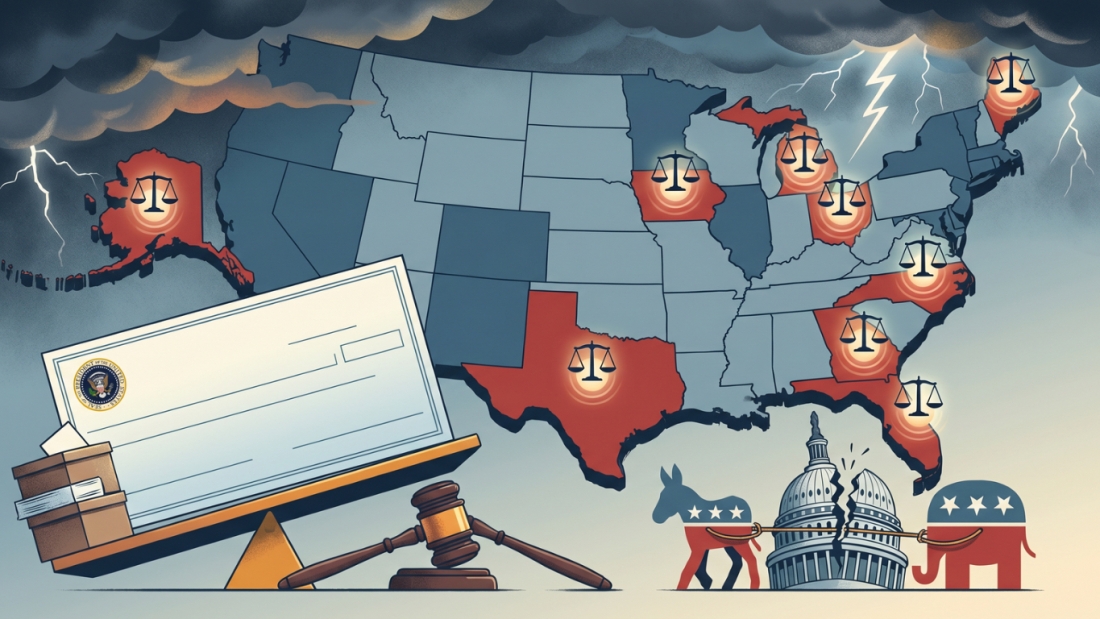
Here are the numbers that keep political strategist in Washington awake at night: Republicans hold the Senate 53-47. Democrats need a net gain of four seats to flip it. And right now, with gas prices running wild, inflation running at 3.3%, and the president’s economic approval sitting at a career-low 31%, the political environment looks like a Category 4 hurricane bearing down on the GOP’s majority.
That doesn’t mean Democrats will flip the Senate. It means the conditions exist for them to do it — and if they do, the last two years of Trump’s presidency look radically different. We’re talking about the difference between a president who can confirm judges, pass reconciliation bills, and shape foreign policy with a compliant upper chamber, and one who faces subpoenas, blocked nominees, and legislative gridlock. That’s the “blank check” framing you’re going to hear a lot between now and November, and it’s not hyperbole — it’s structural reality. So let’s break down the nine races that will decide it.
The National Environment: Everything Is Working Against the GOP
Before we get into individual states, you need to understand just how ugly the backdrop is for Republicans. Democrats lead the generic congressional ballot by roughly 6 points, a margin that historically correlates with significant seat losses for the party in power. Presidents with approval ratings below 50% see their party lose an average of 36-37 House seats in midterms. Trump is sitting in the mid-to-high 30s.
But the real story is the Iran war economy. Since the conflict began on February 28, the closure of the Strait of Hormuz — a chokepoint for 20% of the world’s seaborne crude — has sent energy prices spiraling. Consumer prices jumped 0.9% in March alone, driven by a 21.2% spike in gasoline costs. Airlines are tacking on fuel surcharges. Delivery fees are climbing. If you want the full picture of how much this Iran war is already costing us, we broke that down recently — and the numbers are staggering. A full 66% of Americans now say the president’s policies have worsened economic conditions. This is the water every Republican Senate candidate is swimming in. Some will drown. Some might not. Here’s who’s who.
The Democratic Offense: Where the Majority Gets Built
North Carolina — The Big One
If Democrats flip the Senate, there’s a very good chance it starts here. Former two-term Governor Roy Cooper is running against Michael Whatley, the former RNC chairman, for the open seat left by Thom Tillis’s retirement. And Cooper is running away with it — polling averages put him ahead roughly 49% to 39%, and the Cook Political Report recently shifted the race from Toss-up to Lean Democrat.
Cooper has $14.2 million in cash on hand. Whatley has $2.5 million. The Senate Leadership Fund — the GOP’s primary super PAC, which has committed a staggering $342 million across eight key states this cycle — has allocated $71 million to North Carolina alone. Experts say total spending here could approach $1 billion. That’s not a typo. A billion dollars, for one Senate seat in one state. Welcome to American democracy in 2026.
Maine — Collins’s Last Stand
Susan Collins is the only Republican senator representing a state Kamala Harris won in 2024, and the numbers are catching up to her. Democratic frontrunner Graham Platner leads Collins by 7 to 9 points in recent polling — margins that would be fatal if they hold through November. There’s a wrinkle, though: if Governor Janet Mills wins the Democratic primary instead, polls show a virtual toss-up. So the Democratic primary outcome here matters enormously. Collins has over $8 million in cash, and the SLF has committed $42 million to defend her. Republican-aligned groups have already outspent Democrats nearly 2-to-1 on advertising, with total spending already topping $37 million eight months before Election Day. That’s a lot of money to spend trying to hold a seat in a blue-leaning state with a national environment this toxic for your party.
Alaska — The Peltola Factor
Dan Sullivan probably wasn’t expecting the fight of his political life, but that’s what Mary Peltola is giving him. The former congresswoman — who made history in 2022 — is leading Sullivan 49% to 44% in recent polling and just posted a jaw-dropping $9 million fundraising quarter. Sullivan raised $2.1 million in the same period. The SLF has committed $15 million to backstop him, but in a state where independent-minded voters prize authenticity over party loyalty, Peltola’s crossover appeal is a genuine problem for Republicans. This is a race that, six months ago, barely registered on the national radar. Now it’s a legitimate flip opportunity. Alaska’s unique ranked-choice voting system adds another layer of unpredictability.
The Coin Flips: Where It Could Go Either Way
Michigan — The Three-Way Democratic Primary Problem
Gary Peters’s retirement turned Michigan into the cycle’s marquee open-seat battle. Republican Mike Rogers — the former congressman — is the likely GOP nominee, and the SLF is backing him with $45 million, their largest investment in any offensive opportunity. On the Democratic side, it’s a three-way dogfight between Rep. Haley Stevens, State Senator Mallory McMorrow, and physician Abdul El-Sayed.
Here’s the thing about Michigan: the Democratic nominee matters more than almost any other variable. Emerson College polling from January showed Stevens and McMorrow both leading Rogers by 3-5 points, while El-Sayed was dead even with him. In a state Trump won narrowly in 2024, a bruising primary that leaves the eventual nominee broke and bloodied could hand Republicans exactly the opening they need. This is the race where candidate quality will matter most.
Ohio — The Heavyweight Rematch
If you like your politics dramatic, Ohio delivers. Appointed Republican Jon Husted versus former Democratic Senator Sherrod Brown — two of the state’s most prominent politicians squaring off for J.D. Vance’s old seat. Polling averages show Brown clinging to a razor-thin lead, roughly 47% to 46%, and Cook recently moved the race from Lean Republican to Toss-up.
The SLF has made Ohio its single largest investment anywhere: $79 million. That tells you everything about how nervous Republicans are. Brown is a proven commodity in Ohio — he won three Senate terms in a state that has lurched rightward — and he enters the race with nearly $10 million in cash. But this is still a state Trump carried comfortably. Brown’s populist brand plays well here, but he’ll need every dollar and every ounce of crossover appeal to pull this off in a special election with potentially lower turnout.
The Defense: Holding What They Have
Georgia — Ossoff Under Siege
Jon Ossoff is the only Democrat defending a seat in a state Trump won in 2024, which makes him the most obvious target on the Republican hit list. The good news for Ossoff: he’s been preparing for this fight for years. He’s sitting on a $25.5 million war chest — a massive financial advantage over his Republican challengers. March polling shows him leading GOP frontrunner Mike Collins by 4 points and Derek Dooley by 8.
The GOP primary is another headache for Republicans. Collins, Carter, and Kemp-backed Dooley are all fighting for the nomination, and a messy primary could leave the eventual nominee weakened heading into the general. The SLF has allocated $44 million here, a clear signal that Republicans see Georgia as critical to their majority math. But Ossoff has proven before — in 2020 — that he can win a close race in Georgia when the fundamentals favor Democrats. And the fundamentals right now? They favor Democrats.
The Wild Cards: Races That Shouldn’t Be This Close
Texas — The Cornyn-Paxton Civil War
Texas is supposed to be safe Republican territory, but the GOP is too busy fighting itself to worry about Democrats. Incumbent John Cornyn is locked in a brutal primary runoff with state Attorney General Ken Paxton — polls show it essentially tied — and while they bludgeon each other, Democrat James Talarico has been quietly building a war machine. Talarico just posted a $27 million first-quarter fundraising haul, a national record. General election polls from Public Policy Polling and Impact Research show Talarico with a 1-2 point lead over both potential Republican nominees.
Is Texas actually going to flip? Probably not. But the fact that Democrats are even competitive here forces Republicans to spend resources they’d rather deploy in Michigan or North Carolina. In a cycle where every dollar matters, that’s a strategic win regardless of the final result.
Iowa — Not As Safe As It Looks
Joni Ernst’s retirement created an open seat that Republicans should hold comfortably — Iowa went for Trump by double digits in 2024. But Rep. Ashley Hinson leads Democrat Zach Wahls by just 3 points in early polling, a margin that’s uncomfortably tight for a state this red. The SLF is taking no chances, pouring $29 million into Iowa to bolster Hinson. That’s $29 million in a state Republicans shouldn’t have to worry about — and every dollar spent in Iowa is a dollar notspent in North Carolina or Ohio.
Florida — The Long Shot
The special election to fill Marco Rubio’s seat is rated Likely Republican, and appointed incumbent Ashley Moody leads in most polls. But Alexander Vindman — yes, that Vindman — has made the race more interesting than it has any right to be. One EDGE Communications poll showed Moody’s lead over Vindman at just a single point. Florida has trended red in recent cycles, and Moody starts with significant advantages, but in a wave environment, “Likely R” races have a way of becoming competitive in the final stretch.
Deciding at the Ballot Box
Here’s the scorecard as it stands. Democrats have clear pickup opportunities in North Carolina, Maine, and Alaska. They have a real shot in the Michigan and Ohio coin flips. They need to hold Georgia. And they’ve got long-shot disruption plays in Texas, Iowa, and Florida that force Republicans to spread their $342 million war chest thinner than they’d like.
The Iran war economy has reshuffled this entire map. Six months ago, Republicans were confident about holding the Senate. Now, with 3.3% inflation, $4.16 gas, and a president whose economic approval is lower than his golf handicap, every race has shifted leftward. The Washington Post reported that even Republican strategists privately acknowledge the environment has fundamentally changed. Politico noted that some GOP operatives fear Iran will cost them the majority regardless of whether a ceasefire materializes.
Does any of this mean Democrats will flip the Senate? No. There’s a reason Republicans have $342 million loaded up — money can compensate for a bad environment, and they’ve got more of it. Candidate quality, turnout, and the unpredictable dynamics of nine individual state races all matter. But the structural conditions for a Democratic takeover haven’t been this favorable since 2006.
So when you hear “blank check” this fall, understand what’s actually being decided. It’s not just which party controls the gavel. It’s whether the president spends his final two years governing with a rubber stamp or negotiating with a wall. These nine races will answer that question — and right now, not a single one of them is a sure thing for anybody.
Leave A Comment