

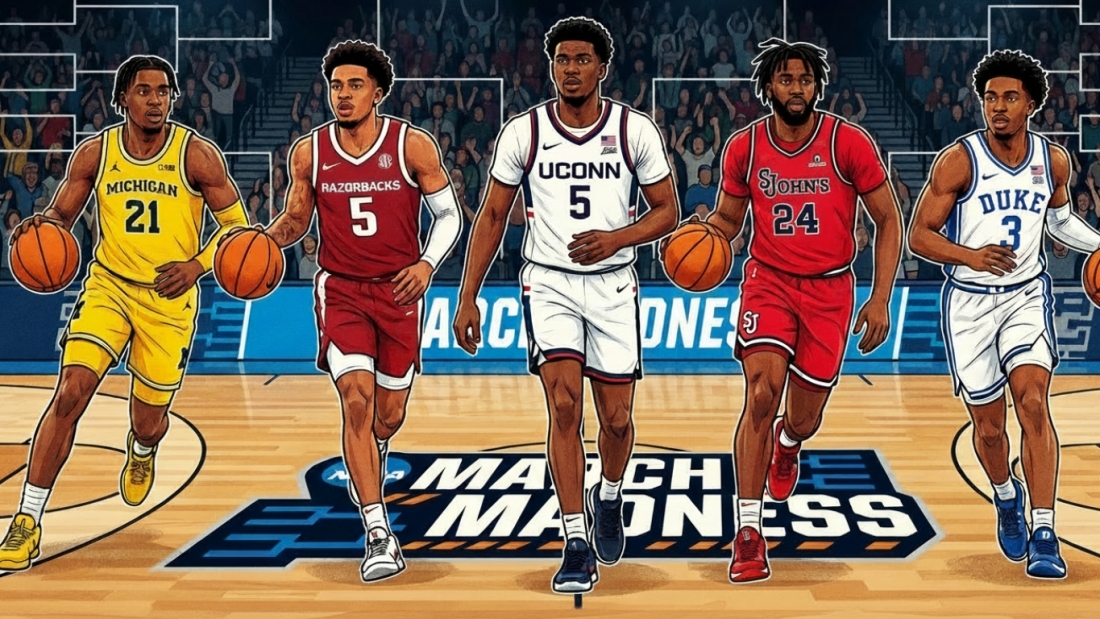
The NCAA Tournament is the greatest pressure cooker in sports. For three weeks, every game is an elimination game, every possession is scrutinized, and every player has a chance to rewrite their future. Some guys wilt under the lights. Others just have a good run. But a select few don’t just play well. They don’t just hit a few big shots.
They fundamentally alter their draft stock and, in the process, make themselves millions. This isn’t about the guys who were already lottery picks. This is about the players who walked into March as question marks and walked out as exclamation points. They answered every doubt, showcased new dimensions to their game, and proved they weren’t just college stars, but legitimate NBA prospects. Here are five players who used the 2026 NCAA Tournament to cash in.
Morez Johnson Jr.
Before March, Morez Johnson Jr. was the guy you appreciated but didn’t necessarily covet. A high-energy, defensive-minded big for a loaded Michigan team. He was the engine, the glue guy, the lunch-pail worker. All the clichés that get you a nice college career but not a guaranteed NBA contract. Then the tournament started. And Johnson decided to stop being a role player and start being a force.
Let that marinate. In the first round against Howard, Johnson put up 21 points and 10 rebounds. Big deal, right? He did it on perfect 8-for-8 shooting from the field. He became only the fifth player in NCAA Tournament history to post a 20/10 game with 100% shooting. That’s not a good game. That’s a statement of intent.
He bookended that performance with a 12-point, 10-rebound double-double in the National Championship game, anchoring Michigan’s defense against a dominant UConn squad. For the tournament, he averaged 12.8 points and 8.0 rebounds, but the raw numbers don’t tell the story. It was the how. He was a defensive chameleon, switching onto smaller players on the perimeter, bodying up bigs in the post, and rotating with perfect timing to erase shots at the rim. He was a vacuum on the glass and a ruthlessly efficient finisher on offense, shooting 62.8% for the tournament.
The NBA Translation: Johnson is the prototypical modern big. He doesn’t need plays called for him to impact the game. He’s a low-usage, high-impact player who can thrive as a roll man, a defensive anchor, and a relentless rebounder. Think a more athletic, switchier Al Horford. He’s the kind of player who fits on any roster and makes a winning impact from day one. Before the tournament, he was a fringe second-rounder. Now? USA TODAY has him going #26. That’s the difference a few good weeks can make.
Darius Acuff Jr.
Everyone knew Darius Acuff Jr. could score. The kid was the SEC Player of the Year and a walking bucket. But the questions were loud. Was he a real point guard? Could he run a team? Or was he just a score-first combo guard who would struggle to adapt to the NBA? Here’s the thing — Acuff heard the whispers. And he used the tournament to silence them.
Leading Arkansas to the Sweet 16, Acuff didn’t just score. He orchestrated, averaging a staggering 29.3 points and 5.3 assists per game in the tournament, including a 36-point explosion against High Point. He wasn’t just hunting his own shot; he was manipulating defenses, making the right read in the pick-and-roll, and setting up his teammates for easy looks.
The NBA Translation: The ability to create your own offense is the most valuable currency in the NBA. Acuff has it in spades. He’s a three-level scorer with a lightning-quick first step and a deep bag of tricks. The tournament proved he’s more than just a scorer; he’s a legitimate offensive engine. The concerns about his defense are still there, but you can’t teach the kind of offensive firepower he possesses. Before the tournament, he was a mid-first-rounder. Now, he’s a creeping into a spot in the lottery.
Zuby Ejiofor
In a draft class full of offensive-minded players, Zuby Ejiofor is a throwback. A 6’9” forward from St. John’s whose primary value comes from his defense, his motor, and his willingness to do the dirty work. He was the BIG EAST Defensive Player of the Year, but his offensive game was seen as a major liability. The tournament didn’t magically turn him into a scorer. But it did show that his defense is so elite, it might not matter.
Ejiofor was a one-man wrecking crew. He averaged 16.3 points, 9.3 rebounds, and 2.3 blocks in the tournament, leading St. John’s to the Sweet 16, including an 18-point, 9-rebound game against Kansas and a 17-point, 8-rebound effort against Duke. He was switching onto guards, protecting the rim, and dominating the glass against top-tier competition.
The NBA Translation: Ejiofor is a plug-and-play defensive specialist. He’s a high energy player whose value isn’t in his box score stats, but in his ability to disrupt everything the other team wants to do. He can guard all five positions, he’s an elite rebounder, and he plays with a relentless motor. Every contender needs a player like Zuby Ejiofor. He’s not going to be a star, but he’s going to be a vital role player on a winning team for a long time. The tournament solidified his draft status and likely earned him a guaranteed contract.
Tarris Reed Jr.
Tarris Reed Jr. was supposed to be an anachronism. A big-bodied, back-to-the-basket center in an era of pace and space. He was a solid college player, but his game didn’t seem to fit the modern NBA. Then came the Furman game. In the first round of the tournament, Reed put up a stat line that looks like a typo: 31 points and 27 rebounds. He single-handedly outrebounded the entire Furman team. It was the first 30/20 game in the tournament since 1968. That’s not just a good game. That’s a history-making performance. Reed rode that momentum all the way to the National Championship game, averaging 21.8 points and 13.5 rebounds for the tournament. He was a dominant force in the paint, a black hole on the defensive glass, and an immovable object in the post.
The NBA Translation: Reed proved that there’s still a place for a dominant interior presence in the NBA. He’s not going to be a floor-spacing big, but he’s going to be an elite rebounder, a powerful finisher, and a guy who will assume the role as the anchor on defense when on the floor. Before the tournament, he was a second-round pick at best. Now, he’s a legitimate first-round prospect.
Isaiah Evans
Isaiah Evans was supposed to be a year away. A talented but inconsistent sophomore on a loaded Duke team. He had the size and the shooting stroke, but he hadn’t put it all together yet. The Sweet 16 against St. John’s was his coming-out party. Evans exploded for 25 points, looking every bit the part of a future lottery pick. He was pulling up from deep, attacking the rim, and creating his own shot with a fluidity that wasn’t there during the regular season. He averaged 16.3 points for the tournament, but it was the way he scored that had scouts drooling.
The NBA Translation: Evans is the prototype of the modern NBA wing. He’s 6’6” with a high release and a smooth shooting stroke. He can score at all three levels, and he has the size and athleticism to be a plus defender. He’s a more fluid and less ball-dominant Brandon Ingram. In a league that is desperate for big wings who can shoot, Evans is a perfect fit. The tournament accelerated his timeline and turned him from a 2027 prospect into a potential 2026 first-round pick.
By the Numbers: The March Madness Bump
Player | Team | Pre-Tournament Projection | Post-Tournament Projection | Key Tournament Stat |
Morez Johnson Jr. | Michigan | Late 2nd / Undrafted | Late 1st Round | 21 PTS, 10 REB, 100% FG vs. Howard |
Darius Acuff Jr. | Arkansas | Mid 1st Round | Top 10 | 29.3 PPG, 5.3 APG in the tournament |
Zuby Ejiofor | St. John’s | 2nd Round / Undrafted | Solid 2nd Round | 16.3 PPG, 9.3 RPG, 2.3 BPG in the tournament |
Tarris Reed Jr. | UConn | 2nd Round | Late 1st Round | 31 PTS, 27 REB vs. Furman |
Isaiah Evans | Duke | 2027 Draft Prospect | Potential 1st Round | 25 points in the Sweet 16 vs. St. John’s |
The Takeaway
The NBA Draft is an inexact science. Teams spend millions on scouting, analytics, and pre-draft workouts. But sometimes, the best indicator of future success is how a player performs when the pressure is at its highest. These five players didn’t just have a good tournament. They showed the world who they are. They answered the questions, quieted the doubters, and proved they belong at the next level.
And in the process, they made themselves a lot of money. That’s not a hot take, it is just business.
Leave A Comment