

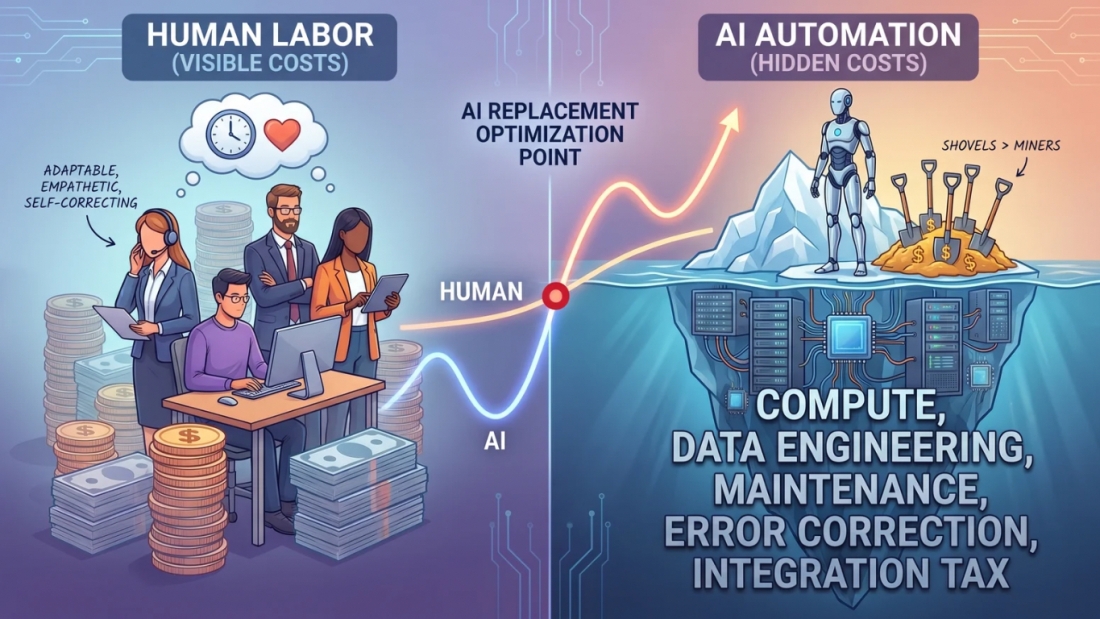
All of these companies want to fire their workforce and replace it with AI. The math says most of them shouldn’t. The pitch is seductive. An AI agent doesn’t call in sick, doesn’t negotiate a raise, and doesn’t need health insurance. It works around the clock. It scales on demand. And in the boardrooms of Fortune 500 companies and scrappy startups alike, the same calculation is being scribbled on the same whiteboard: replace the humans, cut the costs, watch the margins soar. But there’s a number nobody is putting on that whiteboard. It’s the number where the cost of running AI meets—and then exceeds—the cost of the person it replaced. Call it the AI Replacement Optimization Point. And right now, for the majority of businesses, that point is a lot closer than they think.
The Shovels Cost More Than the Miners
The narrative around AI-driven labor replacement has been built on a fundamental assumption: that AI is cheap. It isn’t. Bryan Catanzaro, Vice President of Applied Deep Learning at Nvidia—the company that literally builds the hardware powering the AI revolution—has said the quiet part out loud. According to Fortune, Catanzaro stated that “the cost of compute is far beyond the costs of the employees” on his own team. The man selling the shovels in the gold rush is telling you the shovels cost more than the miners.
He’s not alone. Uber’s CTO revealed the company burned through its entire 2026 AI budget ahead of schedule, simply because the token costs of its AI coding assistants spiraled out of control. Global IT spending is projected to hit $6.31 trillion in 2026, a 13.5% surge driven largely by AI infrastructure. We’ve written before about how major AI companies themselves can’t turn a profit—the gap between capital expenditure and revenue is an industry-wide crisis. The economics are broken at the top. The question is whether they’re any better at the bottom.
A 2024 MIT study tried to answer that question by examining the economic viability of AI across 800 occupations. The result: AI automation was economically attractive in only 23% of the roles evaluated. In the other 77%, keeping the human was simply cheaper. But averages hide the real story. The optimization point isn’t one line—it’s a map, and the terrain is wildly different depending on where you stand. Let’s walk the map.
Where AI Already Wins: Customer Service at Scale
If there’s one function where AI has decisively crossed the optimization point, it’s high-volume customer support—but only when deployed correctly. Consider a mid-sized e-commerce company fielding 50,000 support tickets a month. A traditional fully human team to handle that load—five agents at a loaded cost of roughly $56,500 each (salary, benefits, management overhead, workspace)—runs about $282,500 a year. Now compare a hybrid model: an AI chatbot handles the front line—password resets, order tracking, FAQ answers—while two human agents take the complex escalations. A mid-market AI platform costs around $15,000 a year. Two agents cost roughly $105,400. Total: about $120,400, a savings of up to 63%.
That’s a real number, and it’s why companies like Klarna made headlines reporting that their AI assistant handled two-thirds of customer service chats within its first month. But notice the fine print: the model that works is hybrid. The chatbot handles the repetitive 70%. Humans handle the 30% that requires judgment, empathy, or an actual decision. Companies that tried to go fully automated—removing the human layer entirely—learned the hard way that an AI confidently giving a wrong answer is more expensive than a slow human giving the right one. McDonald’s discovered this when it shut down its AI drive-thru experiment after the system repeatedly botched orders, generating customer frustration and viral social media mockery that no cost savings could offset.
The optimization point in customer service is real, but it has a ceiling. Push past it—try to eliminate the human entirely—and the costs come roaring back as error correction, brand damage, and customer churn.
Where AI Is Bleeding Money: Code Automation
Now walk to the other side of the map. Software development is supposed to be AI’s strongest use case. GitHub Copilot, AI code review tools, automated testing suites—the promise is that a developer with an AI assistant becomes a 10x engineer.
The reality is more complicated, and Uber’s budget implosion is the canary in the coal mine. Every time a developer prompts an AI coding assistant, tokens are consumed. A complex code generation request can burn through thousands of tokens in seconds. Multiply that across hundreds of engineers working eight hours a day, and the meter runs hot. Uber didn’t blow its AI budget on a single moonshot project. It bled out through a million small cuts—tokens consumed by routine coding queries across its engineering organization.
The Hidden Costs
The hidden costs go deeper. MIT Sloan Management Review found that AI-generated code produced an eightfold increase in duplicated code blocks, leading to lower overall code quality and ballooning technical debt. That means companies aren’t just paying for the AI—they’re paying for the cleanup. Code review cycles get longer. Bug rates creep up. Maintenance costs compound quarter over quarter. One study by DX estimated that when you factor in the integration overhead, context-switching costs, and quality degradation, the true cost of AI coding tools can exceed the productivity gains for teams that aren’t carefully managing adoption.
GitHub Copilot’s own pricing tells the story in miniature. At $19 per user per month for the business tier, it sounds trivial. But for a 500-person engineering department, that’s $114,000 a year before a single line of AI-generated code has been reviewed, debugged, or integrated. Stack on the 25-35% “integration tax” that comes with fitting AI tools into existing development workflows, and the bill starts to look less like a shortcut and more like a second mortgage.
The Hidden Line Items Nobody Budgets For
Across every use case, the same pattern emerges: the sticker price of AI is a fraction of the real cost. A modest on-premise AI cluster runs $500,000 to $1 million. Cloud computing for a mid-sized model costs $50,000 to $500,000 a year. Data engineering—collecting, cleaning, labeling, and building the pipelines that feed your models—eats 25% to 40% of your total AI budget before the system produces a single useful output. Then there’s model drift—the gradual decay in accuracy as the real world changes around a static model—which demands continuous retraining at a 15% to 30% annual maintenance overhead. And none of this runs itself. The machine learning engineers and data scientists required to keep the lights on command salaries of $200,000 to over $500,000 a year.
Compare that to a mid-level employee with a $70,000 base salary. Factor in benefits, taxes, recruitment, training, and overhead, and the total lands between $125,000 and $185,000. That’s not cheap. But that employee adapts. They handle exceptions. They read the room. When the AI hallucinates—and it will—a human cleans up the mess. IBM learned this lesson at scale when its Watson AI deployment at MD Anderson Cancer Center exceeded its budget by millions and never integrated into clinical workflows. The AI couldn’t replace the doctors. It couldn’t even reliably assist them.
The numbers at the macro level are damning. Beam AI reports that 42% of corporate AI initiatives produce zero ROI. The RAND Corporation estimates over 80% of AI projects fail outright—double the failure rate of traditional IT projects. These aren’t moonshots at experimental startups. These are enterprise deployments at companies with deep pockets and dedicated teams.
Where the Line Is Moving
This is not an anti-AI argument. It’s an anti-hype argument. The optimization point is real, and in specific domains it’s already been crossed. A senior content creator using an AI writing assistant at roughly $2,400 a year can draft at the pace of a full team, with savings approaching 54%—provided a human editor ensures quality and brand alignment. AI-powered sales tools can multiply a rep’s outbound call volume by 6 to 11 times, cratering the cost per lead.
For data entry, automation can deliver 23% savings over three years, though the upfront implementation cost—often north of $50,000—means the payoff isn’t immediate. And the trajectory favors AI. Inference costs are projected to plummet by over 90% in the next four years as hardware improves and models become leaner. As we’ve discussed in covering AI’s physical infrastructure bottleneck, the constraints aren’t just computational—they’re geological and electrical. But those constraints are being addressed, and when they are, the optimization point will shift dramatically.
Replacement Will Not Be Easy
The AI Replacement Optimization Point is not a universal constant. It’s a moving target, shaped by the task, the industry, the scale of operations, and the maturity of the technology. Today, for the majority of business functions, the point has not been reached. The total cost of deploying and maintaining AI still exceeds the total cost of employing a human being.
The smartest companies aren’t asking “How do we replace our people with AI?” They’re asking “Where has the optimization point already been crossed, and where is it coming next?” That question—precise, unsentimental, grounded in math instead of hype—is the difference between an AI strategy and an AI expense.
Leave A Comment