

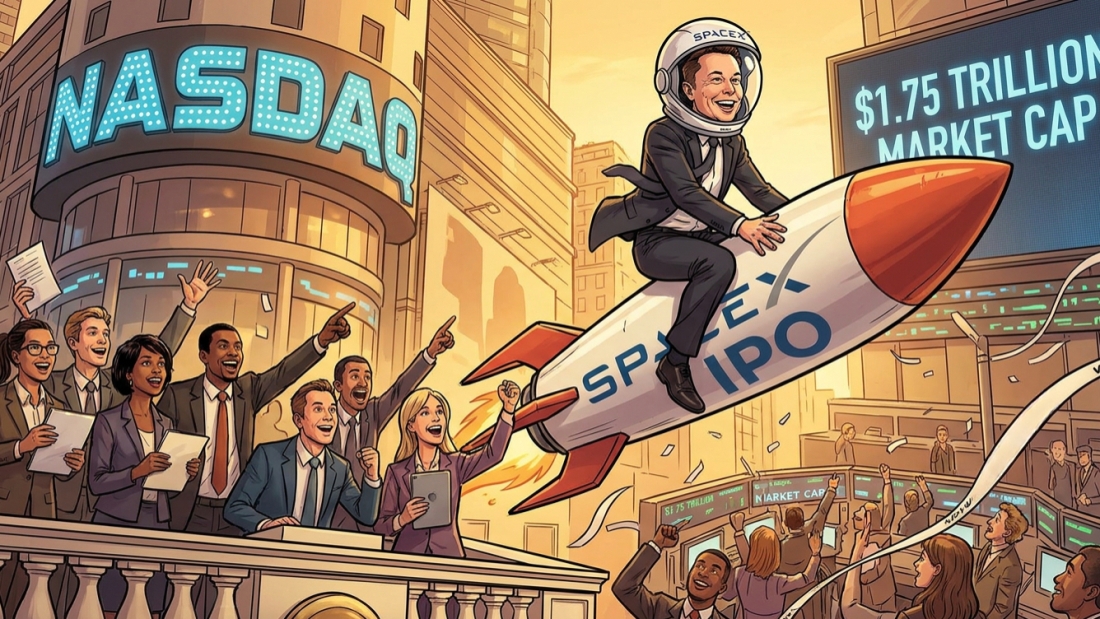
$1.75 trillion. That is the market capitalization assigned to SpaceX, ticker SPCX on its first day as a publicly traded company. It is a number larger than the GDP of Canada. It is roughly 94 times the company’s annual revenue. And it sits atop a business that posted a $4.9 billion GAAP net loss last year. The financial press is calling it the largest IPO in history, and they are not wrong. But the real story isn’t what happened on the Nasdaq floor this morning. The real story is what happened in the years before — and what happens in the months after.
Because for the retail investors who woke up early today, scrambled to place orders through Robinhood and Fidelity and SoFi, and managed to snag a few shares at $135 apiece, the SpaceX IPO is a beginning. For the people this article is about — the founders, the early believers, the pension fund managers who wrote nine-figure checks when this company was still blowing up rockets. Today is just the day their spreadsheets got a public price tag. They have been winning for years. The question is whether those wins are real, or whether they are the most spectacular collection of unrealized gains in financial history. Let’s see who the biggest winners are.
The IPO by the Numbers
The sheer scale of this offering demands context. SpaceX raised $75 billion by selling approximately 555.6 million shares at a fixed price of $135/share — a “take-it-or-leave-it” pricing structure that dispensed with the traditional roadshow range-building entirely. The offering was all-primary: every dollar raised goes to the company, not to existing shareholders cashing out. Nobody sold a share today. Remember that.
Demand was staggering. Total orders exceeded $250 billion — nearly 4x oversubscribed. Retail investors alone placed over $70 billion in orders, despite having their allocation cut from roughly 30% to the low 20s as institutional demand overwhelmed the book. Brokerages implemented anti-flipping restrictions — a polite way of saying they don’t trust retail not to dump shares within the hour.
To put the $75 billion raise in perspective: Saudi Aramco’s 2019 IPO raised $25.6 billion. Alibaba’s raised $25 billion in 2014. SpaceX tripled both of them. And the initial float? Approximately 4% of total market cap — absurdly tight, meaning the price you see today is being set by a sliver of available shares while the overwhelming majority sit locked up. This is not a broad market discovery mechanism. It is a tightly managed supply environment — and that matters for how you read the price.
The underwriters — Goldman Sachs, Morgan Stanley, JPMorgan Chase, and Bank of America — will collect enormous fees. SpaceX will get its $75 billion. And the early investors will get something arguably more valuable: a public price against which to mark their positions.
The Winner’s Circle: Elon Musk
Start with the obvious. Elon Musk owns approximately 42% of SpaceX and controls roughly 85% of the voting power through a dual-class share structure that allows the company to bypass certain Nasdaq governance requirements, including mandates for full board independence. At a $1.75 trillion valuation, his equity position is worth approximately $735 billion on paper.
Read that again. Seven hundred and thirty-five billion dollars. In a single company. It is the largest paper position ever created by an IPO, and it belongs to a man who, in 2008, was scraping together personal loans and burning through the last of his PayPal fortune to keep this company alive. He founded SpaceX in 2002 with $100 million of his own money. He maintained his controlling stake through two decades and 30+ funding rounds via the dual-class structure that governance hawks loathe and founders worship.
The Musk AI Merger
In February 2026, he folded his AI company xAI into SpaceX in an all-stock merger, further consolidating his empire under one roof. The combined entity now operates three business segments; Connectivity (Starlink), Space (launch/Starship), and AI (xAI/Grok) — and Musk sits atop all of it.
But here is the caveat that matters more than anything else in this article: Musk is subject to a 366-day lockup. He is explicitly excluded from the early-release provisions available to other insiders. He cannot sell a single share until June 2027 at the earliest. And even then, selling 42% of a $1.75 trillion company would be so enormously market-moving that the practical liquidity of his position is a fraction of its mark-to-market value. The $735 billion is real in the sense that it exists on a balance sheet. It is not real in the sense that anyone could actually extract $735 billion from this position without cratering the stock. Musk is the richest person in the world, by a wide margin, on paper. Whether he can ever meaningfully monetize this position is a different question entirely.
The Quiet Fortunes: Early Investors
Behind the Musk headlines, a constellation of early believers are sitting on positions that would be headline-dominating in any other context. Here are the biggest.
Antonio Gracias & Valor Equity Partners
This is probably the single most important name most people have never heard in this story. Gracias, a long-time close friend of Musk and former Tesla board member, runs Valor Equity Partners, a Chicago-based private equity firm. Through Valor-affiliated entities, he controls over 500 million shares of Class A stock approximately 7.2%–7.3% of the pre-IPO share count — making him the second-largest individual shareholder after Musk. At the IPO valuation, that position is worth an estimated $106 billion or more. His paper gains alone exceed $60 billion according to The Information.
How did he get here? In 2008, when SpaceX was on the brink of bankruptcy after its third consecutive Falcon 1 failure, Gracias personally loaned Musk $1 million to keep the company alive. A million-dollar bet on a friend. That relationship and the Valor investments that followed has produced one of the most extraordinary returns in private equity history.
There is, however, a governance wrinkle worth noting. SpaceX’s S-1 filing revealed that Valor-affiliated entities hold approximately $20 billion in equipment lease agreements with SpaceX and xAI subsidiaries, deals that auditors classified as debt rather than operating leases. Gracias sits on SpaceX’s board and will serve on the compensation and nominating committees post-IPO. Corporate governance experts have raised questions about the arm’s-length nature of these transactions. Whether you view this as savvy relationship investing or something more complicated depends on your tolerance for conflicts of interest.
137 Ventures
Justin Fishner-Wolfson, the leader of 137 Ventures represents the purest expression of conviction investing in this entire story. Fishner-Wolfson, a former investor at Founders Fund, founded 137 Ventures in 2010 around a simple thesis: as high-growth tech companies stayed private longer, employees holding illiquid equity would need someone to buy their shares. So he became that buyer. He wrote his first SpaceX check around 2010–2011 and has written roughly two dozen more in the years since, steadily accumulating shares through secondary market purchases and authorized participation in SpaceX tender offers.
As of the IPO date, Fishner-Wolfson has not sold a single SpaceX share. Not one. The New York Times described him as sitting “at the center of a multibillion-dollar payout”, and 137 Ventures now manages over $6 billion in assets. The secondary market strategy is less glamorous than leading a Series A — no TechCrunch announcement, no board seat, no logo on the pitch deck. But in terms of pure returns, it may be the most successful venture position of the decade.
Luke Nosek – Nosek Capital
Founders Fund is the PayPal Mafia chapter of this story. Nosek, a co-founder of PayPal who served alongside Musk and Thiel, went on to co-found Founders Fund in 2005 and led the firm’s first institutional investment in SpaceX in 2008. He then left Founders Fund in 2017 to co-found Gigafund — an investment firm created specifically to support SpaceX and other capital-intensive ventures. He still sits on SpaceX’s board. Through direct holdings and Nosek Capital, he controls nearly 33 million shares worth an estimated $6 billion. In almost any other context, creating a fund to concentrate your bets on a single company would be considered reckless. In this context, it looks like prophecy.
Meanwhile, Founders Fund itself — Peter Thiel’s vehicle — holds approximately 3.5% of the combined entity, with paper gains exceeding $60 billion on an original $20 million investment in 2008. If those numbers hold, it represents a return multiple north of 3,000x — one of the greatest venture capital outcomes in history, period.
Ontario Teachers’ Pension Plan
In June 2019, the OTPP invested approximately US$220 million in SpaceX as the inaugural deal for its newly established Teachers’ Innovation Platform. It was a calculated bet by a pension fund — the kind of institution not typically associated with Silicon Valley moonshots.
At the IPO valuation, that position is estimated to be worth as much as US$11.6 billion — a return multiple of approximately 52.7x. A Canadian teachers’ pension fund outperforming every hedge fund on Earth on a single investment. The OTPP made follow-on investments in subsequent years, meaning total holdings may exceed even that $11.6 billion figure, and its Teachers’ Venture Growth division returned 30% in 2025 largely on the strength of SpaceX’s rising private valuations. CIO Gillian Brown has indicated the fund may maintain its position rather than sell into the IPO.
For perspective: the same pension plan wrote down a US$95 million investment in FTX in 2022. The SpaceX position covers that loss roughly 122 times over. Sometimes the house wins.
The Institutional Machine
Beyond the named individuals and the pension fund, the institutional machinery of Silicon Valley and global finance is sitting on an astonishing pile of paper wealth.
Alphabet invested approximately $900 million in SpaceX’s 2015 Series F round alongside Fidelity. That position, diluted through subsequent rounds and the xAI merger to roughly 5%–6.11%, is now estimated to be worth $87 billion to $107 billion — a return of approximately 100x on the original investment. For a company of Alphabet’s size, this crystallizes what analysts call a “hidden” balance sheet asset that could theoretically fund years of AI capital expenditure.
Sequoia Capital, which entered during the 2021 Series J round with approximately $2 billion in total investment, now holds roughly 1.5% of the combined entity — a position valued at over $20 billion, roughly a 10x return. Fidelity holds SpaceX across multiple funds, with its Contrafund alone holding over $8 billion as of mid-2026. Andreessen Horowitz led the 2023 $750 million round at a $137 billion valuation and is now set for “record returns” per Bloomberg. Baillie Gifford holds exposure through multiple trusts including Scottish Mortgage and Edinburgh Worldwide.
Hedge funds D1 Capital Partners and Darsana Capital Partners are sitting on estimated paper profits of $15 billion to $20 billion combined. The pattern is consistent: the earlier you got in, the more spectacular the numbers. A 2015 investor is looking at roughly 146–175x. A 2019 investor at ~57x. A 2021 investor at ~24x. Even those who bought in the 2023 round at $137 billion are sitting on approximately 12.8x in less than three years. The entire venture capital ecosystem’s best-performing fund of the decade might simply be “the one that had the most SpaceX.”
Paper Wealth vs. Real Wealth
Every single number in this article — the $735 billion, the $106 billion, the $11.6 billion, the $60 billion, all of it — is paper wealth. Mark-to-market valuations based on a price set by a 4% initial float on day one of public trading. Nobody profiled above has sold a share. Nobody has “made” anything. They hold positions. Positions can change.
SpaceX’s lockup structure is unusual and tiered. Rather than the standard 180-day cliff, insiders will be allowed to sell in staggered tranches: 20% after Q2 2026 earnings, an additional 10% if the price sustains 30% above IPO for a specified period, then 7% chunks every few weeks from day 70 through day 135, another 28% after Q3 earnings, with all remaining shares unlocking at 180 days post-IPO around December 2026. Reuters described this approach as turning “a tsunami into constant pounding” — spreading the selling pressure but creating months of persistent uncertainty.
Post Lock-Up Period
History is not kind to post-lockup price action. When Palantir’s lockup expired, the stock dropped 13% in a single session. Uber hit all-time lows on its lockup expiration date. SpaceX’s staggered structure may mitigate the cliff effect, but it introduces something potentially worse: a slow, grinding six-month window where new supply hits the market every few weeks. With a tight 4% float, even modest insider selling could produce outsized volatility. The counterarguments exist. Nasdaq-100 inclusion — potentially as early as 15 trading days post-IPO — would force index funds to become mandatory buyers. Ron Baron and BlackRock have publicly stated intentions to hold or increase positions. Those are real factors — but so are the structural supply dynamics of the next six months, and the two will be working against each other.
And then there is the balance sheet. SpaceX carries $29.1 billion in long-term debt as of March 2026. It posted a $4.9 billion GAAP net loss in 2025, driven by heavy AI/xAI capital expenditure, Starship R&D, and debt servicing. These are not the financials of a company that justifies a $1.75 trillion valuation on fundamentals alone. They are the financials of a company that justifies it on narrative — and narrative is a volatile commodity.
The Valuation Question
Is $1.75 trillion justified? The bull case is not frivolous. Starlink generated $11.4 billion in revenue in 2025, growing subscribers from 4.6 million to over 10 million by March 2026, with a 63% EBITDA margin. That is a legitimate cash-generative business with a defensible moat. Launch services contribute another $4 billion, underpinned by NASA contracts and the Starshield military program. ARK Invest’s bull case targets $2.5 trillion by 2030.
But the bear case is equally real. Morningstar’s fair value estimate sits at $600 billion to $800 billion, implying the market is paying a 2–3x premium over what a disciplined fundamental analysis suggests the company is worth. The xAI segment generated $3.2 billion in revenue but is burning cash at a rate that makes the rest of the AI industry look fiscally responsible. Starlink’s average revenue per user declined 18% between 2023 and 2025 as the company traded price for volume, a strategy that works until it doesn’t.
The broader context matters too. Across the AI sector, we are witnessing a pattern where major companies generate enormous revenue but struggle to produce actual profits, the costs of compute, training, and infrastructure consistently eating the margin. SpaceX’s xAI segment fits this pattern precisely: impressive top-line growth masking a capital expenditure problem that has no obvious near-term solution. And as I’ve written previously, the assumption that government contracts and public subsidies will backstop these economics forever is an assumption, not a guarantee.
Betting on the Future
At ~94x revenue with a net loss, the $1.75 trillion valuation is not pricing in what SpaceX is today. It is pricing in what SpaceX might become in five to ten years if everything goes right Starship achieves routine operation, Starlink reaches hundreds of millions of subscribers, xAI becomes profitable, and government contracts continue expanding. That is a lot of “ifs” for a price tag that leaves no margin for error.
Elon Musk is now officially worth 982,600,000,000
— Deestar (@Deestar) June 12, 2026
his net worth went up ~$200 billion since $SPCX launched
richer than 2nd, 3rd and 4th richest men in the world combined
all that money
but how much did YOU make today?? https://t.co/BGv16Au65j pic.twitter.com/MUSKp09FJG
BREAKING: SpaceX, $SPCX , shares are now indicated to open at $162 per share, 20% above the IPO price of $135 per share.
— The Kobeissi Letter (@KobeissiLetter) June 12, 2026
Shares are expected to officially begin trading soon.
The Close
So here is the full picture. The largest IPO in market history. A constellation of early investors holding the largest collection of paper gains ever assembled. A founder sitting on three-quarters of a trillion dollars he cannot touch for 366 days. A pension fund that turned a $220 million check into $11.6 billion. A Chicago PE firm that parlayed a $1 million personal loan into a $106 billion position. A secondary market specialist who bought employee shares for fifteen years and never sold one. These are, on paper, the biggest financial winners in IPO history. And that is worth understanding clearly.
Because “on paper” is doing a lot of work in that sentence. The lockups are real, the debt is real and the net loss is real. The ~94x revenue multiple is real. The history of post-lockup selling pressure is real. The difference between a $1.75 trillion company and an $800 billion company is significant and the next six months will go a long way toward revealing which number is closer to the truth. The financial press will spend the next week celebrating these figures. The magazine covers will feature Musk’s face next to incomprehensible numbers. The winners profiled in this piece will be described as geniuses.
The Real Questions Will be Answered Later
But the question worth sitting with is not who won the IPO. It is who will still be winning in eighteen months, when the lockups have fully expired, when the full share count is trading freely, when the quarterly earnings reports have piled up, and when the market has had time to decide whether $1.75 trillion reflects a company’s value or a moment’s enthusiasm.
The biggest paper winners in history could become the biggest actual winners in history. Or they could become a case study in the difference between mark-to-market wealth and money you can spend. Now you see the structure. Now you know the players. What you do with that information is up to you.
Disclaimer:
This article represents the opinions and analysis of the author and does not constitute financial advice. All figures cited are based on publicly available reports, SEC filings, and media coverage as of June 12, 2026. All gains described herein are unrealized paper gains subject to lockup restrictions, market conditions, dilution, and other factors. Do your own research before making any investment decisions.
Leave A Comment