

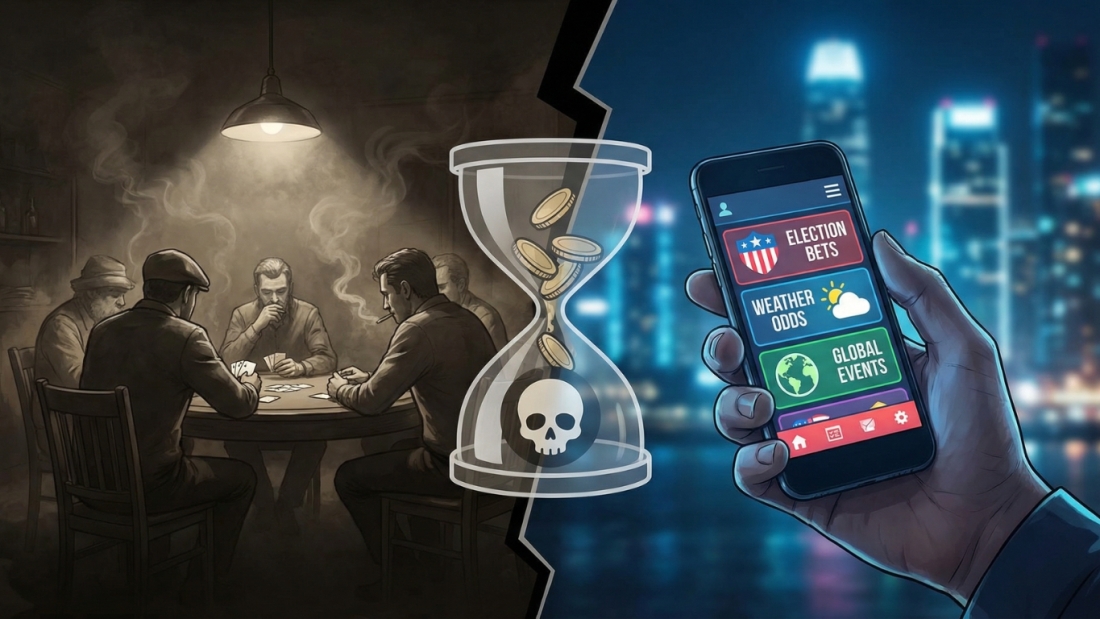
There was a time when gambling was a vice tucked into the corners of society. Smoky rooms. Neon lights. A known danger. A thing you did on the margins.
Now it’s everywhere.
You can gamble on elections, wars, court cases, weather patterns, disease outbreaks, celebrity scandals, and the survival of entire nations — all from the same device you use to text your mother goodnight. The boundaries are gone. The taboo is gone. The friction is gone.
And somehow, we’re calling this progress.
Platforms like Polymarket aren’t just tolerated — they’re celebrated. Endorsed. Legitimized. Even framed as tools for “truth discovery.” The logic goes like this: if money is on the line, people will reveal what they really believe. Price becomes truth. Odds become reality.
But here’s the uncomfortable part we don’t want to admit: When everything becomes a bet, truth stops being something we seek — and becomes something we trade.
The Marketization of Reality
Markets are incredible tools. They allocate resources, coordinate labor, and compress vast amounts of information into signals we can act on. But markets were never meant to decide what is real.
When we allow betting markets to define truth, we incentivize something darker than prediction: influence. Insider knowledge isn’t just valuable it becomes profitable. The earlier you know, the richer you get. The closer you are to power, the more “accurate” your beliefs magically become.
That’s not wisdom. That’s arbitrage.
In the name of being “trustless,” we’re quietly selling off trust itself. Institutions are replaced by odds. Journalism is replaced by price action. Shared reality is replaced by constantly shifting probabilities.
Everything starts to feel like a conspiracy because, in a sense, everything can be gamed.
And paranoia isn’t a bug of this system — it’s the natural outcome.
A Trustless Society Cannot Survive
We’re told that trustless systems are safer. More objective. Less corruptible. But human societies do not run on code alone. They run on shared belief, delayed gratification, and a basic faith that tomorrow is worth investing in.
What happens when that faith collapses?
You stop saving, planning, building.
Why work diligently for thirty years when the currency itself feels fake? Be patient when inflation quietly steals the future from your past efforts? Or trust institutions that printed trillions of dollars overnight and told you it was necessary then acted surprised when nothing made sense anymore?
Post-COVID money printing didn’t just inflate prices. It inflated nihilism.
Currency stopped feeling like a store of value and started feeling like a hot potato. Something you hold briefly before it loses meaning. Something to convert into anything else as fast as possible.
And if money doesn’t matter…Then only bets do.
The Death of Hope Disguised as Opportunity
This is the part nobody wants to say out loud.
The explosion of betting on everything is not a sign of confidence. It’s a sign of despair.
It signals a society that no longer believes slow progress works. That patience pays off. That discipline compounds. That the future is brighter if you show up every day and do honest work.
Instead, we’re left with a culture that whispers the same message over and over:
The only way out is a lucky break.
Hit the crazy bet.
Catch the black swan.
Front-run the collapse.
That’s not entrepreneurship, innovation or optimism. That’s survival psychology.
When Everything Is a Bet, Nothing Is Sacred
When wars become markets, peace becomes mispriced. Elections have odds, legitimacy erodes and when truth becomes a tradable asset, lies become strategies.
A society that gambles on everything eventually stands for nothing.
We are mistaking probabilistic thinking for wisdom, and speculation for insight. We’re teaching ourselves that belief without a payout is naïve, and conviction without leverage is pointless.
And that path doesn’t end in enlightenment.
It ends in fragmentation, with mass suspicion and a permanent state of distrust where every event feels staged, every outcome feels rigged, and every explanation feels incomplete.
This Is the Moment We Decide
This is not a moral panic about technology.
It’s not a rejection of markets, probability, or risk.
It’s a recognition that some things were never meant to be priced.
Markets are powerful precisely because they are limited. They work when they allocate capital — not when they replace judgment, meaning, or shared reality. Once every outcome is tradable, every belief becomes conditional. Once every truth has odds, conviction disappears.
A society cannot function this way for long.
- When wars are markets, peace becomes inefficient.
- When elections are bets, legitimacy erodes.
- When truth is priced, trust dissolves.
None of this fails all at once. It degrades quietly. People stop planning decades ahead and start thinking in windows. They stop building and start positioning. They stop asking what should happen and focus only on what is likely to pay.
This is not intelligence. It is adaptation to a system that no longer rewards patience, work, or faith in the future.
And when enough people reach that conclusion, the system breaks.
Not because the bets were wrong.
But because the thing holding it together — trust — was slowly traded away.
In the end, the house doesn’t win.
It collapses.
Leave A Comment