

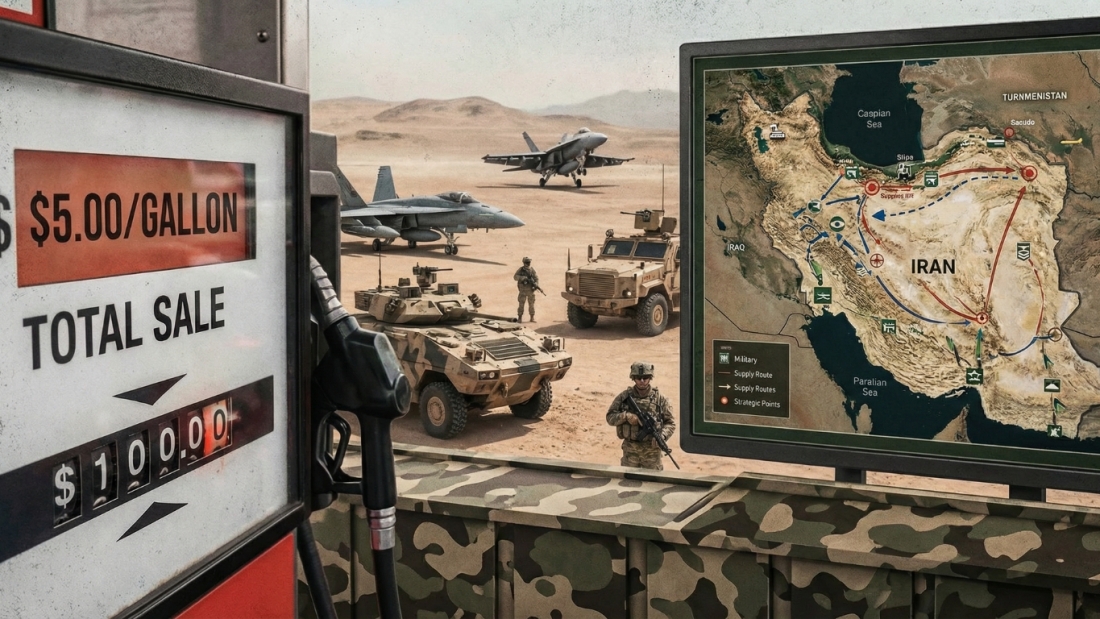
$5.6 billion in munitions. In two days. That’s how the U.S. conflict with Iran started on February 28, 2026. Not with a slow buildup. Not with a measured deployment. With a $5.6 billion firehose of Tomahawk cruise missiles and advanced interceptors pointed at over 5,000 targets. By day six, Pentagon officials told Congress in a closed-door briefing that the tab had crossed $11.3 billion. By day twelve, CSIS pegged it at $16.5 billion. We are one month in. And if you think those numbers are the scary part, you’re not looking at the right ledger.
The Daily Burn Rate
The opening phase of Operation Epic Fury made every prior U.S. military campaign look like a budget exercise. Daily spending hit $2 billion per day during the first 48 hours. The primary culprits: Tomahawk cruise missiles at roughly $3.5 million per unit, and Patriot and THAAD interceptors — among the most expensive munitions in the U.S. arsenal — used to defend against Iranian drone and missile attacks.
To put the Tomahawk number in perspective: at $3.5 million per missile, a single Tomahawk costs more than the median American home. The U.S. fired hundreds of them in the opening salvo. Each one that left a launch tube was a house-sized chunk of taxpayer money detonating on the other side of the world. By day four, the military began transitioning to cheaper, shorter-range JDAM-guided bombs that cost under $100,000 each. That brought the daily rate down to a “mere” $500 million per day.
Half a billion dollars. Every 24 hours. And that’s the cheaper phase.
The Pentagon calls this the “munitions transition point” — the moment when initial long-range precision strikes give way to shorter-range, higher-volume bombing. It’s a technical term that sounds clinical. The financial reality is anything but. Even at the reduced rate, the U.S. is burning through more money per day on this conflict than most federal agencies spend in a month.
The Projections Are Worse Than the Reality
The Penn Wharton Budget Model has run the numbers on what a limited, two-month conflict would cost — assuming no ground invasion.
Scenario | Projected Cost |
Direct military spending (60 days) | |
Likely direct cost (PWBM estimate) | |
Impact on national deficit (with interest) | |
Broader economic losses (trade, energy, markets) |
That’s $65 billion in direct costs and up to $210 billion in economic damage — for a two-month conflict that hasn’t even put boots on the ground. The White House is expected to submit a supplemental funding request exceeding $50 billion to Congress. Some of that will go to regional allies. The rest goes on the national credit card.
And here’s the part that makes the Penn Wharton projections genuinely alarming: they assume a limited conflict. Two months. No ground troops. No prolonged occupation. If any of those assumptions prove optimistic — and in the history of U.S. military engagements in the Middle East, they almost always do — the numbers above become a floor, not a ceiling.
You’re Already Paying at the Pump
Forget the Pentagon’s budget for a second. The cost you’re actually feeling right now is at the gas station. Iran’s blockade of the Strait of Hormuz — the chokepoint for roughly 20% of the world’s oil supply — blew up energy markets within hours.
- Crude oil surged from roughly $67/barrel to nearly $100/barrel, briefly breaking the $100 mark.
- Gas prices jumped from $2.98 on February 26 to $3.93 by March 21 — a 32% increase in three weeks.
- Diesel hit nearly $5 a gallon, which means everything shipped by truck — so, everything — is about to cost more.
The diesel number is the one that should scare you most. Gas prices hurt your commute. Diesel prices hurt everything else. Nearly every product in America touches a truck at some point in its supply chain. When diesel hits $5 a gallon, the cost of moving food, clothing, electronics, building materials — all of it — goes up. You’ll see it at the grocery store before you see it in the headlines. The average American household is now projected to spend an additional $740 on gasoline this year because of the price shock. That doesn’t include the ripple effects from diesel-driven inflation on consumer goods.
When asked about rising gas prices, the response from the White House was: “If they rise, they rise.” Cool.
The Economic Shrapnel Is Everywhere
Gas prices are the most visible cost. They’re not the only one. The Iran conflict has already triggered a cascade of economic damage that’s hitting your mortgage, your retirement account, and your consumer confidence:
- Consumer sentiment fell to its lowest reading of the year in March, with a sharp decline after the war began.
- The S&P 500 and Nasdaq posted their worst four-week stretch since April 2025. If you have a 401(k), you felt it.
- Mortgage rates climbed from just under 6% to 6.53% since the conflict started. That’s thousands of dollars added to the lifetime cost of a home loan.
Hidden Costs
Let’s make that mortgage number real. On a $400,000 home with a 30-year fixed rate, the difference between 6.0% and 6.53% adds roughly $130 per month to your payment. Over the life of the loan, that’s an extra $47,000. Because of a war you didn’t vote for, fought with money the government doesn’t have.
None of this shows up in the Pentagon’s cost estimates. None of it will be in the supplemental funding request. But you’re paying it anyway. And this is just the financial markets. The real-world impacts are already cascading through sectors that most people don’t think about until they feel the pinch. Travel costs are spiking as airlines pass fuel surcharges onto passengers.
Shipping companies are rerouting around the Strait of Hormuz, adding days and dollars to global supply chains. Agricultural commodity prices are climbing because modern farming runs on diesel — from the tractors in the field to the trucks hauling produce to distribution centers.
The Penn Wharton model estimates the broader economic damage at $50 billion to $210 billion — and that range is deliberately wide because the cascading effects of energy disruption are notoriously difficult to model. What we know for certain is that the longer the Strait of Hormuz remains contested, the worse every one of these numbers gets.
The Iraq/Afghanistan Comparison Should Terrify You
Here’s the number that should keep you up at night: $8 trillion. That’s the total estimated cost of the post-9/11 wars in Iraq and Afghanistan, according to Brown University’s Costs of War Project. Not just what the Pentagon spent on bombs and tanks. The total cost — including war-related increases to the defense budget, State Department expenditures, homeland security costs, interest on war debt, and veterans’ care.
The original pitch for Iraq? Around $50 billion. The final tab? 160 times that.
And the biggest chunk hasn’t even been paid yet. The U.S. is projected to spend between $2.2 trillion and $2.5 trillion by 2050 — just on medical care and disability benefits for post-9/11 veterans. That’s not missiles or fuel. That’s the cost of taking care of the people who fought.
Now apply that framework to Iran.
We’re at $11.3 billion in six days. Projected $65 billion in 60 days. And that’s before a single long-term cost is calculated — no veterans’ care projections, no interest payments on the debt used to fund it, no accounting for the economic damage from energy disruptions. If the post-9/11 wars are any guide, the number you’re seeing right now is roughly 1% of what this will actually cost.
Estimated U.S. cost of Iran war rises to $27 billion.
— Clash Report (@clashreport) March 21, 2026
Current burn rate:
$1B/day.
$41.7M/hour.
$11.6K/second.
Based on Pentagon briefing: $11.3B in first 6 days + ~$1B/day ongoing.
Conflict duration: ~21 days pic.twitter.com/n2XjCZ44kT
For context: the financial cost of the Iraq war from 2003 until 2011 ("active war" part) was budgeted at around $900b
— dart (@poordart) March 19, 2026
Y'all burgers are gonna get fleeced so hard on this one if this is the outlook at 3 weeks https://t.co/YlBl4Gvgfw
The Costs Nobody Talks About
Here’s what won’t be in any Pentagon briefing or congressional budget request:
- Interest on war debt. The post-9/11 wars have already generated an estimated $1 trillion in interest payments, with hundreds of billions more coming. Every dollar spent on Iran that’s financed by borrowing — which is all of it — carries decades of compounding interest. The U.S. isn’t paying for this war with cash on hand. It’s paying with credit, and the interest meter started running on day one.
- Veterans’ care. The $2.2 trillion projected for post-9/11 veterans is the largest single category of war costs. Iran will create its own generation of veterans who will need care for the next 50 years. That cost doesn’t appear in any current budget projection — but it’s as certain as the conflict itself.
- Stockpile depletion. The massive expenditure of Tomahawk missiles and advanced interceptors in the opening days raised immediate concerns about stockpile depletion. These weapons take years to manufacture and billions to replace. The cost of replenishing what’s been fired isn’t included in the daily burn rate — it’s a separate bill that will come due over the next decade.
- Opportunity cost. Every dollar spent on Tomahawk missiles is a dollar not spent on infrastructure, education, healthcare, or the entry-level job crisis crushing a generation of new graduates. At $3.5 million per Tomahawk, the opening salvo alone could have funded thousands of teacher salaries, infrastructure projects, or small business grants.
The daily tab for the Iran war isn’t just a line item. It’s a mortgage on the country’s future, and the terms haven’t been disclosed to the people who’ll be paying it.
One Month In, and the Meter’s Running
The Pentagon says $11.3 billion in six days. Penn Wharton says $65 billion in two months. Brown University’s research on past wars says the real number will be measured in trillions, paid over decades. Gas is up 32%. Diesel is pushing $5. Stocks are down. Mortgage rates are climbing. Consumer confidence is cratering. And the official White House response to rising costs is “if they rise, they rise.”
The initial Iraq war estimate was $50 billion. The final cost was $8 trillion. That’s not a rounding error. That’s a pattern. And it’s a pattern that every American should recognize, because we’ve been on this ride before. We know how the math works. The opening costs are always presented as manageable. The projections are always optimistic. The real bill always arrives years later, after the cameras have moved on and the people who made the decisions are out of office.
We’ve seen this movie before. We know how it ends. The only question is how many zeroes get added to the bill before someone admits this isn’t the trailer — it’s the opening act.
Leave A Comment