

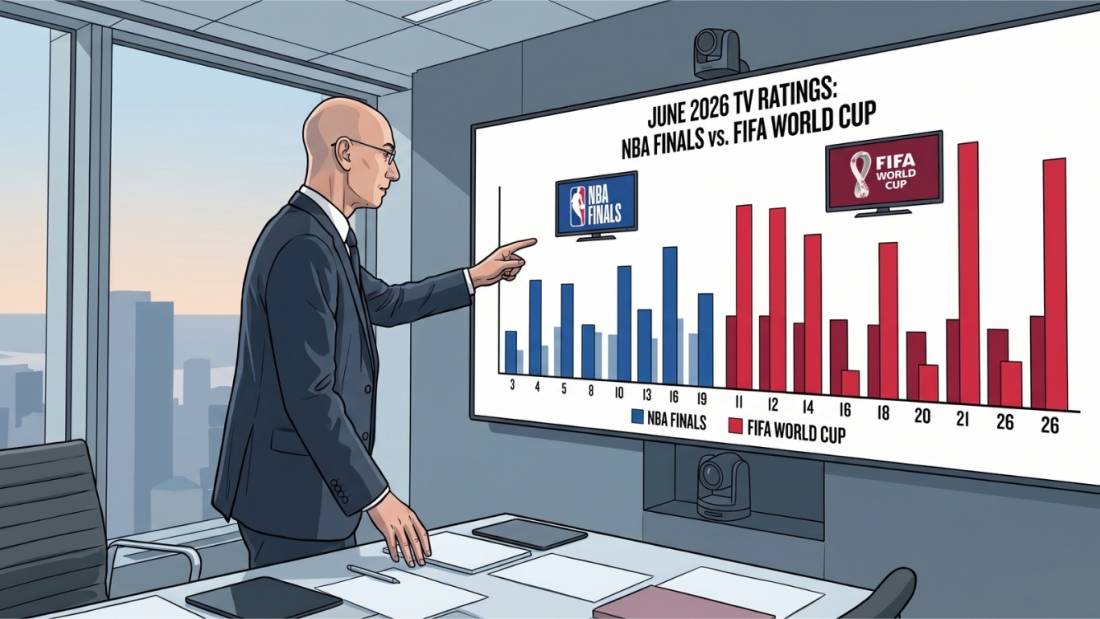
Inside the NBA’s quiet scheduling war against the world’s biggest sporting event — and what it reveals about how Adam Silver thinks about competing for your attention
Somewhere in a conference room at the NBA’s headquarters in New York, probably around October 2025, a group of very smart people stared at a calendar and had a collective panic attack. The viewership projections scared the league office with the 2026 NBA Finals beginning in early June. The 2026 FIFA World Cup — co-hosted by the United States, Mexico, and Canada, the most commercially significant World Cup in the tournament’s history — would kick off on June 11. The United States Men’s National Team would play its opening match against Paraguay at SoFi Stadium in Los Angeles on June 12, a Friday night, in primetime, on a major broadcast network, with the entire country watching.
Under a traditional NBA Finals schedule, that Friday would have been Game 4. The NBA’s crown jewel — the championship series that represents the culmination of an eight-month season, that generates billions in advertising revenue, that is the tentpole product upon which the league’s entire media rights empire is built — was about to go head-to-head with the opening salvo of the world’s most popular sporting event, held on American soil for the first time in 32 years. Creating an existential threat to Finals ratings. And the NBA’s response was the strategic calendar engineering required in modern sports business.
The Schedule: What They Did & Why Every Detail Matters
On January 20, 2026, the NBA announced its Finals schedule, and if you weren’t paying close attention, it looked unremarkable. But every single date choice was a calculated move in a high-stakes chess match against FIFA. The 2026 NBA Finals schedule, broadcast exclusively on ABC:
- Game 1: Wednesday, June 3
- Game 2: Friday, June 5
- Game 3: Monday, June 8
- Game 4: Wednesday, June 10
- Game 5 (if necessary): Saturday, June 13
- Game 6 (if necessary): Tuesday, June 16
- Game 7 (if necessary): Friday, June 19
On Tuesday June 16, the Knicks could host Game 6 of its first NBA Finals in 27 years at MSG.
— Front Office Sports (@FOS) May 26, 2026
That same day, France will be playing its first match of the World Cup at MetLife. pic.twitter.com/XNBkwkaEqN
Most expensive finals ticket this summer 🏆
— CTix (@getctix) May 27, 2026
NBA Finals (Knicks Home Game 1): $162,000
FIFA World Cup Final: $103,400
US Open Men’s Final: $44,205
Stanley Cup Finals (Game 1): $17,272 pic.twitter.com/Khv5Xt1KxO
Three things jump out immediately.
Game 4 – Now Wednesday
Game 4 was moved from Friday, June 12 — the date of the USMNT opener against Paraguay — to Wednesday, June 10. This is the most straightforward defensive move: get your product off the field before the World Cup arrives. By playing Game 4 two days early, the NBA ensured its most-watched regular-cadence game wouldn’t compete with the most-anticipated soccer match in American history.
No Sunday Games
There are no Sunday games. Zero. The first time that’s happened in an NBA Finals since 1970. Sunday night is the most valuable real estate in American television. It’s where the NFL plants its flag from September to February. The day where prestige TV airs and the largest casual audiences gather. The NBA voluntarily ceding Sunday night is like a general surrendering the high ground. You only do it if you believe the battle is unwinnable on that terrain.
And it was. The World Cup would be programming Sundays with group stage matches featuring major international teams, broadcast across multiple networks, generating the kind of multicultural, multi-platform viewership that no domestic league can match. The NBA looked at Sunday and said: we cannot win this day. We will win other days instead.
Possible Game 7
A potential Game 7 lands on Friday, June 19, which would coincide with another USMNT match. But the NBA was comfortable with this overlap because the soccer game was scheduled for the afternoon, preserving the NBA’s exclusive primetime window. This is precision engineering — not avoiding all conflict, but choosing which conflicts are survivable and which are fatal.
The result is a schedule with unusual rhythms. Longer rest periods between later games. A Wednesday-Friday-Monday-Wednesday cadence in the first four games that breaks the traditional every-other-day pattern. It doesn’t look like a normal Finals schedule because it isn’t one. It’s a schedule designed to win a specific battle against a specific opponent, and every irregularity is a tactical choice.
The Business Math: Why This Was a Code-Red Situation
To understand why the NBA went to these lengths, you need to understand the financial stakes — and they are staggering. The NBA Finals is not just a basketball event. It’s a media property worth billions. The league’s new media rights deal, which brought NBC back as a broadcast partner, is structured around the assumption that the Finals will deliver premium ratings in premium windows. Advertisers pay accordingly — a 30-second spot during the Finals costs millions, priced against projected viewership. If those viewership numbers crater because casual fans are watching the World Cup instead, the entire economic model wobbles.
And this specific World Cup was uniquely dangerous. Previous World Cups were hosted in time zones that naturally limited their American TV footprint. Qatar’s 2022 tournament had morning and early afternoon kickoffs in the U.S., and while viewership was strong, it wasn’t competing for primetime eyeballs. But the 2026 World Cup is here. On American soil. In American stadiums. In American time zones. With American primetime kickoffs. With the American national team playing in front of 70,000 people at SoFi Stadium.
Global Competition
This isn’t just scheduling competition. It’s an attention economy war, and the World Cup was armed with nuclear weapons: global cultural relevance, patriotic fervor, massive casual appeal, and the enormous Latino demographic in the U.S. for whom soccer isn’t a secondary sport — it’s the sport. No previous NBA Finals has ever faced this specific combination of threats.
The 2026 playoffs were already on an upswing — viewership hit its highest levels in 33 years, driven partly by the new broadcast deal putting more games on over-the-air television. That momentum was an asset the NBA couldn’t afford to squander by scheduling Games 4, 5, or 6 opposite World Cup primetime matches. Every eyeball that chose soccer over basketball in June would have been a data point used against the league in future rights negotiations.
The AI Angle: How a Schedule Gets Optimized
One detail that flew under the radar: the NBA didn’t just eyeball this schedule. They used advanced AI optimization software from partners like Fastbreak.ai to model different scheduling scenarios and their projected viewership impacts. Using machine learning to simulate millions of possible schedules and identify the configuration that maximizes ratings while minimizing conflicts.
Think about what that means. The schedule you’re watching isn’t the product of a few executives drawing on a whiteboard. It’s the output of an algorithm that processed variables including: projected World Cup viewership by match, historical NBA Finals ratings by day of week, travel logistics for both teams, arena availability, broadcast partner preferences, advertiser commitments, and probably two dozen other factors we don’t know about.
This is the future of sports scheduling, and it’s already here. The leagues that invest in this capability will have a measurable advantage in the attention economy. The ones that don’t will find themselves scheduled opposite events they could have avoided, losing viewers they could have retained, and negotiating media deals from a position of weakness.
How Other Leagues Have Handled (or Fumbled) Similar Conflicts
The NBA isn’t the first league to face a scheduling conflict with a global mega-event, and how other leagues have handled similar situations provides useful contrast. The NHL has historically been the primary victim of World Cup scheduling overlap. The Stanley Cup Finals have competed with World Cup matches multiple times, and the NHL’s response has typically been… to do nothing. To play its regular schedule and hope for the best. The results have been predictable: Cup Finals ratings dip during World Cup years, the NHL’s already-smaller TV footprint gets squeezed further, and the league’s media partners grumble. The NHL’s passive approach to scheduling conflicts is a microcosm of its larger struggle for relevance in the American sports landscape.
You can’t beat the World Cup by ignoring it.
MLB faces a different version of this problem with the Summer Olympics. Baseball is typically in mid-season mode during the Games, and the sport’s response has been mixed — some years they’ve scheduled around the Olympics more aggressively, other years they’ve treated it as business as usual. The results are similarly mixed: Olympics years tend to produce lower regular-season ratings for baseball, but the effect is diffuse because the regular season isn’t a tentpole product the way the Finals or Super Bowl is.
The NFL has the luxury of schedule positioning — its season runs from September to February, a window that almost never conflicts with global mega-events. But even the NFL has shown scheduling savvy in how it handles internal conflicts, like ensuring that Thanksgiving, Christmas, and playoff games are optimized for maximum viewership. The NFL’s dominance isn’t just a product of football’s popularity — it’s a product of relentlessly strategic scheduling that treats every broadcast window as a competitive asset.
What the NBA did in 2026 is closer to the NFL model than the NHL model: proactive, strategic, data-driven, and unapologetic about protecting its product. And that distinction matters more than it might seem, because how a league handles scheduling conflicts reveals how it thinks about its place in the sports ecosystem.
This summer will include the Eastern Conference champion New York Knicks in the NBA Finals, the FIFA World Cup, an absolutely colossal 250th birthday party for America, and maybe the Swift-Kelce nuptials. No big deal. New York is ready. 🏀⚽️🗽 pic.twitter.com/WvaUL07tMv
— Justin Brannan (@JustinBrannan) May 28, 2026
— NBC Sports PR (@NBCSportsPR) June 1, 2026
What This Tells Us About Adam Silver’s NBA
Zoom all the way out, and the 2026 Finals schedule is a case study in how Adam Silver’s NBA operates as a business. Silver’s tenure has been defined by a willingness to treat the NBA not just as a sports league but as a media company that happens to produce basketball. Every major decision — the play-in tournament, the in-season tournament, the mid-season Cup, the new broadcast deal, and now this schedule — reflects a media-first mindset. The question isn’t “what’s best for the on-court product?” It’s “what’s best for the on-court product as viewed through the lens of maximizing audience engagement across all platforms?“
That’s not cynicism. It’s sophistication. The NBA understands something that other leagues are still figuring out: in 2026, sports don’t just compete against other sports. They compete against Netflix, YouTube, TikTok, gaming, and every other form of entertainment that a 25-year-old might choose on a given evening. The attention economy is zero-sum, and the leagues that treat it that way — that fight for every eyeball with the same intensity their teams fight for every possession — are the ones that will thrive.
The World Cup scheduling conflict was a stress test, and the NBA passed it. Not by hoping the problem would go away, not by pretending the conflict didn’t exist, but by making hard choices — giving up Sundays, rearranging the traditional cadence, accepting unusual rest patterns — in service of a larger strategic goal: ensuring that when someone turns on their television during the 2026 NBA Finals, there’s nothing else worth watching at that exact moment. That’s not just scheduling. That’s competitive positioning. And it might be the most important skill a sports league can have in the decade ahead.
Fútbol Wins Here
The 2026 NBA Finals schedule will already be remembered with a quirky footnote: the year the Finals didn’t have any Sunday games. But beneath that quirk is one of the most sophisticated scheduling decisions in modern sports history. A decision that required the NBA to accurately forecast the threat posed by the World Cup, model the viewership impact of different scheduling configurations, sacrifice traditional premium windows in favor of strategically superior alternatives, and execute all of this months in advance with the kind of institutional confidence that comes from genuinely understanding your market position.
The NBA didn’t just avoid a scheduling disaster. It turned a potential crisis into a demonstration of institutional intelligence. And in an attention economy that grows more competitive every year, that kind of intelligence isn’t a luxury. It’s survival.
For more on the NBA’s business moves and what they mean for the league’s future, keep it locked on animalhouseusa.com.
Leave A Comment