

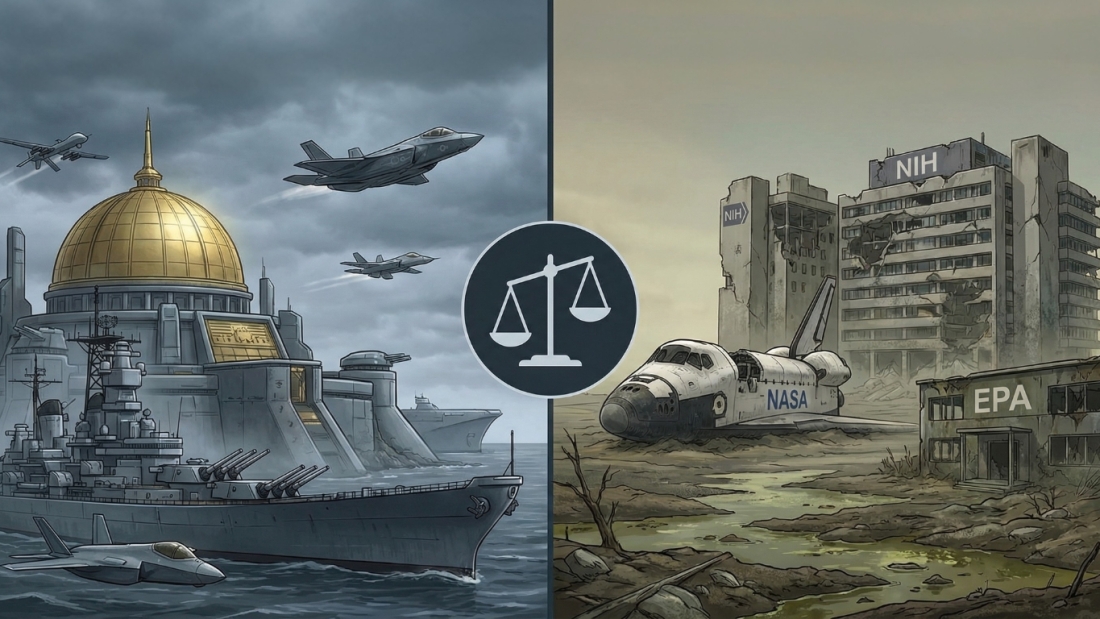
$1.5 trillion. That’s the number the White House dropped on Congress last Friday. Not billion. Trillion. The largest defense budget request in the history of the United States — a 44% increase over fiscal year 2026, roughly $500 billion more than what the Pentagon got last year. To put that in perspective: the entire GDP of Australia is about $1.7 trillion. Trump is asking Congress to hand the military the economic output of a G20 nation. Every year.
Budget Director Russell Vought called it a plan that “advances President Trump’s delivery of peace through strength by reinvesting in the foundations of American military power.” Peace through strength. With a $1.5 trillion price tag. During a war with Iran that’s already burning $1 billion a day. Sure.
The flip side of the coin? A $73 billion gut-punch to domestic programs — a 10% cut across non-defense discretionary spending. Health research, housing, education, NASA, the EPA — all on the chopping block so the Pentagon can build a battleship with the President’s name on it. Literally. We are breaking down what $1.5 trillion buys, what it kills, and why the math should concern anyone who pays taxes.
What $1.5 Trillion Buys
The Golden Dome — $185 Billion and Counting
The crown jewel of the defense budget is the Golden Dome, a space-based missile defense system designed to detect and destroy ballistic, hypersonic, and cruise missiles before they reach U.S. soil. Think Iron Dome, but for an entire continent. The FY2027 request includes $17.1 billion for Golden Dome, bringing total allocated funding to $38.9 billion. The official price tag? $185 billion over the next decade — up from the original $175 billion estimate Trump floated. That’s already a $10 billion cost overrun and the thing hasn’t deployed a single piece of hardware yet.
But this is where politicians have fun spending other people’s money. The Congressional Budget Office says the real number could be anywhere from $161 billion to $542 billion over 20 years. The American Enterprise Institute — not exactly a left-wing think tank — projected that a robust Golden Dome could cost $3.6 trillion over two decades when you include operations, maintenance, and replenishment. AEI also noted that at the $175 billion price point, the system would, at best, intercept “only a handful of incoming missiles.”
A handful. For $175 billion. The system’s components read like a sci-fi movie pitch: constellations of satellites in low Earth orbit, AI-powered command networks, directed-energy weapons, hypersonic interceptors, and “left of launch” cyber and electronic warfare capabilities. Whether any of it works at scale is a question nobody in the White House seems interested in answering before writing the checks.
The Golden Fleet — $65.8 Billion for Ships
The Navy is getting $65.8 billion for shipbuilding — a nearly 50% increase from last year and a 242% jump from pre-buildup levels. That buys 18 battle force ships and 16 non-battle force vessels, effectively doubling last year’s request.
The headline grabber? The Trump-class battleship. Yes, that’s what it’s called. The budget includes $1 billion in advanced procurement for what the Navy says will be the largest surface combatant built since World War II — up to 880 feet long, displacing 30,000 to 40,000 tons, armed with nuclear-capable hypersonic cruise missiles, 128 vertical launch cells, a railgun, lasers, and conventional guns.
The first ship has already been named: the USS Defiant. Secretary of the Navy John Phelan called it “the largest, deadliest, and most versatile and best-looking warship anywhere on the world’s oceans.” Best-looking. That’s a direct quote from the Secretary of the Navy. About a warship.
Analysts estimate each Trump-class battleship will cost $10 to $15 billion per vessel and take more than a decade to build. For context, you could fund the entire National Institutes of Health for two months with one battleship. Or give every public school teacher in America a $25,000 raise. But sure — the boat looks cool. The Zumwalt-class destroyer program was supposed to build 32 ships. It built three. The Littoral Combat Ship was supposed to be a cheap, flexible platform. It became an expensive maintenance headache that the Navy started decommissioning early. Now we’re betting $65.8 billion on the same industrial base to build the most ambitious naval expansion since the Reagan era. What could go wrong?
Munitions, Drones, and the F-47
The Iran war burned through missile stockpiles at a rate that surprised even the Pentagon. The budget allocates funding for 12 critical munition types to rebuild and expand the defense industrial base for scalable production. Translation: we shot a lot of expensive things at Iran and need to buy more.
The budget also includes “unprecedented investments” in unmanned systems — part of a “drone dominance” initiative — along with continued development of the F-47, a sixth-generation fighter jet targeting first flight by 2028. AI integration across the force is also a major line item, including the expansion of the Pentagon’s GenAI.mil platform.
Troop Pay Raise: 5–7%
The one item in the defense budget that directly helps human beings: a 5% to 7% pay raise for military personnel. This is genuinely needed — military pay has lagged inflation for years, and recruitment has been a persistent problem. No argument here. But it’s worth noting that a 7% raise for all 1.3 million active-duty troops costs roughly $13 billion. That’s less than 1% of the total budget. The other 99% is hardware.
Here’s the Spend, in a Table
Item | FY2027 Request | Context |
Total Defense Budget | $1.5 trillion | 44% increase over FY2026 |
Golden Dome (missile defense) | $17.1 billion | $38.9B total allocated; $185B projected |
Navy Shipbuilding (“Golden Fleet”) | $65.8 billion | 18 battle force + 16 non-battle force ships |
Trump-class Battleship (advance procurement) | $1 billion | Est. $10–15B per ship total |
Munitions Resupply | Classified/multiple lines | Rebuilding stockpiles after Iran war |
F-47 Sixth-Gen Fighter | Continued development | First flight target: 2028 |
AI & Drone Dominance | “Unprecedented” investment | GenAI.mil, unmanned systems |
Military Pay Raise | ~$13 billion (est.) | 5–7% across active duty |
Now Here’s What’s Getting Cut
This is where the budget shifts from a defense document to a values statement. Because the $1.5 trillion doesn’t come from nowhere. It’s offset — partially — by $73 billion in cuts to everything that isn’t a weapon. The White House budget document used the word “woke” 34 times to describe programs targeted for elimination. Thirty-four. In a federal budget document.
National Institutes of Health — Cut $5 Billion
The NIH — the agency that funds cancer research, Alzheimer’s studies, and the development of vaccines— gets a $5 billion haircut, dropping its funding from $47 billion to $41 billion. The White House says NIH “broke the trust of the American people.”
The budget also proposes eliminating three entire NIH institutes, including the National Institute on Minority Health and Health Disparities. The National Center for Complementary and Integrative Health gets axed too.
One Tomahawk cruise missile costs $3.5 million. The NIH’s entire budget for minority health disparities research is roughly $3.2 billion. We fired hundreds of Tomahawks in two days during the Iran opening salvo. But studying health disparities? That’s the waste they found.
NASA — Cut $5.6 Billion (23%)
The space agency that put humans on the moon gets a 23% budget cut, dropping to $18.8 billion. The Science Mission Directorate — the part that actually does science — takes a 47% hit, losing $3.4 billion. More than 40 missions are slated for termination, including the Mars Sample Return.
The SERVIR program, which uses satellite data to help developing countries respond to climate disasters, is eliminated because it “imposed climate extremism on developing countries.” Climate extremism. From satellites.
The Office of STEM Engagement — NASA’s education arm — is eliminated entirely. In a country that can’t fill engineering jobs.
At least Artemis survives. The budget puts $8.5 billion toward landing astronauts on the Moon by 2028. So we can still do that, as long as nobody needs to study the science of getting there.
Environmental Protection Agency — Cut 52%
The EPA gets cut in half. A $4.6 billion reduction bringing it to its lowest funding level since the Reagan administration — the 1980s. The atmospheric-protection program is eliminated entirely because it prioritized “the cult of ‘climate change.'” That’s a direct quote from the budget.
Environmental justice programs? Gone. Over $1 billion in grants that help states enforce the Clean Air Act and Clean Water Act? Cut. $2.5 billion from state revolving loan funds for clean water infrastructure? Slashed. The Superfund program that cleans up toxic waste sites in American communities? Defunded.
The agency responsible for making sure your drinking water doesn’t kill you is being gutted so the Pentagon can build a battleship named after the President. I suppose even with an $8 billion budget there are still some places with unsafe drinking water. Nothing is working.
Everything Else on the Chopping Block
Program / Agency | Proposed Cut | What It Does |
$10.7 billion | Housing for low-income Americans, homelessness programs | |
$15.5 billion (30%) | Humanitarian aid, global health, diplomacy | |
$4.8 billion (50%+) | Basic scientific research funding | |
$3.5 billion | Job training, worker safety, labor enforcement | |
19% | University research grants, food programs | |
Eliminated ($4 billion) | Heating/cooling for low-income households | |
Eliminated ($775 million) | Anti-poverty programs | |
$768 million cut | Aid for refugees entering the U.S. | |
$15 billion canceled | Renewable energy, EV charging, NOAA grants | |
$1.4 billion cut | Tax enforcement and collection |
The Reconciliation Trick
Here’s the structural play nobody’s talking about enough. Of the $1.5 trillion, the White
House wants $1.1 trillion to go through regular appropriations — the normal process that requires bipartisan support. The remaining $350 billion? Through budget reconciliation — a procedural maneuver that bypasses the Senate filibuster and can pass with a simple party-line majority.
That means $350 billion in defense spending — the size of the entire defense budget of most NATO countries — could be approved without a single Democratic vote. Reconciliation was designed for tax and spending adjustments. It’s now being used to fund battleships and missile constellations.
This isn’t just a budget. It’s a structural attempt to remove bipartisan negotiation from defense spending. If it works, future administrations can use the same playbook. The implications for democratic governance of the military budget are enormous, and almost nobody in Congress is raising the alarm.
Tim Dillon just declared that MAGA is “the greatest scam in history.”
— Holden Culotta (@Holden_Culotta) April 4, 2026
“To run as America First, and then turn around and go … we’re here to have a defense budget of $1.5 trillion.”
“And we’re here to fight wars.”
“It makes Enron look like a guy doing three-card monte on the… pic.twitter.com/iEIHlfpHbp
🚨 RAY DALIO JUST WARNED EVERYONE…
— NoLimit (@NoLimitGains) February 17, 2026
America is going broke.
The national debt just hit $38 trillion.
Interest payments alone are now larger than the entire defense budget.
The government is borrowing money just to pay interest on the money it already borrowed.
Read that… pic.twitter.com/kDsA3Ztfs0
The Historical Context
At $1.5 trillion, this budget exceeds the Reagan-era military buildup in inflation-adjusted terms. It approaches defense spending levels not seen since just before World War II as a share of federal discretionary spending.
During the Cold War, when the U.S. was staring down a nuclear-armed Soviet Union with 40,000 warheads, defense spending averaged about 8–10% of GDP. The FY2027 request would push defense spending to roughly 5% of GDP — the highest since the peak of the Iraq and Afghanistan wars in 2010.
But here’s a critical difference: in the Cold War, the U.S. was building a military to deter a superpower. Today, we’re building a military while simultaneously using it — burning through $1 billion a day in Iran — and the national debt is already over $36 trillion. We’re not paying for this with a healthy economy and manageable debt, the way Eisenhower or even Reagan could argue. We’re paying for it with a credit card that already has a $36 trillion balance.
What This Budget Actually Says
A president’s budget doesn’t become law. Congress holds the purse. Lawmakers have historically rejected the deepest proposed cuts in these documents, and both parties are already signaling resistance to pieces of this one. Senate Democrats have called the proposal “morally bankrupt.” Some Republicans are raising alarms about using reconciliation for defense spending. But a budget is a values document. It tells you what a government prioritizes. And this one is crystal clear:
- A Trump-class battleship is worth more than the National Institutes of Health.
- The Golden Dome is worth more than the EPA, NASA’s science division, the National Science Foundation, and LIHEAP combined.
- A railgun on a ship is worth more than clean drinking water programs.
- “Drone dominance” is worth more than housing for low-income Americans.
The White House budget document calls targeted programs “woke, weaponized, and wasteful.” It used the word “woke” 34 times, referred to climate science as a “cult.”, described health disparities research as “DEI expenditures.” It called satellite-based climate monitoring “climate extremism.” This isn’t a budget that happens to cut some programs to fund defense. It’s a budget that uses defense as the vehicle to dismantle the parts of government that this administration finds ideologically offensive — and dares Congress to stop it.
The Bill Is Coming
We’ve been here before. The original estimate for Iraq was $50 billion. The final cost was $8 trillion. Not a rounding error — that’s a pattern. A pattern of underestimating costs, overcommitting resources, and sticking the next generation with the bill. The FY2027 defense budget is built on projections of steady 3% GDP growth and inflation stabilizing near 2%. If those assumptions hold, maybe the math works on a spreadsheet somewhere. If they don’t — and the Iran war, energy disruptions, and $5 diesel suggest they might not — this budget becomes the opening bid on a fiscal crisis. $1.5 trillion for defense. $73 billion cut from everything else. A battleship with the President’s name on it. And the word “woke” 34 times in a federal budget document. That’s the priority list. Read about it. Because you’re paying for it.
Leave A Comment