

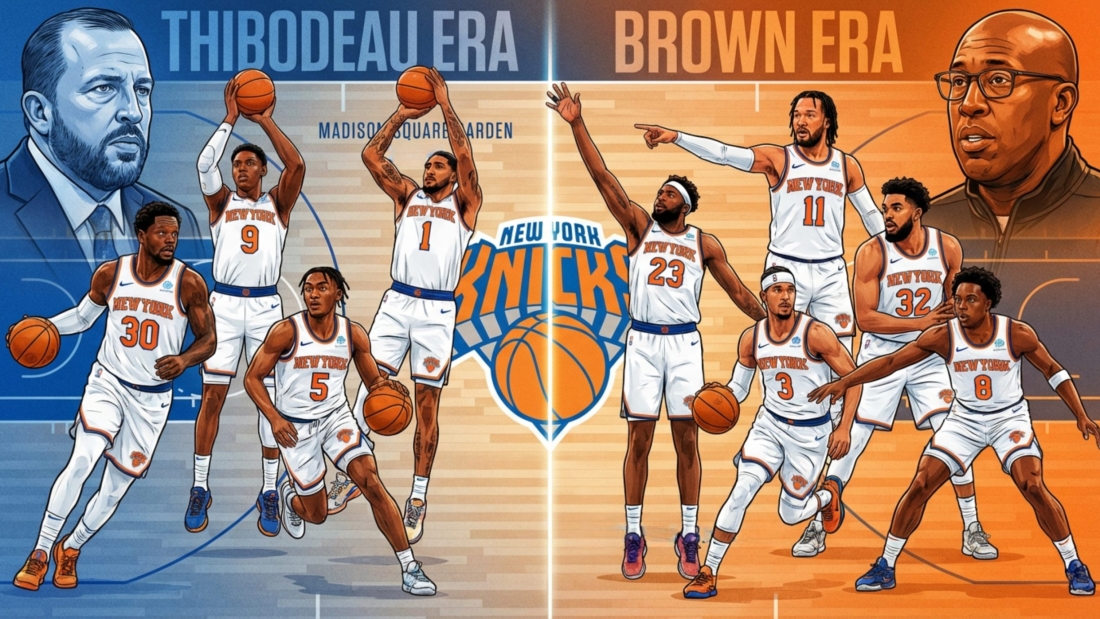
53 wins. An NBA Cup trophy. A franchise record for the most wins by a first-year head coach — surpassing Pat Riley. And yet, a significant chunk of Knicks Twitter is still arguing about whether this team is actually better than last year’s squad. So I wanted to add to the debate by talking numbers.
With the playoffs on the doorstep, many Knicks fans are measuring Mike Brown’s first-year team against Thibodeau’s 2024-25 squad, the one that integrated Karl-Anthony Towns, went 51-31, and punched a ticket to the Eastern Conference Finals for the first time in 25 years. That’s the real benchmark. Not Thibs’ rebuild years. Not the Julius Randle era. The best version of his Knicks against the first version of Brown’s.
Here’s the thing — the real details are in the analytics despite the similar records. The data tells a quantifiable story across every major statistical category. And when you line it all up side by side, the picture of what Brown has built becomes hard to argue to why Leon Rose made his decision last spring. That can all blow up depending on whatever happens in the playoffs.
Offensive Efficiency: More Points, Better Process
The top-line offensive numbers are where this conversation starts, and they immediately favor Brown. Thibodeau’s 2024-25 offense posted an Offensive Rating of 117.3. Brown’s 2025-26 unit pushed that to 118.7 — a +1.4 improvement. That might not sound massive in a vacuum, but in a league where offensive efficiency is measured in razor-thin margins, a 1.4-point jump in ORtg is the difference between a good offense and an elite one. Across a full season, that gap translates to roughly 3-4 extra wins just from scoring efficiency alone.
But the how matters more than the what. Thibs’ offense leaned on Brunson’s creation and KAT’s floor-spacing — powerful, but methodical. It was effective because of individual brilliance, not systemic design. The team ranked 27th in three-point attempts and 27th in catch-and-shoot threes. Not great “team” basketball. An offense that ranked 3rd in overall efficiency was accomplishing it despite being one of the worst volume shooting teams in the league from behind the arc.
Brown was hired to change such an approach. Under his system, three-point attempts jumped from 34.1 to 38.2 per game (+4.1), and catch-and-shoot attempts went from 23.4 to 27.7 per game (+4.3). The team leaped from 27th to 3rd in three-point attempts and from 27th to 2nd in catch-and-shoot threes. Corner three attempts — the most efficient shot in basketball outside of a layup — rose from 10.2 to 12.0 per game (+1.8). And they did all of this while converting at 37.6% from deep (4th in the NBA), proving this wasn’t just volume for volume’s sake. These were quality looks generated by design.
The formula is clear: Brown built an offense that generates better shots for more players. Thibs’ offense needed Brunson to be a magician for it to hum at times. Brown’s offense hums because the system creates advantages before the ball even gets to the decision-maker. That’s a higher ceiling, and it’s a ceiling that doesn’t collapse the moment your point guard has an off night. That is why this playoff run is critical for players such as OG Anunoby and Mikal Bridges to remain aggressive on offense.
Defensive Identity: Tighter, Smarter, Meaner
Here’s where people who didn’t watch both seasons closely might assume it’s a wash. It’s not. Thibodeau’s defense posted a 113.3 Defensive Rating. Brown’s came in at 112.3 — a full point lower, which means a full point better. A -1.0 improvement in DRtg is significant. It means Brown’s team allowed fewer points per 100 possessions than a coach who is branded as one of the best defensive coaches of his generation.
Both teams were physical, disciplined and anchored by elite perimeter defenders in OG Anunoby and Mikal Bridges. But Brown made a schematic adjustment that solved a lingering Thibodeau-era problem: opponent three-point shooting. By leveraging a healthy Mitchell Robinson to dominate the interior — the Knicks ranked 4th in points allowed in the paint — Brown’s scheme funneled drivers into Robinson’s shot-blocking radius while keeping perimeter defenders at home on shooters. Last year’s team was elite inside (Thibs allowed just 43.4 paint points per game, 3rd-fewest), but the help defense sometimes left kick-out shooters wide open. Brown kept the paint locked and closed out better on the arc.
The result? A defense that didn’t just match Thibodeau’s standard — it raised it. And when you pair that 112.3 DRtg with the 118.7 ORtg, you get the real headline number.
Net Rating: The Single Best Measure of Team Quality
If you want one number that captures the gap between these two teams, it’s Net Rating. Thibodeau’s 2024-25 Knicks posted a +4.0 Net Rating. Brown’s 2025-26 Knicks posted a +6.4 Net Rating. That’s a +2.4 improvement — a massive jump that reflects simultaneous upgrades on both ends of the floor.
To put that in context: a +4.0 net rating is a solid playoff team. A +6.4 net rating is historically elite. Since 2000, teams with a net rating north of +6.0 have overwhelmingly been conference finalists or better. Brown’s Knicks aren’t just outperforming Thibs’ best team — they’re operating at a level that correlates directly with deep postseason runs.
That +2.4 gap didn’t come from one side of the ball. It came from +1.4 on offense AND -1.0 on defense, a balanced, dual-sided improvement that indicates genuine team-wide growth, not a fluke spike in one area. This is what a well-coached team looks like when the philosophy actually fits the roster.
Fourth Quarter Dominance
Here’s where the conversation shifts from “good team” to “championship-caliber team.” And this is where Brown’s Knicks separate themselves not just from Thibs’ squad but from most teams in the modern NBA.
Brown’s 2025-26 Knicks posted a 4th quarter net rating of +11.7. Let that marinate. A +11.7 net rating in the fourth quarter means this team demolished opponents when games were being decided. They outscored teams by nearly 12 points per 100 possessions in crunch time. That’s not just winning close games — that’s putting teams away.
For comparison, Thibodeau’s teams had an inconsistent track record in late-game situations. His 2020-21 squad was elite in the clutch (+12.5 net rating), but his more talented 2022-23 team was a disaster in close games, posting a -10.7 clutch net rating with a 120.2 defensive rating in clutch minutes. That inconsistency was a red flag then, and it’s a sharp contrast to what Brown is working with now.
Why does fourth quarter dominance matter for the playoffs? Because the postseason is fourth quarters. Every game tightens. Every possession matters more. Margin for error evaporates. A team that dominates Q4 in the regular season is a team with the composure, execution, and depth to handle the pressure of a seven-game series. And there’s no coaching that into a team overnight — it’s a reflection of conditioning, trust, and system.
Clutch Performance: Historic, and That’s Not Hyperbole
Beyond Q4 overall, the Knicks’ clutch numbers — defined as games within five points in the final five minutes — are legitimately historic. Brown’s 2025-26 Knicks posted a clutch net rating of +20.5. That is the highest clutch net rating in NBA modern era history, dating back to 1996 when the league began tracking the stat.
Thirty years of clutch data. Thousands of teams. And this version of the Knicks sits at the top. This isn’t just about Jalen Brunson hitting tough shots (though he obviously does — the man carried the team home against Atlanta with a drive-and-one, a game-tying three, a go-ahead steal-and-layup, and free throws all in the final minutes). It’s about an entire roster that executes at an elite level when the game is on the line. OG hitting free throws to seal it. Robinson getting a block and a tip-in off the bench. Clarkson providing a spark when the starters need a breather.
Thibs’ Knicks could grind you. Brown’s Knicks seemed to have used all that experience to now kill you in the clutch. A +20.5 clutch net rating heading into the playoffs should be most appealing stats to Knicks fans. When this team needs a bucket or a stop in the final minutes, they get it at a rate no team in the modern era has matched. If that doesn’t translate to playoff success, nothing does.
Bench Production
This is the single most lopsided comparison between the two eras, and this is more credit to the Front Office rather than an indictment on Thibs. Under Thibodeau in 2024-25, the Knicks bench scored 21.7 points per game. Under Brown, that number surged to 31.6 points per game — a staggering +9.9 increase. Nearly 10 extra bench points per game. That’s not a tweak. That’s a transformation. The matter of the fact is this is a bester roster from top to bottom than last years. Thibs only trusted the starters. The minutes tell the story of why. Thibs’ bench averaged just 12.7 minutes per player per game. Brown pushed that to 16.5 (+3.8). He didn’t just give his bench more minutes as charity — he gave them meaningful minutes within a coherent system.
Why does this matter beyond the regular season? Because every NBA championship in the last two decades has been won by a team with a productive bench. The 2024 Celtics, the 2023 Nuggets, the Bucks, the Warriors dynasties — all of them had second units that could hold leads or even extend them. Thibs’ 2024-25 bench was the worst in the NBA. The worst. You simply cannot win a championship when your bench bleeds points every time your starters sit. The formula is clear: You need eight or nine guys you trust in the playoffs. Brown has them. Thibs never did.
"Thibs is a great coach...I'm not trying to replace him, I'm just trying the best I can do with this team"
— Knicks Videos (@sny_knicks) April 9, 2026
Mike Brown says he did not know until yesterday that with the Knicks next win, they will have surpassed last year's team win count pic.twitter.com/lJEVtRJlKV
"We're heading in the direction of being where we need to be"
— Knicks Videos (@sny_knicks) April 10, 2026
Mike Brown says that he likes "the climb" that the Knicks have made in the past week ahead of the playoffs pic.twitter.com/hNiFN8CX1m
Ball Movement and Shot Quality: The System Upgrade
Basketball analytics have proven one thing beyond debate: ball movement creates better shots. And the gap between these two teams in ball movement is enormous. Passes per game went from 281.2 under Thibodeau to 290.3 under Brown (+9.1). That’s roughly nine additional passes per game flowing through the offense — nine more opportunities to swing the ball, make the defense rotate, and create an open look. The Knicks jumped from 23rd to 5th in the NBA in passes made.
But where those passes went matters even more. Catch-and-shoot three-point attempts — the highest-efficiency perimeter shot in basketball because the shooter doesn’t have to create off the dribble — jumped from 23.4 to 27.7 per game (+4.3). Corner three attempts, the most efficient three-point shot by location, rose from 10.2 to 12.0 per game (+1.8). The team also attacked closeouts at a top-seven rate (up from 24th), meaning the three-point threat opened up driving lanes that didn’t exist under Thibs’ more static spacing.
This isn’t just “more passing.” It’s a fundamentally different offense — one that creates advantages through system design rather than individual brilliance. The 2024-25 Knicks needed Brunson to be spectacular for the offense to work. The 2025-26 Knicks have a system that generates open shots whether Brunson has 30 or 15. That redundancy is what separates good regular-season teams from championship teams.
The Rebounding Edge: Controlling the Glass
Rebounding has always been a Knicks identity marker, dating back to the Thibodeau era’s physical, effort-driven style. But Brown’s team does it better. Total rebounds per game went from 42.6 to 45.6 (+3.0). Three extra rebounds per game means three extra possessions — three more opportunities to score and three fewer for the opponent. Over a seven-game series, that’s roughly 21 additional possessions. Games are decided by smaller margins than that.
The offensive rebounding numbers are particularly impressive given the team’s shift toward perimeter shooting. You’d expect a team launching 38.2 threes per game to sacrifice offensive boards (long rebounds scatter in unpredictable directions), but Brown’s Knicks ranked 5th in the league at 12.9 offensive rebounds per game, and they improved from 15th to 6th in second-chance points. The ability to shoot at volume from deep and dominate the glass is a rare combination — one that makes this offense almost impossible to game-plan against. You can pack the paint, and they’ll shoot over you. You can run off screens, and they’ll crash the boards.
Free Throw Generation
A quieter but still meaningful upgrade: the Knicks improved their free throw attempts from 20.7 to 21.3 per game (+0.6). In isolation, that’s modest. But in the context of a team that’s now shooting significantly more threes and pushing pace, maintaining — and slightly increasing — free throw attempts signals that the Knicks haven’t abandoned attacking the rim. They’re just doing it more efficiently because the spacing created by Brown’s three-point-heavy system gives drivers wider lanes.
In the playoffs, when whistles get tighter and half-court execution matters more, a team’s ability to draw fouls and get to the line is critical. Brown’s offense generates free throws through systemic spacing, not just Brunson barreling into traffic. That’s more sustainable over a seven-game grind.
What All of This Means for the Playoffs
Here’s where the numbers stop being an academic exercise and start being a prediction engine. Every statistical advantage Brown’s Knicks hold over Thibs’ 2024-25 team directly addresses a playoff-specific need:
1. The +6.4 net rating says this team can handle any opponent.
Historically, teams at +6.0 or better in net rating have been overwhelmingly represented in conference finals and beyond. The 2024-25 squad’s +4.0 was good. The 2025-26 squad’s +6.4 is championship territory.
2. The +11.7 fourth quarter net rating means they close games.
The playoffs are a series of close games. Blowouts are rare after the first round. A team that dominates the fourth quarter at a +11.7 clip has proven, over 82 games, that it has the composure, execution, and stamina to win the games that matter — the ones decided in the final six minutes.
3. The +20.5 clutch net rating — the best since 1996 — means they thrive in chaos.
When games come down to the final five minutes with the score within five points, no team in modern NBA history has been better than this one. That’s not a fluke or a small sample. That’s an identity. It means Brunson, OG, KAT, and the supporting cast have been in the pressure cooker all season and consistently outperformed.
4. The bench scoring 31.6 PPG means depth won’t be the fatal flaw.
This is the single biggest reason to believe Brown’s team will go further than Thibs’ did. The Pacers exploited a 21.7 PPG bench in the 2025 ECF. That vulnerability is gone. Brown’s nine-man rotation gives him options Thibs never had — the ability to go small, go big, match pace with fast teams, or grind with physical ones.
5. The 31.7 starters’ MPG means fresh legs in May and June.
Thibs’ starters were logging 35.8 MPG. Those 4.1 fewer minutes per game compound across an 82-game season. Brown’s starters arrive at the playoffs with more rest, fewer nagging injuries, and more burst. In a conference that includes Milwaukee, Cleveland, and Boston — all teams capable of pushing a series to six or seven games — the team with fresher legs in Game 6 usually wins Game 6.
6. The ball movement (290.3 passes/G, 27.7 C&S 3PA/G) means the offense is harder to scheme against.
Playoff defenses are designed to take away a team’s best action. Thibs’ offense had clear actions to target — Brunson pick-and-rolls, KAT post-ups. Brown’s offense has multiple triggers. You can load up on Brunson, and the ball swings to an open corner three. You can switch everything, and the drives increase. The 2025-26 offense is built to adapt, and adaptation is the single most important offensive trait in a seven-game series.
The 2024-25 team made the conference finals. That’s real, and it matters. But that team had a fatal flaw — an overworked starting five and a non-existent bench — and that flaw was exposed at the worst possible time. Brown’s team doesn’t have a comparable structural weakness. The defense is tighter. The offense is more dynamic. The bench is a weapon. The starters are fresher. And the team’s ability to close games is historically unprecedented.
Culture and Chemistry: From Grit to Sacrifice
Credit where it’s due — forever and always. Thibodeau resurrected this franchise. He took a punchline and turned it into a destination. His intensity built a culture of accountability that made the Knicks relevant again. Players defended him publicly, even as anonymous league polls voted him the coach players least wanted to play for. That tension between external perception and internal loyalty was real, and it fueled some of the franchise’s best basketball in decades.
Brown’s approach has been different by design. He’s built a culture of “sacrifice” — players empowered in huddles, held accountable through direct conversation, and trusted with expanded roles. The NBA Cup win in December was proof of concept. And when the team hit that brutal 2-9 stretch in January? They responded with a five-game winning streak capped by a 120-66 demolition of the Nets.
Compare & Contrast
The Thibodeau era gave Knicks fans their pride back. He earned every bit of respect this fanbase has for him. But the Mike Brown era has taken that foundation and modernized it into something that looks, feels, and — most importantly — measures like a genuine championship contender. Let’s put the full picture on the table:
Statistic | 2024-25 (Thibs) | 2025-26 (Brown) | Change |
Winning Percentage | 62.2% | 64.6% | +2.4% |
Offensive Rating | 117.3 | 118.7 | +1.4 |
Defensive Rating | 113.3 | 112.3 | -1.0 (better) |
Net Rating | +4.0 | +6.4 | +2.4 |
Starters MPG | 35.8 | 31.7 | -4.1 |
Bench PPG | 21.7 | 31.6 | +9.9 |
3-Point Attempts/G | 34.1 | 38.2 | +4.1 |
Catch-and-Shoot 3PA/G | 23.4 | 27.7 | +4.3 |
Corner 3PA/G | 10.2 | 12.0 | +1.8 |
Passes per Game | 281.2 | 290.3 | +9.1 |
Rebounds | 42.6 | 45.6 | +3.0 |
Free Throw Attempts/G | 20.7 | 21.3 | +0.6 |
Better on offense, defense, in the fourth quarter and in the clutch. Deeper bench. Fresher starters. More ball movement, shooting, rebounds. and wins. It doesn’t get better than that until they perform now. Toss it all out the window as now the expectations are sky high.
Thibs taught the Knicks how to fight. Brown is trying to finish the job. The playoffs will tell us the rest. But heading into the postseason, this team has more weapons, depth, schematic flexibility, and a clutch pedigree that no NBA team has matched in 30 years. That’s not just an upgrade over last year. That’s a team built to do something this franchise hasn’t done since 1973.
Leave A Comment