

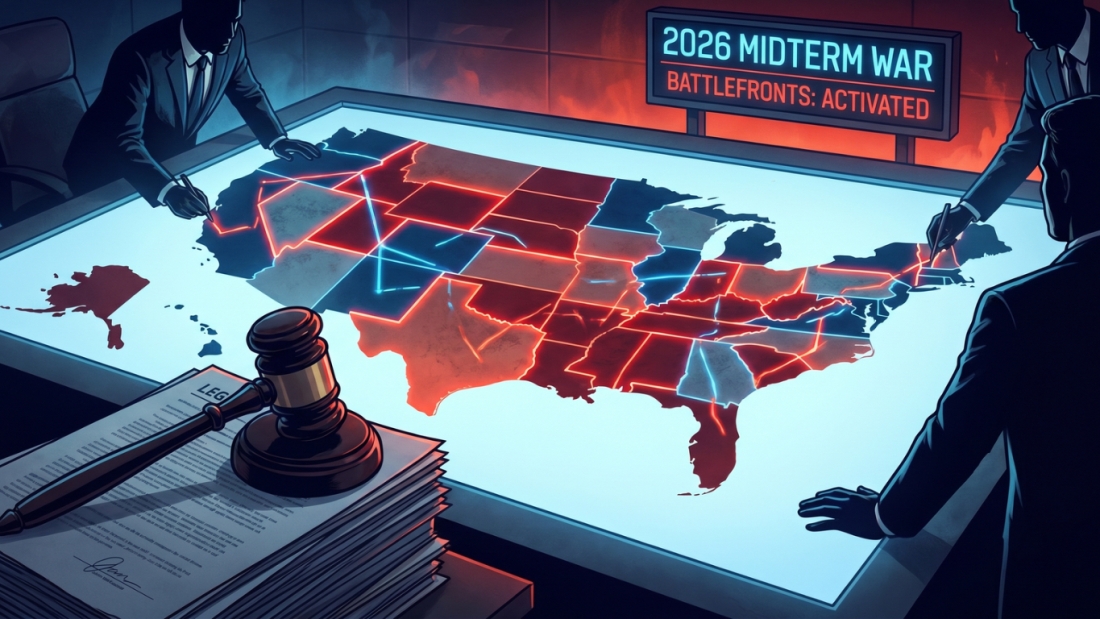
The 2026 Midterm War Has Already Started — And Most People Don’t Know the Battlefield has Already Changed.
April 29, 2026, a key date. You probably missed it. While everyone was arguing about gas prices and scrolling through their feeds, the Supreme Court dropped a nuclear bomb on American democracy — and by the time most people realized what happened, Republican-controlled state legislatures were already racing to redraw the map.
This isn’t about the elections in November. This is about something bigger. The 2026 midterm elections are being fought right now — not with campaign ads or door-knocking, but with legislative sessions, courtroom battles, and maps being redrawn in real-time to eliminate sitting members of Congress before voters even get a chance to cast a ballot.
Nobody’s writing this as a unified story. CNN covers Louisiana. POLITICO covers Florida. The New York Times covers Tennessee. But zoom out, and you see something nobody wants you to see: this is a coordinated, multi-front war for control of the House of Representatives, triggered by a single Supreme Court decision that gutted the Voting Rights Act and set off the largest redistricting arms race in modern American history. Here’s the full battlefield.
FRONT 1: The Supreme Court Just Nuked the Voting Rights Act
On April 29, 2026, the Supreme Court ruled 6-3 in Louisiana v. Callais that Louisiana’s second majority-Black congressional district was an unconstitutional racial gerrymander. Justice Samuel Alito, writing for the majority, effectively rewrote the rules for Section 2 of the Voting Rights Act (VRA) — the provision that for decades required states to draw districts that gave minority voters a fair shot at electing representatives of their choice. The decision didn’t technically strike down Section 2. It just made it nearly impossible to enforce.
The new requirements are brutal: To challenge a discriminatory map, plaintiffs must now prove not only that a district dilutes minority voting power, but also that any alternative map they propose meets every single one of the state’s political goals — including protecting incumbents and partisan preferences. They must also prove that racial-bloc voting can’t be explained by party affiliation, which is nearly impossible in the South where race and party are deeply correlated.
Justice Kagan, in her dissent, didn’t mince words: the majority had “eviscerated Section 2” and rendered it “all but a dead letter.” Translation? The Voting Rights Act — the landmark 1965 law that broke the back of Jim Crow-era voter suppression — just got gutted. And Republican-controlled state legislatures saw it as a green light.
FRONT 2: The Redistricting Arms Race
Per Wikipedia’s full tracker, this is the largest coordinated mid-decade redistricting effort in modern American history. States that already redrew their maps before November 2026:
| State | Who Benefited | Seats Shifted |
| Texas | Republicans | +5 R |
| California | Democrats | +5 D |
| Virginia | Democrats | +4 D |
| North Carolina | Democrats | +1 R |
| Missouri | Republicans | +1 R |
| Ohio | Republicans | +2 R |
| Florida | Republicans | +4 R |
That’s 22 House seats being reallocated — not by voters, but by state legislatures. And those are just the states that finished before May. Alabama, Tennessee, Mississippi, Louisiana, Georgia, and South Carolina are all considering or actively pursuing their own redraws.
The House GOP currently holds a 217-214 majority — meaning they can afford to lose two seats and still control the chamber. Democrats need to flip three seats to take back the House. When you’re fighting over margins that thin, every single district matters. And right now, both parties are fighting to rewrite the entire game board.
FRONT 3: Florida’s Special Session — The Same-Day Power Grab
Here’s where it gets wild. On April 29, 2026 — the same day the Supreme Court issued its ruling — Florida’s Republican-controlled Legislature passed a new congressional map. Not a week later. Not after public comment. The same day.
Governor Ron DeSantis had been prepping for this. In January, he called a special legislative session for April, conveniently timed to coincide with the Supreme Court’s decision. When the ruling dropped, Florida was ready to move.
The new map targets four Democratic incumbents: Kathy Castor (Tampa), Darren Soto (Orlando), Lois Frankel (Miami), and Debbie Wasserman Schultz (Miami). It splits the Puerto Rican community in Orlando across multiple districts, carves up Tampa Bay to eliminate Castor’s seat, and dilutes Democratic votes across South Florida. The goal? Flip Florida’s delegation from 20-8 Republican to 24-4 Republican — a gain of four GOP seats in a single stroke.
DeSantis’s legal counsel argued that because the Supreme Court weakened the VRA, Florida no longer has to follow the “Fair Districts” amendments in its own state constitution — the provisions that explicitly ban partisan gerrymandering. Democratic election lawyers have promised lawsuits, but the map is already law. DeSantis signed it May 4. This wasn’t opportunism. This was planned. And it worked.
FRONT 4: The Hit List — Specific Seats Being Targeted
Forget abstract discussions about “partisan advantage.” Let’s talk about the actual human beings Republicans are trying to erase from Congress.
Tennessee’s 9th District — Memphis
Target: Rep. Steve Cohen, the only Democrat in Tennessee’s congressional delegation and one of Trump’s most vocal critics in the House.
Tennessee Governor Bill Lee called a special session on May 1 to redraw the state’s maps. Senator Marsha Blackburn proposed a plan that would split Memphis into three separate districts, stretching one all the way to Chattanooga along the southern border. The goal? Dilute the Black vote in Memphis — which makes up the core of Cohen’s support — and create a 9-0 Republican sweep of Tennessee’s delegation.
Cohen didn’t hold back: “This is a transparent effort to dilute the Black vote in Tennessee to the point of irrelevance. The Supreme Court has gone totally rogue.” Oh, and by the way? Tennessee’s primary filing deadline already passed in March. So if Republicans succeed, voters who already filed to run won’t even know what district they’re in.
Mississippi’s 2nd District
The 2nd District is over 60% Black and represented by Democratic Rep. Bennie Thompson. Governor Tate Reeves announced a special legislative session scheduled for around May 20, initially to redraw state Supreme Court districts. But Republicans are openly discussing adding congressional redistricting to the agenda.
The math is simple: crack the 2nd District, spread Black voters across multiple Republican-leaning districts, and you flip another Democratic seat red.
Louisiana’s 2nd District — Cleo Fields
This one is the most brazen. Louisiana’s congressional primary was supposed to happen on May 16. Ballots were already mailed. Votes were being cast. Then the Supreme Court ruling came down, and Louisiana Governor Jeff Landry suspended the entire primary.
Rep. Cleo Fields, a Black Democrat who won his seat in 2024 after a federal court ordered Louisiana to create a second majority-Black district, is now suing the state. His argument? “People are already voting. It adds insult to injury to come and say, ‘Your vote won’t be counted.'”
Republicans want to throw out those votes, redraw the map to eliminate Fields’ district, and revert to the old map with only one Black-majority district. Per CNN’s reporting, this could net the GOP 1-2 additional seats in Louisiana alone.
FRONT 5: Canceling Votes Already Cast
Let’s pause on Louisiana, because this is where the redistricting war crosses into truly dangerous territory. Louisiana’s primary was already underway. Absentee ballots were in the mail. Military voters stationed overseas had already received theirs. Early voting was scheduled to start. And then the state government said: “Never mind. We’re canceling it.”
Rep. Cleo Fields didn’t mince words: “People are already voting. It adds insult to injury to come and say, ‘Your vote won’t be counted.'” Think about what this precedent means. If a state can cancel an election mid-vote because a redistricting opportunity emerges, what’s stopping other states from doing the same? Alabama’s primary is May 19. Tennessee’s is in August. Both states have filed or are considering filing to redraw their maps. If the courts allow Louisiana to throw out votes, every state with a redistricting effort in the pipeline could do the same. This isn’t just gerrymandering. This is voiding votes that have already been cast. And it might be legal.
FRONT 6: The House Math
Here’s the real stakes. Republicans currently hold a 217-214 majority in the House (with several vacancies). That’s the narrowest margin in decades. To pass legislation, Republicans need near-total party unity. Lose two seats? You lose the majority.
Democrats need to flip just three seats to take back the House. Now add redistricting. According to Brookings Institution analysis, up to 12 majority-minority seats in the South are now at risk due to the Supreme Court’s ruling. If Republicans successfully redraw maps in Louisiana, Tennessee, Mississippi, Alabama, Florida, and Georgia, Democrats could lose 19 House seats from redistricting alone — before a single vote is cast in November. But here’s the twist.
FRONT 7: The Blue Wave vs. The Map — Why This Could All Backfire
Brookings also points out something most outlets are ignoring: the Republican strategy could spectacularly backfire. For decades, “packing” Black voters into majority-minority districts helped Republicans. By concentrating Democratic voters into a few districts, Republicans made the surrounding districts whiter and more conservative. It was a win-win for the GOP: they could claim to support minority representation while quietly locking in Republican majorities everywhere else.
But now, Republicans are doing the opposite. They’re “cracking” these districts — spreading Democratic voters across multiple districts to dilute their power. On paper, this should flip more seats red. But there’s a problem: If a Democratic wave is coming, spreading Democratic voters into previously safe Republican districts makes those districts competitive.
And signs of a blue wave are everywhere. Abortion rights are driving turnout. Trump’s approval rating is underwater in swing states. Moderate Republicans are retiring in record numbers. If Democrats overperform in November — which midterms historically favor the party out of the White House — these newly redrawn “safe” Republican districts could suddenly flip blue.
It’s called “dummymandering” — when you gerrymander so aggressively that you accidentally make your own seats vulnerable. And per analysts at Democracy Docket, Republicans may have just walked into that trap.
Redistricting Update For 2026:
— OSZ (@OpenSourceZone) May 4, 2026
Passed:
🔴 TX: +5
🔴 FL: +4
🔴 OH: +1
🔴 NC +1
🔵 CA: +5
Getting appealed:
🔴 MO: +1
🔵 UT: +1
🔵 VA: +4
Called a special session:
🔴 LA: +1-2
🔴 AL: +1-2
🔴 TN: +1
Total:
Appeal maps passes: 🔴 R+5–7
Appeal maps get strike down: 🔴 R+9–11 pic.twitter.com/LUD2dzX7h0
🚨Tennessee Gov. Bill Lee NOW calls special session to REDRAW congressional maps
— Morse Report (@MorseReport) May 1, 2026
5 states have now officially begun redistricting processes after Supreme Court delivered a DEVASTATING blow to Democrats’ race-rigging scheme.pic.twitter.com/X0KlTgXx3g https://t.co/h0cy5XjB2b
This Is the War Nobody’s Talking About
Here’s what nobody wants to say out loud: the 2026 midterm elections might have already been decided — and it had nothing to do with voters. You can knock doors, donate to campaigns, register voters and phone bank and canvas your neighborhood. But if your district gets erased by a state legislature before Election Day, none of that matters.
The Supreme Court didn’t just weaken the Voting Rights Act on April 29. They opened the floodgates for the largest mid-decade redistricting war in modern history. Seven fronts. Dozens of seats. Ballots being thrown out mid-vote. Sitting members of Congress being legislatively erased.
And the wildest part? It might all backfire. If a blue wave hits in November, Republicans could find themselves defending a dozen districts they accidentally made competitive by cracking Democratic strongholds too thin.
But that’s the gamble both parties are making. Republicans are betting they can lock in a House majority by redrawing the map. Democrats are betting they can overcome it with raw turnout. The battlefield just changed. The question is: will voters even realize it before it’s too late?
Read more: 9 Senate Races That Decides Whether Trump Gets His Way in 2026
Leave A Comment