

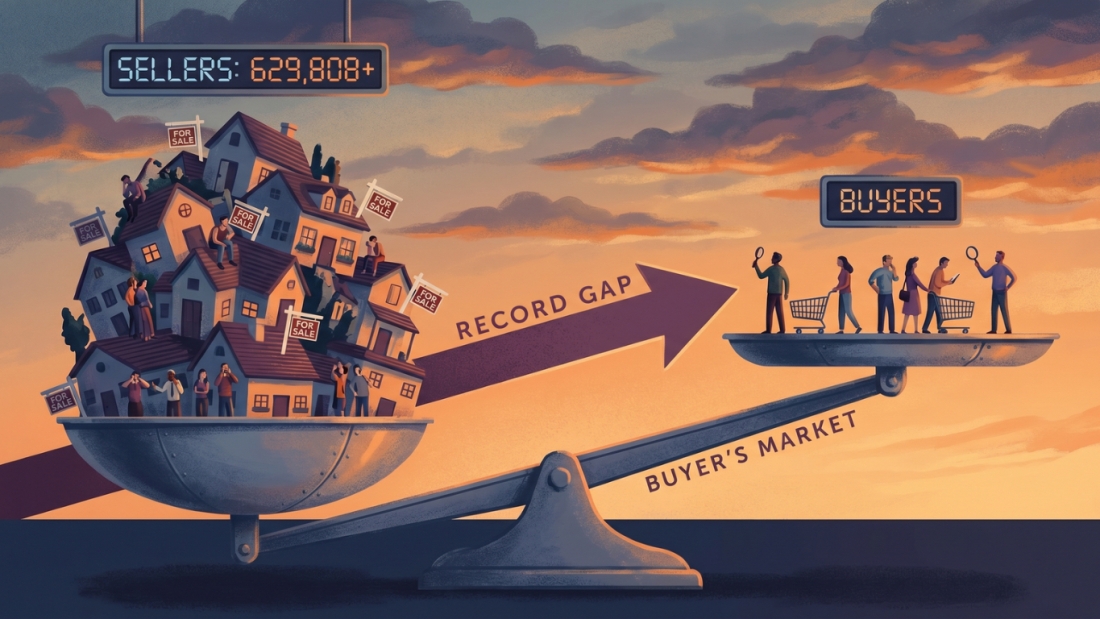
The Housing Market Has Flipped—And It’s Historic
If you’ve been watching the housing market recently, you’ve probably noticed something feels off. Homes are sitting on the market longer. Sellers are getting more flexible on price. And if you’re a buyer right now? Well, you’re in a position we haven’t seen in over a decade. Here’s the headline: According to Redfin’s latest data, there are 629,808 more home sellers than buyers in February 2026. That’s a 46.3% gap—the largest margin in Redfin’s records going back to 2013. A year ago, the gap was only 449,409 (29.8%). We’re not just seeing a market shift; we’re watching a seismic move.
For context: that’s nearly 630,000 more people trying to sell their homes than people trying to buy them. Think about what that means. Sellers are competing with each other. Buyers? They’re calling the shots.But here’s the twist—and it’s an important one—this “buyer’s market” isn’t the bargain-hunting opportunity it might sound like. Why? Because home prices haven’t collapsed, and most people still can’t afford to buy even if prices have softened. Let’s break down what’s really happening.
The Perfect Storm: Why Sellers Are Flooding the Market
This record gap didn’t happen overnight. It’s the result of several colliding forces, and understanding them is key to knowing what comes next. Home prices are up approximately 40% nationally between 2020 and 2025, according to Newsweek reporting on market data. In just five years, the cost of entry into homeownership has become almost unattainable for average Americans. To put this in perspective: a home that cost $300,000 in 2020 is now worth around $420,000. That’s not just inflation—that’s a fundamental repricing of real estate that’s left millions of potential buyers sitting on the sidelines.
Remember the pandemic-era mortgage rates under 3%? Those days are long gone. Freddie Mac data shows 30-year fixed-rate mortgages are hovering around 6.37% as of April 2026, with rates near 6.9% earlier in the year. Combined with higher home prices, your monthly payment is nearly double what it would’ve been in 2021. The math is brutal. At 6.9% on a $400,000 home, you’re looking at over $2,600 a month just in principal and interest—before taxes, insurance, and HOA fees. Many buyers have simply tapped out.
Layoffs in tech and other sectors, tariff fears, and geopolitical tensions, including the Iran conflict, are creating widespread anxiety about the economy. People who were on the fence about selling have decided to pull the trigger while the market’s still strong. People considering buying? They’re waiting to see what happens next.
Where the Seller Desperation Is Worst
This is the interesting part: inventory is rising, and it’s largely due to the easing of the mortgage lock-in effect and new construction in the Sun Belt. Homeowners who locked in those super-low pandemic rates are finally willing to sell (knowing they’ll lose that rate), and new construction is flooding markets like Austin, Nashville, and Phoenix. More inventory + fewer buyers = more pressure on prices and more negotiating power for those who are actually buying. The imbalance isn’t evenly distributed across the country. Some markets are absolutely brutal for sellers.
The Sun Belt Is Drowning in Inventory
The worst hit areas are predominantly in the South:
Miami, FL: 163% more sellers than buyers
Nashville, TN: 120% more sellers than buyers
Austin, TX: 112% more sellers than buyers
West Palm Beach, FL: 110% more sellers than buyers
San Antonio, TX: 104% more sellers than buyers
These figures come directly from Redfin’s February 2026 analysis, and they tell a clear story: the Sun Belt’s explosive growth of the past five years has reversed. These were the markets that attracted droves of remote workers during the pandemic. Now? Sellers are competing hard for a shrinking pool of buyers. If you want a deeper dive into why Florida specifically is struggling, check out why the Florida housing market is losing its newcomers—it’s a critical read for understanding the bigger picture.
The Northeast Still Has Some Seller Strength
Not all markets are equally hit. According to Redfin, a few areas still favor sellers: Newark, NJ; Montgomery County, PA; Nassau County, NY; Milwaukee, WI; and New Brunswick, NJ. These markets haven’t experienced the explosive growth-then-reversal cycle of the Sun Belt, so buyer demand is steadier. If you’re looking at this data, you’re probably asking: Is this actually good news for buyers, or is it a trap?
The answer: It’s complicated.
Technically, yes, this is a buyer’s market. You have more options. Sellers are more willing to negotiate. You can be pickier about which home you buy. The negotiating leverage is firmly in your court. The median home price sits at around $405,400 as of December 2025, with 30 consecutive months of year-over-year price increases, according to PBS NewsHour. This is important: prices aren’t collapsing. They’re still elevated, but they’re not falling off a cliff everywhere. In some markets, we’re seeing real price softening. In Cape Coral, Florida, prices are down 9.6%, which is significant. Other markets are seeing modest price cuts, longer time-on-market, and reduced bidding wars.
Sellers outnumbered buyers by a record 37% in October, giving homebuyers room to negotiate.
— Redfin (@Redfin) November 28, 2025
The buyer’s markets are concentrated in the Sun Belt and on the West Coast, while balanced markets and seller’s markets skew more toward the Midwest and East 👉 https://t.co/njbg6l3Zgm pic.twitter.com/yggkZnEBR0
BREAKING 🚨: U.S. Housing Market
— Barchart (@Barchart) April 13, 2026
Home Sellers now outnumber Buyers by 630,000, the largest gap ever recorded 🤯👀 pic.twitter.com/BhtFIgPD4D
The Bad News (and It’s Significant)
But here’s the reality check: most people still can’t afford to buy. Those higher prices combined with higher mortgage rates have pushed homeownership out of reach for a massive segment of the population. A buyer’s market only matters if you have the financial capacity to actually buy. If you’re a first-time homebuyer or you’re trying to move up the property ladder, this market isn’t offering much relief. You might get a slightly better deal on a home, but the fundamental problem—affordability—hasn’t been solved.
What Should You Do?
If you’re a seller, this is sobering. It’s no longer a seller’s market. If you’re planning to list, be realistic about pricing, invest in curb appeal, and be prepared to negotiate. The window for easy sales has closed.
If you’re a buyer, this moment is actually your best opportunity in years—but only if you’re financially ready. Lock in your financing now while rates are where they are. Get pre-approved. Have your down payment ready. When you find the right home, you can make a strong offer without the fear of being outbid by 20 other people.
If you’re on the fence about either buying or selling, remember: markets move in cycles. The question isn’t whether you can wait for a “perfect” time (you can’t predict that), but whether your personal circumstances make now the right time for you. The housing market is telling us something important: the easy money days are over. Prices won’t spike 40% again in five years. Mortgage rates won’t drop back to 3% anytime soon. What we’re facing now is a normalization—and normalization means those of us who are prepared have leverage.
The question is: are you ready to use it?
Leave A Comment