

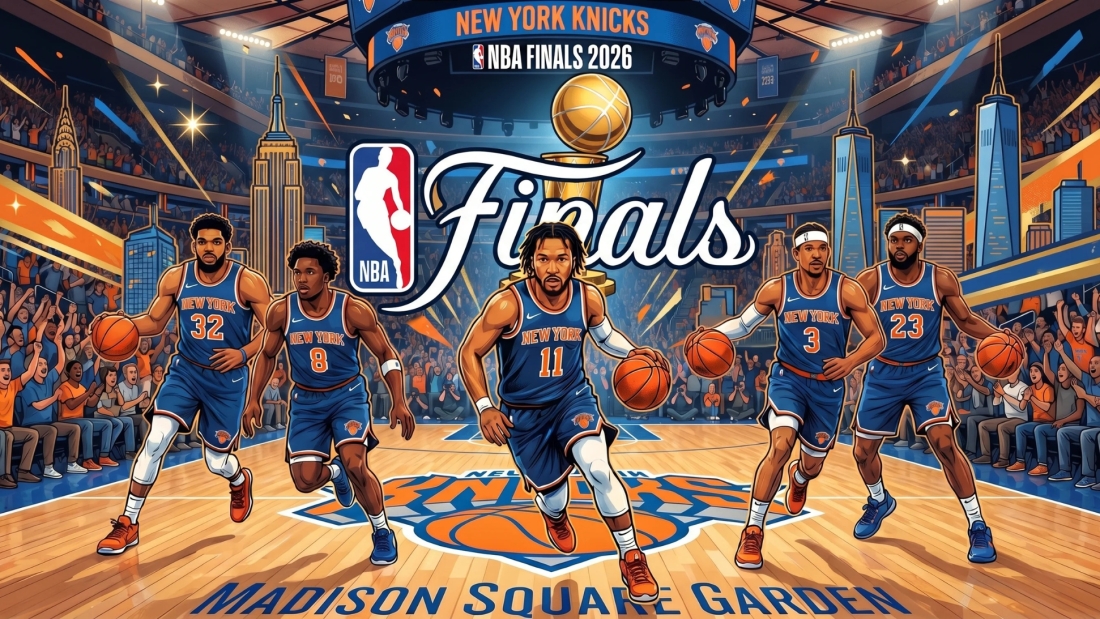
Many thought last year they had to blow it up. Others thought Mike Brown was a lateral move and this roster had a ceiling. Now, eleven straight playoff victories and a NBA Finals berth. The only ceiling this team is looking for is the one at MSG where they hope a future championship banner hangs.
New York fans have run a marathon to get to their first NBA Finals for the first time since 1999. The Thibs firing, Hiring Mike Brown. The Giannis speculation. The “don’t blow it up” argument when everyone was screaming to tear it down after last year’s ECF loss. Every beat of this story, has led us to this almighty run that New York fans have never seen.
Go back to June 2025. The Knicks had just lost to the Pacers in the Eastern Conference Finals — their first trip to the conference finals in 25 years — and the reaction was exactly what you’d expect from a fanbase that’s been conditioned by two decades of organizational malpractice to assume the worst. Fans were screaming for trades. Media was running “what went wrong” columns. The whole discourse had that familiar, suffocating energy of a franchise about to panic and destroy something good because it wasn’t perfect yet.
And when the Knicks fired Thibodeau — a move that genuinely shocked people given that he’d just taken them deeper than they’d been since the Clinton administration — we didn’t panic with everyone else. Rather, we wrote “Knicks Hoping Thibodeau Firing Can Lead to Warriors Parallel” and framed it through the lens of other franchises that upgraded from a good coach to a great one. Mark Jackson to Steve Kerr. A foundational builder replaced by a system architect who could take the same talent and unlock another gear. Eleven months later, the Knicks are in the Finals.
It Wasn’t Magic — It Was Architecture
The Knicks’ 2026 Finals run isn’t a random hot streak. It isn’t a fluke. It’s the logical conclusion of a process that started with a controversial coaching change, continued through a philosophical transformation, survived a rocky mid-season stretch, and culminated in the most statistically dominant playoff run in modern NBA history. And if you weren’t tracking the process, the result looks like magic. It wasn’t magic. It was architecture.
So let’s build this thing from the ground up the way the Knicks did. Start with the coaching change, work through the identity shift, and end where we are now: eleven straight wins, two consecutive sweeps, and a city losing its collective mind for the first time in 27 years.
The Mike Brown They Didn’t See Coming
The Mike Brown hiring was always going to be polarizing. The man’s most famous head coaching moment before this season was getting swept in the 2007 Finals with a 22-year-old LeBron James, and his subsequent career as a head coach in Cleveland and Sacramento didn’t exactly scream “championship architect.” When the Knicks brought him in, the discourse was brutal. Lateral move. Retread. The Knicks being the Knicks again.
But what was the Mike Brown who walked into the Knicks facility in July 2025 was not the same coach who got fired in Cleveland. He’d spent the better part of fifteen years as an assistant on championship staffs, most critically with the Golden State Warriors, where he didn’t just observe the revolution — he helped engineer it. He absorbed spacing principles, motion concepts, the idea that defense and pace aren’t mutually exclusive. Watched Steve Kerr manage superstars. Learned how culture compounds over time. And he came to New York with a philosophy that was specifically calibrated for this roster, not some recycled playbook from 2007.
The Measurable Differences
The differences from Thibs were immediate and measurable. Just eight games into the season, the fingerprints were already visible. The Knicks had gone 5-0 at home for the first time since 2012-13. Bench scoring jumped from 21.7 to 30.4 points per game, because Brown actually trusted his reserves. Three-point attempts spiked from 34.1 to 43.6 per game, a philosophical overhaul in shot selection that signaled the end of Thibs’ grind-it-out approach. Third-quarter performances — historically a problem under Thibodeau — became a strength, suggesting that Brown’s halftime adjustments were sharper and his rotational management was keeping legs fresh for the second half.
Eight games is a small sample. But the trends we identified as “sustainable” in November turned out to be exactly that — the early returns of a system that would eventually produce the most dominant postseason the franchise has ever seen.
Defense: Flipping the Switch
The real tactical masterstroke, though, didn’t happen until mid-season. Through the first 43 games, the Knicks’ defense ranked 18th in the league. Average. Forgettable. The kind of number that makes you wonder if maybe the Thibs critics were right about needing that hard-nosed defensive identity. Then on January 20th, Brown made adjustments — schematic, rotational, philosophical — and from that point forward, the Knicks posted the league’s top defensive rating at 103.1. Not top five. Not “among the best.” Number one. That transformation is the single most important development of the Knicks’ season, because it’s what gave this team its identity.
Seek and Destroy Isn’t a Slogan — It’s a Doctrine
You hear “seek and destroy” and maybe you think it’s just a slogan. The kind of thing coaches put on t-shirts and players say in postgame pressers. But with this Knicks team, it’s a tactical doctrine with specific, identifiable components — and understanding those components is how you understand why this team just went on an eleven-game winning streak that produced a combined point differential of +262 over their last ten games, the most dominant stretch in NBA postseason history.
Start with the defensive switching. Most teams that switch everything do so passively — they switch to avoid getting beaten, to stay in front of their man without expending extra effort. The Knicks switch to attack. They identify your action, meet it at the point of initiation, and force you to reset with less time and worse spacing. When OG Anunoby switches onto your ball handler, he doesn’t just contain — he suffocates. When Mikal Bridges blows up a screen, he doesn’t just recover to his man — he takes away the passing lane to the roller and forces a secondary read that the offense hasn’t practiced. The scheme that led to fast break points is what put the dagger into the Cavs.
The Transition Game
Following this shift in the transition game. The Knicks led the playoffs in fast-break points for a reason — the defense generates offense. A deflection becomes a steal becomes a two-on-one becomes a dagger three before the opposing coach can even call timeout. In the clinching game against Cleveland, the Knicks won fast-break points 33-9.
And then there’s the physicality. The Knicks led the playoffs in hustle metrics — loose balls recovered, deflections, contested shots. These aren’t talent stats. These are identity stats. They measure want-to, effort, the willingness to hit the deck for a 50-50 ball in the third quarter of a game you’re already winning by 20. They have shown their killer instinct and it does both for 48 minutes with a relentlessness that feels almost ideological.
The spiritual component matters just as much as the tactical one, though. “Seek and destroy” isn’t just how the Knicks play — it’s who they are. It’s the mentality that allowed them to fall behind 2-1 against Atlanta in the first round and respond with three consecutive blowouts. The mentality that produced a 140-89 annihilation in Game 6 — featuring a 47-point halftime lead, the largest in NBA playoff history. It’s a mentality that’s specifically, unmistakably taken over in New York.
Eleven Straight and the Numbers Still Undersell It
Now here’s where it gets really fun, because the eleven-game streak isn’t just a number — it’s a proof of concept. It’s the empirical validation of everything Mike Brown built and everything the roster committed to.
The streak started in Game 4 against Atlanta and didn’t end until… well, it still hasn’t ended. Tied for the third-longest winning streak in a single NBA postseason, matching the 2001 and 1989 Lakers. Nine of the eleven wins were by double digits. The Knicks set an NBA record by winning six consecutive road playoff games by 10-plus points. Their offensive rating during the streak hit 122.2 — best in the postseason. They shot 53.8% from the field over a ten-game stretch, the kind of efficiency that doesn’t just beat teams — it demoralizes them.
And the thing is, the numbers almost undersell it. Because those numbers don’t capture the feeling of watching the Knicks go up 30 in the first half and then somehow increase the margin. They don’t capture the way opposing coaches started pulling starters in the third quarter of playoff games — playoff games — because the outcome was already decided. They don’t capture the look on the Cavaliers’ faces in Game 4 of the ECF, down 37 at home, watching the Knicks celebrate on their floor in what became Cleveland’s worst home playoff loss in franchise history.
Nineteen Years in the Wilderness: The Coach’s Redemption Arc
The Mike Brown factor deserves its own space in this story because the man’s journey is almost as compelling as the team’s. Nineteen years between Finals appearances as a head coach — an NBA record. He built something new. His “pace and space” philosophy — what he called “conceptual basketball” — was designed to create organized chaos for defenses. Rapid ball movement. Multiple initiation points. Drive-and-kick sprays that created open threes. A read-and-react system that reduced the isolation burden on Brunson and turned Towns into a playmaking hub rather than just a floor spacer.
But the tactical innovations alone don’t explain it. Brown also proved to be better in the in-game chess match. Against Cleveland, he repeatedly attacked James Harden on defense — data showed Brunson shot a blistering 7-of-11 when guarded by Harden. He devised a brilliant strategy using Mitchell Robinson to manipulate the bonus situation: insert the poor free-throw shooter when Cleveland was near the penalty, bait them into a foul, then sub Robinson out and force Cleveland to deal with Brunson and Towns at the line for the rest of the quarter.
Heading into the NBA Finals, Brown has earned this city’s trust by treating its team not as a brand to be managed but as a roster to be maximized, and the results speak for themselves — a 53-29 regular season record, a first-ever NBA Cup in December, and a trip to the Finals built on a 12-2 playoff run that felt more like a coronation than a competition.
Twenty-Seven Years of Pain, and Then This
And this is where I get sentimental, and I don’t apologize for it. Twenty-seven years. The Knicks haven’t been to the Finals since 1999, and if you were born in the late ’90s and grew up a Knicks fan, your formative basketball memories are traumatic. What you actually lived through was the Isiah Thomas era. Eddy Curry’s contract. The hope-then-collapse cycle that repeated itself so many times it stopped feeling like bad luck and started feeling like destiny. From 2001 to 2022, the Knicks had the lowest winning percentage in the NBA. They won one playoff series in over two decades. The basketball Mecca became a mausoleum.
The 1999 comparison is inevitable, but it only goes so far. That team — Jeff Van Gundy’s squad, the 8-seed that shocked the world in a lockout-shortened season — was defined by blue-collar grit and resilience. They lost Patrick Ewing to an Achilles injury in the Conference Finals and still clawed their way to the championship round on the backs of Latrell Sprewell, Allan Houston, and Larry Johnson. They were the ultimate underdog. The 2026 Knicks aren’t an underdog — they’re a wrecking ball.
But there’s one connection that transcends all of it. Rick Brunson was a reserve guard on that 1999 team. There’s a photo that’s been circulating — a toddler Jalen Brunson at the 1999 Finals, twenty-seven years before he became the ECF MVP who led the franchise back to the same stage. Father to son, ’99 to ’26, the basketball passing literally and figuratively between generations. If you wrote that in a screenplay, a producer would tell you it’s too on the nose. But this is sports, and sports doesn’t care about subtlety.
This Team’s Own Identify
This team is its own thing, though. Don’t let the nostalgia obscure that. The 1999 Knicks were defined by their fight. The 2026 Knicks are defined by their dominance. They didn’t survive and advance — they annihilated. A +19.4 average margin of victory entering the Finals — the highest in NBA history for a team reaching the championship round. These aren’t the scrappy upstarts. These are the bullies. And New York loves it, because New York has always been a city that respects the willingness to come and take what’s yours.
The celebration outside Madison Square Garden when the ECF ended was something else. Thousands of fans flooding the streets of Midtown, the whole city vibrating at a frequency that hadn’t been felt since… honestly, since ever, for most of the people celebrating. The sports landscape of the biggest city in the world unified around a single team for one night. That doesn’t happen in New York. New York doesn’t agree on anything. And yet on May 25th, every corner of the five boroughs agreed: the Knicks are back, and it feels different this time.
Four More Wins
The Finals opponent — whoever emerges from the Thunder-Spurs Western Conference series — will present a challenge unlike anything the Knicks have faced in this run. Either Shai Gilgeous-Alexander or Victor Wembanyama’s era-defining versatility. The Knicks don’t have home-court advantage. The eleven-game streak will be tested against the West’s best.
But here’s why I’d bet on this team: they’ve already proven that their identity scales. It started with beating a Hawks team that had them down 2-1 by adjusting and responding with three consecutive demolitions. They swept a 76ers team that was supposed to test their half-court offense, and then swept a Cavaliers team that had beaten Pistons who had the best record in the East and made them look like they didn’t belong on the same floor. Different opponents, different challenges, same result — because “seek and destroy” isn’t a game plan that gets schemed out. It’s a collective decision to play harder, play smarter, and play meaner than whoever’s standing across from you. You can’t game-plan against conviction.
If you’re a Knicks fan, take it all in. This is your good old days. Twenty-seven years of pain, of “wait till next year,” of watching other cities celebrate while the Garden sat quiet — that era is over. The Knicks aren’t just back. They’re in the NBA Finals. And the seek-and-destroy mentality that brought them to this moment isn’t going anywhere. Four more wins. That’s all that stands between this team and the only thing that matters. And if you’ve been paying attention — if you’ve been reading along since the beginning — we know you’ll be praying to the very end.
Leave A Comment