

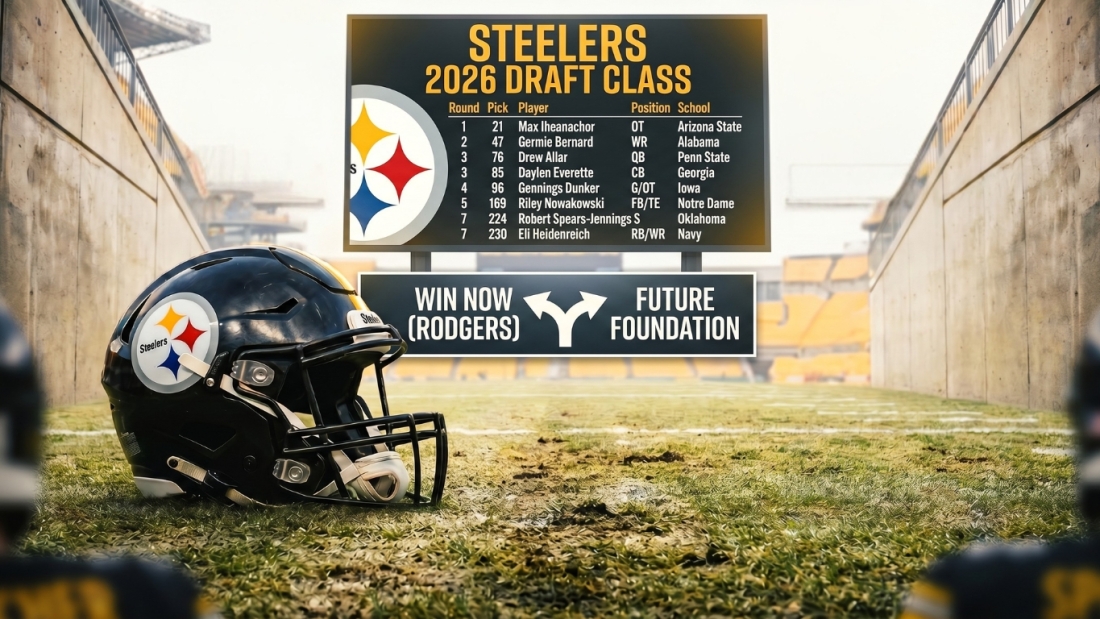
Based on the two pieces we wrote heading into draft season, the pre-draft read was pretty much on target: the Steelers had already cleaned up a lot of the roster in free agency, entered the draft with flexibility, and still needed to come away with offensive line help, receiver depth, secondary depth, and some kind of quarterback succession plan. After the draft, that is basically exactly what Omar Khan and Mike McCarthy tried to do.
The Steelers ended up making 10 picks, headlined by a first-round offensive tackle, a second-round receiver they traded up for, and a third-round quarterback that has people talking. They were aggressive. They were strategic. And they left Pittsburgh with a draft class that looks like it could define the next era of Steelers football.
The Full 2026 Draft Class
Round | Pick | Player | Position | School |
1 | 21 | Max Iheanachor | OT | Arizona State |
2 | 47 | Germie Bernard | WR | Alabama |
3 | 76 | Drew Allar | QB | Penn State |
3 | 85 | Daylen Everette | CB | Georgia |
3 | 96 | Gennings Dunker | G/OT | Iowa |
4 | 121 | Kaden Wetjen | WR/Returner | Iowa |
5 | 169 | Riley Nowakowski | FB/TE | Indiana |
6 | 210 | Gabriel Rubio | DT/DE | Notre Dame |
7 | 224 | Robert Spears-Jennings | S | Oklahoma |
7 | 230 | Eli Heidenreich | RB/WR | Navy |
By Steelers.com, ESPN, and CBS Pittsburgh.
The Big Picture
The Steelers now look like a team that is trying to do two things at once: Try and win now if Aaron Rodgers comes back. Prepare for life after Rodgers if he does not. That is the entire story of this draft and the draft is over.
They did not blow up the roster or panic-draft a quarterback in Round 1. Omar Khan did not ignore the offensive line or sit back with 12 picks and let the board happen to them. They used their capital aggressively, trading up for Germie Bernard in Round 2 and Gennings Dunker in Round 3. So where do they stand now? They are deeper, younger, more flexible — and still tied to the Rodgers decision in the short term.
The Steelers Solved the Offensive Line Question — Just Not the Way Many Expected
Before the draft, the major unresolved need was left guard after losing Isaac Seumalo. I laid out the question perfectly: do they take a guard at 21, wait until Day 2, or use the pick on best player available? The Steelers chose a hybrid answer. They did not draft Vega Ioane or a pure guard at 21. Instead, they took Max Iheanachor, an offensive tackle from Arizona State, at No. 21.
This pick told us a few things:
- The Steelers were not comfortable enough with the tackle situation, especially with Broderick Jones’ neck injury still uncertain and declining his $19.1 million fifth year option.
- They valued offensive line upside over forcing the left guard pick.
- They wanted flexibility up front, not just a one-position answer.
Iheanachor is a fascinating story. He is a Nigerian-born immigrant who only started playing organized football in 2021. At 6-foot-6 and over 320 pounds, he did not allow a single sack in his senior season across 484 pass-blocking snaps. He ran the second-fastest 40-yard dash among offensive linemen at the Combine (4.91 seconds). The physical tools are elite. The experience level is raw. That is the bet.
Then they came back in Round 3 and addressed the original Seumalo hole with Gennings Dunker from Iowa. ESPN noted that while Dunker played tackle in college, Steelers offensive line coach James Campen said the team views him as guard first, tackle second. That matters. This is the left guard plan.
So, where does the offensive line stand now? Pretty solid — with upside.
The Steelers have invested premium assets into the offensive line repeatedly in recent years, and this draft doubled down on that. Iheanachor gives them tackle insurance and potential long-term starter ability. Dunker gives them a real competition at left guard instead of just handing the job to Spencer Anderson or Brock Hoffman. The key word is competition. They did not sign a proven plug-and-play Seumalo replacement, but they added enough young talent to make the line deeper and more athletic.
Wide Receiver Went From “Solved Enough” to a Real Strength
Earlier in the offseason, we said the Pittman trade meant the Steelers did not need to spend an early pick on receiver. That was logical at the time. DK Metcalf and Michael Pittman Jr. gave them a legit top two. But the Steelers clearly disagreed with the idea that they were done there. They traded up from No. 53 to No. 47 with the Colts to take Germie Bernard from Alabama. According to CBS Pittsburgh, they sent picks 53, 135, and 237 for 47 and 249. ESPN reported that the Steelers had their sights on USC receiver Makai Lemon before Philadelphia jumped them, then pivoted to Bernard. That says receiver was more than a luxury. It was a priority.
Now the room looks much different:
- DK Metcalf: vertical threat / alpha physical presence
- Michael Pittman Jr.: chain mover / contested catch receiver
- Germie Bernard: versatile inside-outside route runner
- Kaden Wetjen: returner / manufactured-touch slot option
- Other depth pieces competing behind them
Bernard brings exactly what McCarthy’s offense values: physicality, route-running intelligence, and versatility. He forced 17 missed tackles in 2025 and tied for fifth in the SEC with seven touchdown catches. Doing this while lining up inside, outside, and or with his experience in the return game. He is also a willing blocker. That is a major upgrade from where things stood before free agency. Bernard gives them the kind of receiver Rodgers typically trusts: reliable, physical, detailed, and useful in the short-area passing game. Wetjen gives them the return juice they lost with Calvin Austin III and Kenneth Gainwell leaving. Wetjen led the FBS in punt return average (26.8 yards) and had four punt return touchdowns at Iowa.
The conclusion: Pittsburgh’s receiver room is no longer just “fixed.” It might be one of the more improved position groups on the roster.
The QB Situation Got More Interesting, Not Less
This is the biggest shift from the pre-draft outlook. I wrote that the Steelers probably would not spend a premium pick on quarterback in this weak class. Technically, they did not use a first- or second-rounder. But they did use the 76th overall pick — the George Pickens trade pick — on Drew Allar. Steelers Twitter did not take that reminder too kindly. Friends of Steelers fans made so many Carson Beck jokes, they forgot that this was a possibility. Allar has the size and arm strength McCarthy values in an AFC North quarterback. I will break that down further at a later time.
The current quarterback picture now looks like:
- Aaron Rodgers: still the likely 2026 starter if he returns
- Mason Rudolph: veteran floor/backup option
- Will Howard: 2025 sixth-round developmental QB
- Drew Allar: 2026 third-round developmental QB with better physical tools
Allar is the kind of project McCarthy has succeeded with before. At 6-foot-5 and 228 pounds with a cannon arm, he has prototypical size and arm strength. He threw for 3,327 yards and 24 touchdowns in 2024 and holds Penn State records for completion percentage (63.2%) and interception percentage (1.3%). He is one of only three FBS players to throw over 1,000 career passes with fewer than 15 interceptions. But, there is always a BUT, he is also inconsistent. Against top-10 Power Four opponents in 2024, his completion rate dropped to 53.7% with three touchdowns and four interceptions. He broke his ankle in 2025, cutting his season short. He speeds up under pressure and sometimes locks onto pre-snap reads.
Hall of Fame quarterback Kurt Warner said Allar’s arm talent “jumps off the screen” and he could be the “steal of the draft” if he can control his arm and become consistently accurate. That creates a crowded quarterback room, but it also clarifies the Steelers’ thinking: they are not putting all their future eggs in the Will Howard basket. Smart considering Will Howard didn’t even play a snap in the preseason. Allar gives them a second young quarterback lottery ticket or a risky stock, if you will. If Rodgers comes back, Allar can sit and develop. If Rodgers retires, the Steelers can let Rudolph, Howard, and Allar compete — although that would obviously lower the team’s 2026 ceiling tremendously.
The big takeaway: Pittsburgh still does not have its guaranteed quarterback of the future, but it now has more optionality.
The Secondary Got More Depth
The Steelers already did a lot of secondary work in free agency with Jamel Dean, Jaquan Brisker, Darnell Savage, and Asante Samuel Jr. But they still needed young, cost-controlled depth. They got that with:
- Daylen Everette, CB, Georgia (Round 3, Pick 85)
- Robert Spears-Jennings, S, Oklahoma (Round 7, Pick 224)
Everette is the more important pick. He was taken at No. 85 and brings outside/inside versatility. ESPN noted he played outside corner at Georgia but also took slot and nickel reps at the Senior Bowl. That fits what Patrick Graham wants: defensive backs who can tackle, cover, and move around.
The Steelers now have a cornerback room with:
- Joey Porter Jr.
- Jamel Dean
- Asante Samuel Jr.
- Daylen Everette
- depth competition behind them
That is a much healthier group than what we were writing about in early March. Spears-Jennings is more of a seventh-round developmental safety/special teams type, but he adds athleticism and depth to a room that had a lot of moving parts. He ran a 4.32-second 40-yard dash at the combine, which gives you an idea of the speed he brings.
The conclusion: corner is no longer a glaring hole. It is now a deeper group with a real long-term developmental piece in Everette.
Defensive Line Still Feels Like the One Area They Did Not Fully Attack
This is the one spot where the draft feels a little light. We correctly identified defensive line youth as a need in our offseason analysis. Cam Heyward is back, Sebastian Joseph-Day was added, and Derrick Harmon was already part of the succession plan from the previous draft. But in 2026, the Steelers waited until Round 6 to take Gabriel Rubio from Notre Dame.
Rubio has size and inside-outside flexibility, but he is not the kind of premium defensive line investment that screams “future Cam replacement.” He was not even invited to the NFL Combine. He is more of a rotational depth piece and potential special teams contributor.
So the defensive line is better than it was before free agency, but it still feels like a position they may need to revisit in 2027. The Steelers clearly prioritized offense, quarterback, and secondary depth over adding another high-end defensive lineman. That is not necessarily wrong. It just means the defensive front is more “stable for now” than “solved long-term.”
Special Teams Got a Boost
This is easy to overlook, but the Steelers clearly cared about special teams value in this class. Kaden Wetjen was drafted in Round 4 largely because of his return ability. Steelers.com noted he had 954 punt return yards, a 17.7-yard average, and four punt return touchdowns at Iowa, plus 1,538 kickoff return yards and two kickoff return touchdowns.
That matters in the modern NFL with the dynamic kickoff rules. Pittsburgh lost Calvin Austin III and Kenneth Gainwell, so they needed someone who could flip field position. Wetjen may have been a little rich in Round 4 if you only view him as a receiver. But if he is their top dual returner, the pick makes more sense. He is also not just a returner — he can play slot receiver and bring juice to manufactured touches in the passing game.
So, Did the Steelers Execute the Plan?
Mostly, yes. In March, before the draft, the roadmap was:
- Fix receiver ✓
- Add offensive line help ✓
- Get younger on defense ✓
- Do not force quarterback too early ✓
- Use draft capital aggressively or strategically ✓
- Maintain flexibility for 2027 ✓
After the draft, they checked most of those boxes.
What They Got Right
- Offensive line: Took Iheanachor in Round 1 and Dunker in Round 3.
- Receiver depth: Added Bernard and Wetjen after already trading for Pittman.
- Quarterback development: Took Allar in Round 3 without forcing a first-round QB.
- Secondary depth: Added Everette and Spears-Jennings.
- Special teams: Wetjen and later-round athletes should help immediately.
- Roster flexibility: Many picks have multi-position value.
NFL execs on the Steelers draft in The Athletic pic.twitter.com/3HSuI7HEwD
— Chris Dokish (@ChrisDokish) May 1, 2026
Longtime draft analysts Rob Rang on Steelers 2026 draft class and his grade of it #Steelers #NFL https://t.co/gx5WfHvCE1 pic.twitter.com/nAyyLSci8D
— Steelers Depot 7⃣ (@Steelersdepot) April 29, 2026
What Is Still Unsettled
- Aaron Rodgers’ decision still controls the 2026 ceiling.
- Left guard still has to be earned, not assumed.
- Drew Allar is a project, not a clean succession answer.
- Defensive line youth remains a medium-term need.
- The roster is better, but the AFC is still brutal.
Where They Stand Now
The Steelers are in a stronger position than they were before the draft, but the draft did not completely change their identity. It sharpened it. They are now a team built around:
- A deeper offensive line
- A much-improved receiver room
- A veteran-ready roster if Rodgers returns
- A developmental quarterback pipeline if he does not
- A secondary with more talent and versatility
- A coaching staff clearly trying to build a more modern, flexible offense
If Rodgers returns, the Steelers can be an AFC playoff team again with a puncher’s chance to make noise. The offense has enough weapons now: Metcalf, Pittman, Bernard, Pat Freiermuth, Darnell Washington, Dowdle, Warren, Kaleb Johnson, and an upgraded offensive line. That is a better supporting cast. If Rodgers retires, the Steelers are probably more of a transition team and have to pivot fast. They would have to find out whether Rudolph, Howard, or Allar can function in McCarthy’s offense. In that scenario, the roster is still better, but the ceiling drops from “contender” to “competitive evaluation year.”
The Post-Draft Verdict
The Steelers did not draft like a rebuilding team. They drafted like a team trying to extend a contention window by a thread. The Allar pick says there is still a level of uncertainty in the Rodgers situation. The Iheanachor and Dunker picks say they know the next quarterback — whoever it is — needs a better front. The Bernard pick says McCarthy’s offense needed more than just two big-name receivers. The Everette pick says they still want cheap, young defensive backs even after spending in free agency.
So, where do the Steelers stand now? They stand as one of the more improved teams of the 2026 offseason — but still one quarterback decision away from knowing what kind of season this really is. If Rodgers comes back, they are going to try and win now. If he does not, this is the beginning of the next Steelers quarterback search — only now with a much better foundation around whoever gets the job.
Leave A Comment