

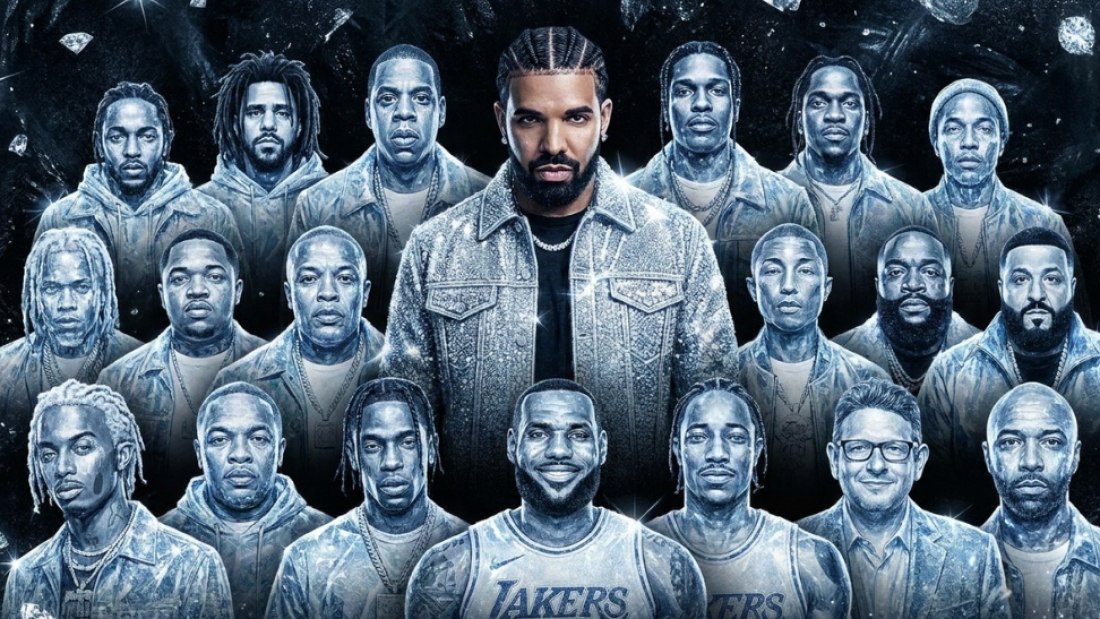
Here’s the uncomfortable truth about Iceman that neither Drake’s loyalists nor his haters want to hear: this album is not a comeback, and it’s not a collapse. It’s a manifesto. A 463,000-first-week, Billboard-record-shattering record from a man who decided that if the entire industry was going to write his obituary after the Kendrick Lamar feud, he was going to make damn sure he got the last word on every single person who gave Kendrick that platform.
It has been about two weeks since Drake surprise-dropped Iceman, Habibti, and Maid of Honour — a 43-song, three-album avalanche that immediately occupied the top three spots on the Billboard 200, making him the first artist in history to pull that off. Fifteen number-one albums. A tie with Taylor Swift.
But Iceman isn’t really about the numbers. It’s about the names. Sixteen of them we could identify. A world of traitors, opportunists, and people who owed him loyalty and chose the other side instead. That’s the paradox of Iceman: the technical execution is sharp, the subject matter is exhausting, and the result is another polarizing Drake project.
Kendrick Lamar
Kendrick isn’t just a target on Iceman — he’s the gravitational center of the entire project. Every other name on this list exists downstream of the Drake-Kendrick war. Every betrayal Drake catalogs, every friendship he mourns, every grudge he resurrects traces back to the fallout from a feud that exploded in 2024 and shook up the current landscape of hip-hop. “Like That.” “Not Like Us.” The Super Bowl Halftime Show. The Grammys. The consensus — from critics, fans, and the culture at large — was that Kendrick won. Decisively. Drake’s subsequent lawsuit against UMG over the promotion of “Not Like Us” only reinforced the perception that he was flailing.
Direct Shots
So Drake doesn’t try to land a single knockout punch on Iceman. Instead, he spreads Kendrick disses across nearly a third of the album — “Make Them Pay,” “Janice STFU,” “Make Them Remember,” “Dust,” “Make Them Cry” — in a death-by-a-thousand-cuts approach. On “Make Them Pay,” he goes after Kendrick’s streaming numbers with “Damn who is this guy for real, hundred million streams vanished, no one got questions… he a magician” — which, let’s be honest, sounds like a man who’s been refreshing Spotify dashboards at 3 AM and calling it research.
On “Janice STFU,” he dismantles Kendrick’s community-activist image: “White kids listen to you ’cause they feel some guilt and that’s how your soul gets fulfilled / Handing out turkeys on camera inside of your hood then you go back to the hills.” And then there’s the simplest, pettiest line: “F— a big three anyway.” And finally, on “Make Them Remember,” he even throws a Muggsy Bogues reference at Kendrick’s height, because apparently no angle is too small. (Pun intended.)
Every Diss On Drake's ICEMAN #drake #kendricklamar #iceman #RAPBEEF #RAP pic.twitter.com/8vdqv5GoL5
— MLT_REALTIM96 (@MltRealtim96) May 17, 2026
A compilation showing where Drake turned every diss Kendrick had toward him right back on him in “ICEMAN” https://t.co/IT9VSLf2oC
— Akademiks TV (@AkademiksTV) May 18, 2026
J. Cole
If the Kendrick section is about a war, the J. Cole section is about a funeral. These bars don’t hit like punches — they hit like a door closing. On “Make Them Pay,” Drake delivers what might be the most emotionally honest moment on the entire album: “I love you ’cause of the history, but if we being real, I could never forgive you.”. And then, quieter, almost like an afterthought: “And you never called me back…” He caps it on “Make Them Remember” with a declaration of principle: “I’d much rather death than submission.”
Cole was apparently a brother-in-arms, the other third of the “Big Three” mythology that defined a generation of rap. When the Kendrick beef exploded in 2024, Cole briefly entered the fray with “7 Minute Drill” — a diss aimed at Lamar — and then publicly apologized and retracted it. Most people viewed the retraction as humble and mature. Drake viewed it as the ultimate betrayal: not just neutrality, but active surrender.
That’s what makes “I’d much rather death than submission” so devastating. It reframes Cole’s apology — which the internet largely applauded — as cowardice. You don’t have to agree with Drake’s framing to feel the weight of it. And “you never called me back” is more damaging than any punchline could ever be, because it’s not a diss — it’s grief. By mourning the friendship publicly, Drake does something clever: he turns J. Cole into the cautionary tale. This is what happens when you don’t ride with me. It’s loyalty as ideology, and whether you find it admirable or toxic depends entirely on which side of the Drake-Kendrick line you stand on. Either way, it’s arguably the most effective section on the entire record.
Jay-Z
Drake didn’t go nuclear on Hov. He went subliminal, which tells you everything about the power dynamic. On “Janice STFU” and “Whisper My Name,” Drake rewrites the famous internet hypothetical with a single, bratty line: “I take 500K down to dinner, I never could learn shit from none of y’all.” If you’ve been online in the last five years, you know the debate: “$500,000 or dinner with Jay-Z?” Most people choose the dinner — the wisdom, the connections, the mentorship. Drake takes the cash and slams the door. It’s a rejection of the entire mentorship hierarchy that hip-hop runs on.
The subtext is clear — after Roc Nation selected Kendrick for the 2025 Super Bowl Halftime Show, Drake views Jay as having picked a side. The wrong one. The line is clever, disrespectful, and honestly kind of funny. But notice that Drake will name-drop LeBron directly, call out Cole by name, go thermonuclear on Rocky — and Jay-Z still gets the coded treatment.
Pusha T
The Drake-Pusha beef predates the Kendrick era entirely — this one’s been simmering since the Obama administration. Pusha’s 2018 track “The Story of Adidon,” which revealed Drake’s son to the world, remains one of the most notable diss records in modern hip-hop. The animosity has never cooled. On “Make Them Pay,” Drake doesn’t try to out-lyric Pusha. Instead, he flexes a different kind of power: “I own all the chains that they ever repped from Virginia…” He’s referring to his purchase of Pharrell’s old N.E.R.D. and Star Trak jewelry at auction — chains that carried decades of Virginia hip-hop cultural weight, now sitting in Drake’s house.
Drake dissing Jay-Z and Pusha T 😭 pic.twitter.com/14JZ2MLpRo
— sah (@soundlikesex) May 27, 2026
🧊🚨DEVELOPING: Drake dissed Grammy winning rapper ASAP Rocky on his new album ICEMAN as he clowned Rocky for releasing a song that was so poorly received that his baby mother Rihanna didn’t promote it on her pages.
— Dom Lucre | Breaker of Narratives (@dom_lucre) May 15, 2026
“Your baby mama ain’t even post your single, where she at?” pic.twitter.com/zcRXOQcocP
A$AP Rocky
This is where Iceman gets nasty. Not clever-nasty. Not strategic-nasty. Just nasty. Drake and Rocky’s tension has always lived at the intersection of professional rivalry and the fact that they both dated Rihanna — which, in the world of celebrity ego, is the kind of overlap that creates permanent scar tissue.
On “Burning Bridges,” Drake observes that Rihanna didn’t promote Rocky’s album Don’t Be Dumb: “Your baby momma ain’t even post a single, damn, where she at?” That line is genuinely funny and genuinely mean — the kind of specific, verifiable observation that makes a great diss because the target can’t respond without making it worse. He also raps about “sharing women” on “Ran to Atlanta,” a barely veiled reference to their shared romantic history.
But then on “Firm Friends,” Drake crosses into different territory entirely: “K-Y-S A-S-A-P, that’s some shit that you could do for me.” Using the “KYS” acronym is the most aggressive moment on the album, and it generated a hell of a meme. The Rocky section reveals Drake at his pettiest and, honestly, his most entertaining. Not even strategic bars — just clowning your opponent. Whether that’s compelling art or just a rich man’s grudge journal is a matter of taste. For what it’s worth, it’s probably a little of both.
Pharrell Williams
Pharrell gets caught in the same Virginia crossfire as Pusha, but his section carries its own specific sting. On “Make Them Pay” and “Firm Friends,” Drake twists the knife of ownership: “Dog, I was wearing your prized possessions.”
There’s something undeniably cold about wearing another man’s legacy jewelry and then rapping about it. The image does all the work — no lyrical gymnastics required. Drake walking around in Pharrell’s iconic chains is a visual diss that operates 24/7, long after the song ends. Pharrell’s closeness with Pusha T (both from Virginia, both tied to the N.E.R.D./Star Trak universe) has always made him collateral damage in Drake’s feuds, and the auction elevated him to a direct target. That said, Pharrell is a generational producer who scored some of the decade’s biggest pop songs and runs Louis Vuitton menswear. The man is doing fine.
Rick Ross
A collaboration that aged like milk. Drake and Ross were frequent partners on tracks like “Aston Martin Music” and “Lord Knows” — real golden-era stuff. Then the Kendrick beef happened, and Ross released “Champagne Moments”, his own diss track, while publicly mocking Drake. The betrayal stung because it came from someone Drake had genuinely elevated.
On “Make Them Pay,” Drake fires back with a bar that’s as much wordplay as argument: “Dog, I was aiding Ross with streams before Adin Ross had ever streamed.” The Rick Ross/Adin Ross name-pun is clever, and the underlying claim — I made your streaming numbers before streaming culture even existed — has teeth. There’s a kernel of truth there: Drake genuinely did boost Ross’s commercial profile during their collaborative peak. Ross, predictably, responded by calling Iceman “horrendous” and “trash”.
DJ Khaled
The Khaled diss might be the most complicated moment on the entire album. On “Make Them Pay,” Drake drops the most lyrically dense attack on Iceman: “And, Khaled, you know what I mean / The beef was fully live, you went halal and got on your deen / And your people are still waitin’ for a free Palestine / But apparently everything isn’t black and white and red and green.”
A lot happening in four bars. Drake and Khaled are multi-hit collaborators — “I’m On One,” “Popstar,” “For Free” — and Drake expected loyalty during the Kendrick war. He got silence. So he accuses Khaled, who is of Palestinian descent, of using his faith (“deen”) as a convenient excuse to stay neutral in the rap beef while simultaneously not speaking up loudly enough for his own people.
Playboi Carti
Drake isn’t just going after legacy acts on Iceman — he’s checking the younger generation too. On “Whisper My Name,” he uses Carti’s alias to confront him directly: “Baby boy please, I heard what you said to lil bro about me / Yeah, and when you run into the ICEMAN, what you gon’ do except freeze? / You not bout to squeeze / You not in the streets.”
The tension reportedly stems from Carti siding with Kendrick and refusing to clear a feature on a previous Drake track, “No Face.” In Drake’s loyalty-obsessed worldview, that’s a declaration of war. The “freeze” wordplay ties neatly into the album’s ice motif, and there’s an almost parental condescension in the “baby boy” framing that’s designed to get under Carti’s skin. Drake challenges his street credibility — a standard rap move — but the execution is solid enough. The problem? Carti’s fanbase operates in a completely different musical universe. They don’t care about traditional rap beef dynamics; they’re vibing to leaked tracks and abstract SoundCloud aesthetics. The diss lands in hip-hop terms but might not even register in the dimension Carti actually inhabits.
Mustard
If you produced the beat to the biggest diss track of 2024, you’re going to end up on the wrong side of the response album. Mustard made the instrumental for “Not Like Us” — literally the sonic backdrop of Drake’s most humiliating public moment.
On “2 Hard 4 The Radio,” a track paying homage to Bay Area legend Mac Dre, Drake takes aim at Mustard’s production résumé, essentially arguing that Mustard hasn’t had a significant hit since their 2014 collaboration on YG’s “Who Do You Love.” The argument is factually shaky — Mustard literally won a Grammy for “Not Like Us” and has consistent production credits across the industry. But Drake isn’t really making an empirical case; he’s trying to minimize the man who scored the soundtrack to his worst moment.
Dr. Dre
This is the most dangerous diss on Iceman — not because of its technical brilliance, but because of who it’s aimed at and what it implies. On “Make Them Remember,” Drake raps: “I heard they got special places in hell / For n—as jokin’ about evil when they did it themselves, damn.”
He doesn’t say Dre’s name. He doesn’t have to. The bar alludes to Dr. Dre’s well-documented history of domestic violence allegations — a subject that hip-hop has largely chosen not to revisit for decades. Drake’s point is clear: Your camp came after my morality, but your own mentor has a deeply problematic past. It’s the hypocrisy play, and it’s a legitimate rhetorical move. But notice the subliminal delivery. Drake will name-drop LeBron, spell out “KYS” for Rocky, and address Khaled by name — but Andre Young, like Jay-Z still gets the coded treatment. The plausible deniability is the strategy: plant the seed, let the internet do the rest, and never have to answer for it directly. Smart. Calculated. And the calculation is precisely what dulls the edge.
Travis Scott
Drake and Travis Scott made “Sicko Mode” together — a global smash, one of the defining songs of its era. Travis reportedly aligned with Kendrick, Future, and Metro Boomin during the 2024 beef buildup, encouraging the performance of “Like That” at a festival. Drake later mimed shooting at an inflatable effigy of Travis’s head during a concert, because when you’ve decided subtlety is for people who aren’t selling out arenas, that’s apparently the move.
On “Make Them Pay,” the actual lyric is almost understated by comparison — Drake raps about trying to “catch one of you boys ‘Stargazin'” in the field, a direct nod to Travis’s hit single. It’s almost too subtle. If you’re not tracking every Drake feud in real-time, you’d miss it entirely. That’s either masterful restraint or a signal that Drake doesn’t view Travis as a primary threat — more of a supporting character in someone else’s betrayal arc. The concert effigy stunt honestly did more damage than any lyric could. Sometimes the off-record action speaks louder than anything on wax.
Chromaz walked out at the exact moment when Drake started dissing Lebron on "make them remember" 😂😂😂
— Akademiks TV (@AkademiksTV) May 21, 2026
the boy is diabolical Lebron got the chromessi pic.twitter.com/i8cdqcdY6m
I always thought Asap Rocky had it worse… but damn Demar Derozan got cooked so bad
— Badnis (@coolmike00) May 26, 2026
“They bragging bout how you went home, the fvck are they on? CRODIE, we threw em away”… GPop sent us a real one from Daygo, and next thing we was song parades”😭🥀 pic.twitter.com/4NDsf2WPQc
LeBron James
Rappers and athletes, a tale as old as time in hip-hop. Drake and LeBron were tight — courtside buddies, mutual brand ambassadors, the kind of celebrity friendship that gets its own paparazzi cycle. Then LeBron was filmed enthusiastically dancing to “Not Like Us” at “The Pop Out” concert in Los Angeles in 2024. For Drake, that wasn’t a man vibing to a hit song — it was a friend choosing the enemy’s anthem.
On “Make Them Remember,” Drake delivers what might be the best bar on the album: “I shouldn’t even be shocked to see you in that arena, because you always made your career off of switching teams up.” The double-entendre of. LeBron’s Cleveland-to-Miami-to-Cleveland-to-LA journey mapped perfectly onto the accusation of personal disloyalty. Then comes the follow-up: “Please stop asking what’s going on with 23 and me… he’s not real, it’s in my DNA.”. The “23 and me” line references LeBron’s jersey number and Kendrick’s song “DNA.” — contrasting his own “realness” against LeBron’s perceived fakeness in a single breath. This is Drake at his most effective: when the diss comes from genuine hurt rather than manufactured beef. You can hear the betrayal and authenticity. LeBron probably won’t respond. He doesn’t have to. But he’ll remember this, and Drake knows it.
DeMar DeRozan
The LeBron diss stings many fans but, DeRozan got cooked. DeMar was the Raptor — the franchise player who represented Toronto when nobody else wanted to. Drake and DeMar were bound by the city, by loyalty to a franchise the rest of the league treated as a punchline. Then DeRozan appeared in the “Not Like Us” video and at “The Pop Out” concert, publicly siding with Kendrick — a Los Angeles native — over the man who’d been Toronto’s most famous fan.
On “National Treasures,” Drake’s shared his piece: “We must’ve been dealin’ the spur of the moment / ‘Cause why did we think you could get us a ring?” Unpack that. “Spur of the moment” references the San Antonio Spurs — the team DeRozan was traded to. “‘Cause why” is a phonetic play on “Kawhi” — as in Kawhi Leonard, the player who replaced DeMar and won Toronto its only championship. Then the twist of the knife: “G Pop sent us a real one from Daygo / And next thing we knew, we was doin’ parades.” “G Pop” is Gregg Popovich.
It’s ice cold — pun absolutely intended — and it’s also cruel. DeRozan gave his heart to Toronto and was traded against his will. But cruelty is the album’s brand, and this diss is mean, precise, and devastatingly effective. If you’re a Raptors fan, it’s uncomfortably close to the truth, which is exactly what makes it sting.
Lucian Grainge
Every other target on Iceman is a person Drake feels betrayed by. Lucian Grainge is a system Drake feels attacked by — and that makes the Grainge disses operate on a completely different plane. Drake sued Universal Music Group in 2025, alleging the label improperly promoted Kendrick’s “Not Like Us” to damage his brand. Grainge, UMG’s CEO, publicly called the lawsuit “ridiculous.” The entire triple-album release was widely speculated to be a strategy to burn through contractual obligations — a Frank Ocean Endless/Blonde play for the streaming era.
On “B’s On The Table” and “Make Them Remember,” Drake makes his case on wax: “I’m fighting the man, not suing a rapper, you boys are not listening” and “I’m the golden goose, shakin’ things up at Lucian’s house.” Elsewhere: “Swear my label gotta free me, baby.” The “golden goose” framing is shrewd — he’s telling UMG they need him more than he needs them, while simultaneously building a case of dissatisfaction that could serve future litigation.
The “fighting the man, not a rapper” line is Drake repositioning himself as an anti-corporate rebel, which is a fascinating pivot for a guy who built his empire on label infrastructure. Whether the contract-escape theory is true or not, every line about Grainge reads like both a diss track and a legal filing. This isn’t rap beef — it’s corporate warfare set to a beat, and it’s one of the most interesting threads on the album.
Joe Budden aka “Janice”?
Every great grudge album needs its comic relief, and Joe Budden fills that role whether he likes it or not. Drake and Budden have been feuding since Budden criticized Views in 2016. A full decade of mutual animosity that, in internet years, qualifies as a generational conflict. Budden, now a prominent podcaster, has turned critiquing Drake into a content vertical.
On “Make Them Remember,” Drake goes full tabloid: “I watched this guy spasm with a puzzled face… Showed her the time of her life while broski havin’ stomach aches… and send her back to you while you sleep walking naked in another state.”
He’s referencing Budden’s past relationship issues (speculated to involve Tahiry Jose) and a known incident where Budden was seen sleepwalking naked. A leaked track, “1 AM in Albany,” goes even further. Is it effective? In the way revenge gossip is always effective — it generates noise, embarrasses the target, and gives the internet something to screenshot.
No way Joe Budden many years back his “given white woman name is Janice” 😂😂😂 Damn, Janice STFU pic.twitter.com/HM6HfvKtRm
— Hip-Hop Unison (@hiphopunison) May 27, 2026
Gamma CEO Larry Jackson spoke on Drake’s record deal and confirmed that Drakes catalogue is worth more than the 70’s, 80’s and 90’s combined
— Akademiks TV (@AkademiksTV) May 28, 2026
Websites attacking Larry Jackson's credibility later surfaced accusing him of botting who could be behind this? pic.twitter.com/vcQCtXz19K
Maybe it is 20v1?
Step back from the sixteen names and look at the mosaic, and Iceman‘s thesis snaps into focus. And that is only the individuals the fans have identified. Some disses still might be going over our heads. But, this isn’t just a collection of disses — it’s a taxonomy of betrayal. Drake has organized his entire worldview into categories of disloyalty: the rival (Kendrick), the friend who flinched (Cole), the legend who picked a side (Jay-Z), the collaborators who switched up (Ross, Khaled, Travis), the personal enemies (Rocky, Pusha, Pharrell), the former friends who danced on his grave (LeBron, DeMar), the younger generation that disrespected him (Carti), the producers who scored his humiliation (Mustard, Dre & even Metro Boomin), the institution that profited off his pain (Grainge), and the critic who’s been waiting a decade for this (Budden). Everyone gets a role in Drake’s persecution narrative, and the casting is meticulous.
Is Iceman a comeback?
Not in the traditional sense — Drake never left. The man just posted the biggest debut week of 2026. Is it a farewell? The album’s final track, “Make Them Know,” where he buries the old Drake — “What happened to Drake from 2009… I don’t think we’ll be seein’ him again” — certainly plays like one. But we’ve watched Drake announce the death of his old persona before, and he keeps showing up with a new album and a new list of grievances.
What Iceman actually is, is a repositioning. Drake is no longer competing for “greatest rapper alive.” He’s competing for something more ambitious and more exhausting: the right to define his own legacy in real time, against everyone who has a different version of the story. He’s turned the album into a courtroom, the bars into testimony, and the culture into a jury. The Pinocchio imagery isn’t subtle — he’s calling everyone else liars and daring us to believe his version instead. Whether you buy it depends on how much loyalty you think Drake is owed. But sixteen names, eighteen tracks, and not a single white flag. Whatever Iceman is, it’s not a surrender.
For more Drake analysis, check out our breakdown of whether Drake dropped three albums to escape his UMG contract.
Leave A Comment