

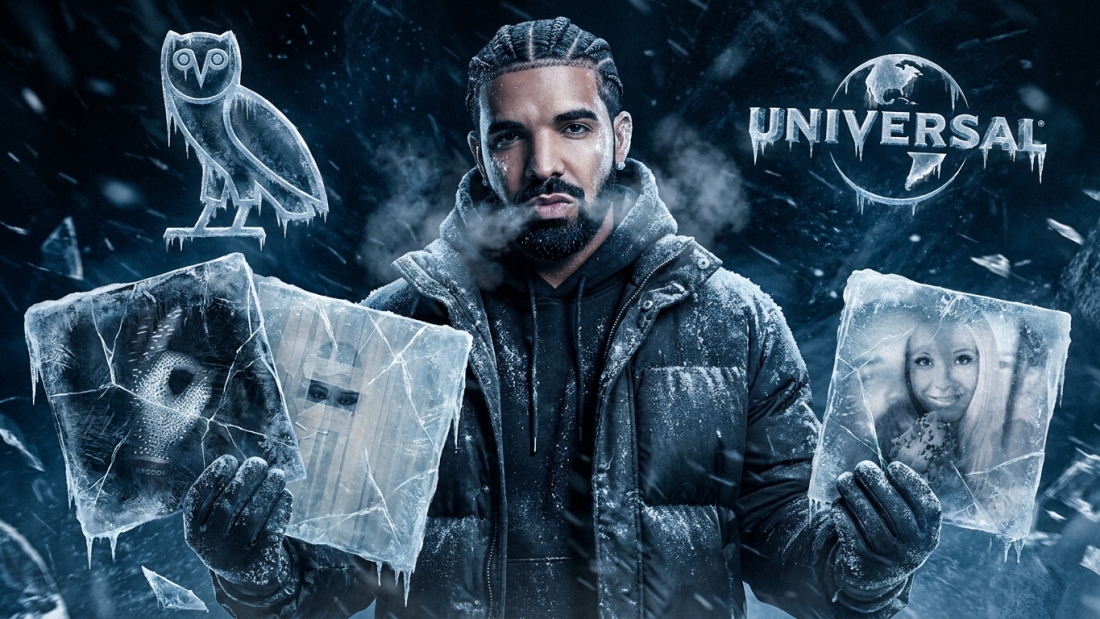
Drake just dropped 43 songs in one night. Three full albums — Iceman, Habibti, and Maid of Honour — all at once, with barely a warning. And the internet immediately did what it does best: started theorizing. The biggest question on everyone’s mind isn’t about the music. It’s about business. Specifically: did Drake just flood the market with music so he could walk away from Universal Music Group for good? Let us join the speculation.
The Tweet That Started the Conversation
Within hours of the drop, O’Shea Jackson Jr. (Ice Cube’s son, for those keeping score) tweeted what everyone was thinking: “Did he drop 3 albums to get out the deal!?”
He wasn’t alone. Yahoo Finance ran a business breakdown within hours. HotNewHipHop reported that the contract theory dominated fan discourse almost immediately. Even Vulture’s review opened by acknowledging the sheer volume felt calculated — “this is so much Drake” wasn’t just a description, it was the whole point.
It’s the most logical read of the situation. Here’s why.
Did he drop 3 albums to get out the deal!?!
— O’Shea Jackson Jr (@OsheaJacksonJr) May 15, 2026
I’ve just realised Drake is dropping 3 studio albums in one night to finish his UMG DEAL…
— Astro (@CrAstro2) May 15, 2026
he’s doing a bigger finesse than what Frank Ocean did with ENDLESS 😭😭
The $400 Million Elephant in the Room
Back in 2022, Drake re-signed with UMG in a deal reportedly worth upwards of $400 million. That’s not a record deal — that’s a LeBron-sized agreement covering recordings, publishing, merch, and visual media. The kind of contract that locks an artist down unless they deliver a set number of albums.
So when Drake shows up on a livestream with three hard drives and the message “I made this so that I could make this” flashing on screen — yeah, it’s hard not to read between the lines. Some of these albums might have been the obligation. The rest might be what freedom sounds like.
Three Albums, Three Drakes
This wasn’t just a content dump. Each project has its own identity, and breaking them down shows how deliberate this was.
Iceman — The Rapper Returns
The centerpiece. Iceman is Drake’s ninth studio album — 18 tracks of bar-heavy introspection confronting the fallout from his 2024 feud with Kendrick Lamar. Loaded with disses at Kendrick, J. Cole, Rick Ross, DJ Khaled, and even LeBron James. On “What Did I Miss?” he calls out Kendrick’s “Pop Out” concert and people who played both sides. The cover art — a hand in a sequined glove — is a direct Michael Jackson nod, telling you where he thinks he belongs. Production from Oz, Tay Keith, Conductor Williams, and Gordo mixes sharp melodic trap with moody lo-fi.
Habibti — The Lover Boy Goes Global
Habibti — Arabic for “my love” — is the 11-track R&B project that leans all the way into vulnerability and romantic melancholy. Drake explores the emptiness behind the playboy lifestyle over smooth production led by longtime collaborator Noah “40” Shebib, with features from PartyNextDoor, Sexyy Red, and Qendresa. If Iceman is a fist, Habibti is an open hand — slow-burning, moody, and aimed squarely at international streaming markets.
Maid of Honour — Caribbean Energy & Club Records
Maid of Honour brings 14 tracks of upbeat, Caribbean-influenced melodies with features from Popcaan, Central Cee, and Sexyy Red. “BBW” samples Trinidadian classic “Work” by Denise “Saucy Wow” Belfon, and on “New Bestie” Drake pays homage to Vybz Kartel in patois. The album cover — a vintage portrait of his mother — adds a sentimental layer to what’s otherwise his most playful, club-ready work.
Three albums, three audiences, one goal: prove he can still do everything, all at once.
Drake Said It Himself
You don’t even need to speculate when the man is literally rapping about it. The lyrics on Iceman are about as subtle as a freight train:
- On “Make Them Pay”: “I’m better off independent, they should let him leave, yeah / ‘Cause I just wanna be free”
- On “Janice STFU”: “Swear my label gotta free me, baby”
- On “B’s on the Table”: “I’m fighting the man, not suing a rapper, you boys are not listening”
That last one is particularly telling. He’s drawing a clear line — this isn’t about Kendrick anymore. This is about the suits. Drake is telling you, in plain English (and Canadian), that his real war is with the corporate machine behind his music. As Complex noted, these lines read less like song lyrics and more like a legal position statement set to 808s.
The Legal Mess Behind the Music
To really understand why Drake might be desperate to leave, you need the full timeline. We broke the whole thing down previously, but here’s the short version:
- May 2024: Kendrick drops “Not Like Us” — a cultural phenomenon containing some of the most damaging allegations ever put on a mainstream record. We covered how this feud escalated to historic levels in real time.
- Nov. 2024: Drake’s company, Frozen Moments LLC, accuses UMG and Spotify of artificially boosting the song’s streams.
- Jan. 2025: Drake files a formal defamation lawsuit against UMG, arguing his own label promoted a “false and malicious narrative.”
- Oct. 2025: A judge dismisses the lawsuit, ruling Kendrick’s lyrics were protected “hyperbole.”
- Jan. 2026: Drake appeals. March 2026: UMG fires back, calling the suit “astoundingly hypocritical.”
Drake is actively suing his own label. His label is calling him a hypocrite in legal filings. And then he drops three albums on them in one night.
He Wouldn’t Be the First
Drake’s strategy might be unprecedented in scale, but the playbook has history. Artists have been doing contract dumps for decades — and some of the biggest names in music used this exact tactic. Prince wrote “SLAVE” on his face and spent the mid-’90s rapidly releasing albums from his vault to escape Warner Bros. He called the contract “slavery,” changed his name to a symbol, and flooded the market until he was free. It worked — he eventually regained his masters.
Frank Ocean released Endless, a visual album, to technically fulfill his Def Jam contract, then independently dropped Blonde the very next day. The obligatory project was an art-house experiment. The free one was a masterpiece. Sound familiar?
Lil Wayne’s battle with Cash Money Records dragged on for years, and Drake was right in the middle of it. Drake’s own 2015 mixtape If You’re Reading This It’s Too Late was widely viewed as a move to burn off his Cash Money obligations. The irony of him using the same strategy a decade later against a different label isn’t lost on anyone.
The pattern is clear: when a superstar wants out, they flood the zone.
The Numbers Are Talking Too
The streaming impact was immediate. Reports surfaced that Spotify and Apple Music temporarily struggled to handle the influx of listeners at midnight. Official first-week numbers are pending, but projections suggest Iceman alone could challenge for the biggest debut of 2026. For context, Scorpion was the first album to hit one billion streams in a single week. With 43 tracks across three projects, he’s guaranteeing himself weeks of Billboard chart real estate through sheer volume.
The Other Theories (Because Nothing Is Ever Simple)
The contract theory is the prevailing read, and it’s the one that makes the most sense. But Drake is Drake — nothing he does has just one angle.
Proving a point. After spending two years getting dragged in the court of public opinion following the Kendrick beef — something we tracked from the start — Drake needed to remind everyone he can still work. 43 songs is an absurd output. Many are overwhelmed by the saturation but others are grateful to sift through what they love.
Fan service, literally. Rap purists get Iceman. The R&B crowd gets Habibti. Club-ready listeners get Maid of Honour. Every version of Drake, served up on a platter by a man who’s been listening to every “I miss the old Drake” tweet for five years. Some still remain unsatisfied.
So What Happens Next?
Here’s where it gets really interesting. If Drake has fulfilled his album obligations, the road ahead looks like uncharted territory for an artist of his size. The most likely scenario is that Drake goes fully independent through OVO Sound. OVO has been releasing music, running a festival, and building a brand for over a decade — but until now, it operated under UMG’s distribution umbrella. A fully independent OVO means Drake owns his masters, controls his schedule, and keeps a dramatically larger share of revenue.
The real question is distribution. Drake could strike a distribution-only deal — the kind Taylor Swift and other megastars have pushed toward — or go direct, leveraging his 80+ million monthly Spotify listeners in ways no artist his size has attempted. Then there’s the wildcard: the legal battle doesn’t disappear just because the contract ends. But the leverage changes entirely. He’d no longer be suing his own label — he’d be suing a former business partner. Very different dynamic.
Whatever happens, Drake going independent would be the biggest artist-label separation since Prince. And unlike Prince, he’d be doing it at the peak of the streaming era, where a superstar doesn’t need a label to reach his audience. He just needs Wi-Fi.
What’s Next?
The lyrics are a resignation letter set to 808s. The legal battle has turned openly hostile. The triple-album drop is unprecedented for any artist, let alone one who could coast on singles and features forever. That livestream moment — “I made this so that I could make this” — tells you everything. Whether Drake ends up fully independent, builds OVO into its own major operation, or negotiates a completely different kind of deal, one thing is clear: Aubrey is trying to leave. And he just made 43 songs to prove it.
Leave A Comment