

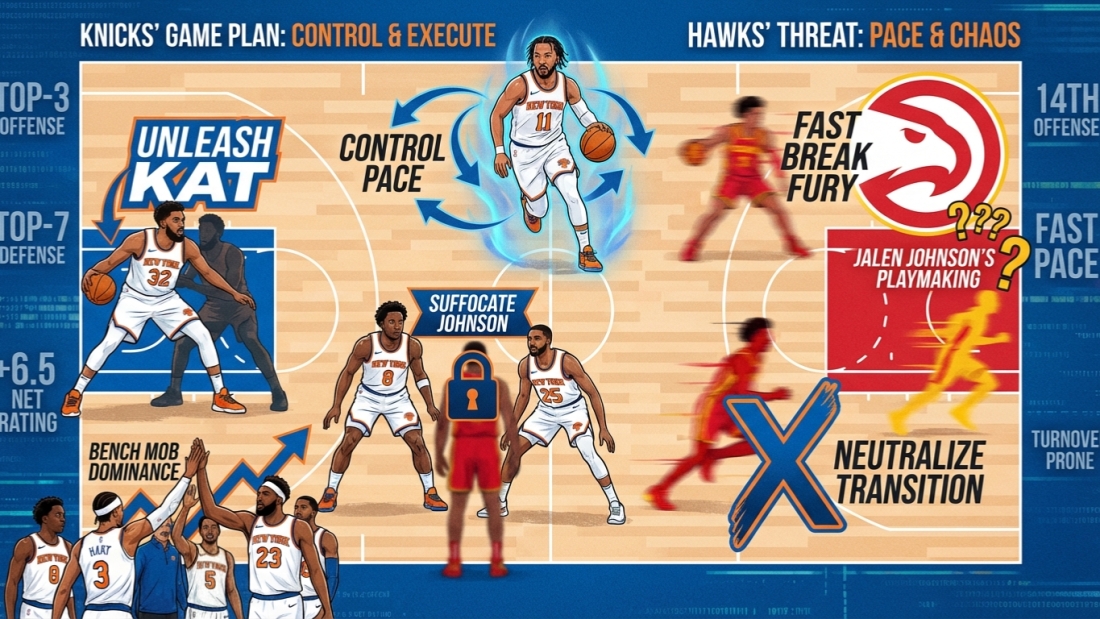
The New York Knicks are a 53-29 team with a top-three offense, a top-seven defense, and a +6.5 net rating — and yet, if you’ve been a Knicks fan for longer than five minutes, you know that none of that matters if you sleepwalk into the first round. The Atlanta Hawks are here, they’re the 6th seed, and they are not the pushover some people want them to be.
On paper, the Knicks should win this series. But “on paper” doesn’t play basketball. The Hawks went 19-5 after the All-Star break, rattled off an 11-game winning streak, and are playing with the kind of momentum that makes a lower seed dangerous. This is a team that figured something out in the second half of the year — and if New York doesn’t come correct, Atlanta has the talent to make this a long, ugly series. So let’s scout them. Let’s break down what the Hawks do well, where they’re vulnerable, and exactly what the Knicks need to execute to punch their ticket to Round 2.
Scouting Atlanta: What the Hawks Do Well
First things first — respect the opponent. The Hawks aren’t just here to collect a playoff check. Their 46-36 record undersells what this team became after the Trae Young trade. Swapping Young for CJ McCollum and Corey Kispert didn’t just change the roster; it changed the entire identity. Under Quin Snyder, Atlanta shifted to a faster, more egalitarian offense that stopped living and dying on one man’s pull-up threes. The result? A 9th-ranked defense (113.7 Defensive Rating) and a team that actually competes on both ends.
The engine of this thing is Jalen Johnson, and he’s the real deal. 22.5 points, 10.3 rebounds, 7.9 assists — a first-time All-Star putting up numbers that look like a point-forward from another era. He’s their primary creator, their best rebounder, and the reason Atlanta’s offense has any structure at all.
Then there’s Nickeil Alexander-Walker at 20.8 points per game, giving Atlanta a legitimate second scorer who can get a bucket in isolation. Onyeka Okongwu is a bruiser inside (15.2 points, 7.6 rebounds), and Dyson Daniels is one of the most disruptive perimeter defenders in the league at 2.0 steals per game. This is a team with defined roles and enough talent to hurt you if you’re not locked in.
And the pace. Atlanta plays at the 5th-fastest pace in the NBA (101.7). They want to push the ball, create chaos in transition, and turn the game into a track meet. That’s their comfort zone.
Where the Hawks Are Vulnerable
For all that momentum, the Hawks have structural weaknesses that a team like the Knicks can absolutely exploit. And the numbers tell the story clearly.
Their offense is middling.
A 116.1 Offensive Rating ranks just 14th in the league. That’s fine for the regular season, but in a playoff series where defenses tighten up and half-court execution matters more, “14th” becomes a problem. Their net rating of +2.4 (12th) tells you this is a good team, not a great one. For context, the Knicks’ +6.5 net rating is nearly three times that number. The gap in team quality is real.
Their three-point shooting is inconsistent.
Outside of Luke Kennard (49.7% — but off the bench) and Alexander-Walker (39.9%), the Hawks lack reliable deep shooting across the roster. In a seven-game series, the Knicks can scheme to take away those two shooters and dare the rest of Atlanta to beat them from deep. That’s a bet worth making.
They turn the ball over.
Atlanta averaged 13.4 turnovers per game during the regular season. Against a Knicks defense that thrives on forcing mistakes and converting them into transition opportunities, that number could balloon. The Knicks generated 8.1 steals per game — and every live-ball turnover they force is a fast break going the other way, neutralizing Atlanta’s pace advantage entirely.
Their bench is average.
After the mid-season trade, the Hawks’ bench ranked just 15th in scoring. Compare that to the Knicks, whose bench transformation under Mike Brown has been nothing short of revolutionary — going from dead last in minutes and scoring to 35.9 bench points per game. That’s a massive edge in a playoff series where depth gets tested every single night.
They’re largely untested in the postseason.
This is the Hawks’ first playoff appearance since the Trae Young trade. Jalen Johnson has never played a meaningful playoff minute. Neither has this version of the roster. Playoff intensity is different — the physicality ratchets up, the whistle tightens, and you can’t rely on regular-season habits. Experience matters, and the Knicks have it in spades.
The Knicks’ Playbook: How to Win This Series
Control the Pace — Make Atlanta Play YOUR Game
This is the single most important tactical battle of the series. Atlanta wants to run. They’re 5th in pace. The Knicks play at the 25th-fastest tempo in the league. That’s not a bug — it’s a feature. Mike Brown’s system is built around generating high-quality possessions in the half-court: move the ball, attack closeouts, and get open threes.
The Knicks shoot 37.6% from deep (4th in the NBA) and went from 27th to 3rd in three-point attempts under Brown. That’s an offense designed to execute, not rush.
Every time the Knicks slow the game down, get into their sets, and make Atlanta defend in the half-court for 18-20 seconds, the advantage tilts heavily toward New York. The Hawks’ defense is good — 9th in Defensive Rating — but it’s built to thrive in a chaotic, up-and-down game. Take that away, and they become much more beatable. Rebound the ball, limit transition opportunities, and force Atlanta to grind. That’s the formula.
Unleash Karl-Anthony Towns
KAT averaged 28.5 points and 13.5 rebounds against the Hawks in two regular-season meetings this year. He was a matchup nightmare, and nothing about Atlanta’s frontcourt suggests that changes in a seven-game series. Okongwu is physical, but Towns has the size, skill, and shooting range to pull him away from the rim and make him uncomfortable on the perimeter. The Knicks need to feed KAT early and often, establishing him in the post and letting his gravity open up driving lanes for Brunson and cutting lanes for the wings. When Towns is rolling, the Knicks’ offense goes from elite to unguardable — and the Hawks simply don’t have the personnel to match him.
Win the Brunson vs. Daniels Matchup
Dyson Daniels is who they are going to stick on Brunson early. He’s long, physical, and his 2.0 steals per game represent the kind of perimeter disruption that can bother even the best ball-handlers. He’ll try to be in Brunson’s jersey all series, and there will be possessions where he makes life difficult.
But here’s the thing — Jalen Brunson has been here before. He’s the engine of a 119.8 Offensive Rating (3rd in the NBA), and he showed exactly what he does in high-pressure moments in the April 6th win over the Hawks — a game-tying three, a go-ahead steal and layup, and clutch free throws to seal it. Brunson’s ability to “carry us home down the stretch,” as Coach Brown put it, is exactly why the Knicks are built for this.
The key is using the system to free Brunson, not asking him to beat Daniels one-on-one every possession. Run him off screens. Use Towns as a pick-and-pop partner to force switches. Get Brunson attacking downhill against slower defenders, not dancing against Daniels at the top of the key. Brown’s offense — with its 5th-ranked passing attack and elite catch-and-shoot generation (2nd in the NBA) — is designed to create advantages. Use it.
Suffocate Jalen Johnson
If there’s one player who can swing this series for Atlanta, it’s Jalen Johnson. His 22.5/10.3/7.9 line makes him a do-everything threat, and the Knicks need to make his life as miserable as possible.
This is where New York’s wing depth becomes a weapon. Start OG Anunoby on Johnson, then rotate Mikal Bridges onto him when OG needs a breather. Keep fresh, elite defenders on him at all times. Force him into contested mid-range jumpers instead of letting him get to the rim or create open looks for teammates. The Knicks’ 7th-ranked defense has the versatility to throw multiple looks at Johnson — switching, trapping, and forcing him to work for every single point.
The goal isn’t to shut him down completely — that’s probably unrealistic. The goal is to make him earn everything and limit his playmaking. If Johnson is spending all his energy just to score his points, he has less left in the tank to set up Alexander-Walker and Okongwu.
Win the Bench Battle Decisively
This might be the Knicks’ single greatest structural advantage in the entire series. The bench revolution under Mike Brown — 35.9 points per game, up from a league-worst 18.8 — is the kind of edge that compounds over a seven-game series. Jordan Clarkson, Deuce McBride, Tyler Kolek, and Mitchell Robinson bring scoring, defense, and energy that Atlanta’s 15th-ranked bench simply cannot match.
When starters sit, the Knicks should be gaining ground, not just holding serve. That’s a luxury most teams don’t have, and it becomes even more valuable in the playoffs when fatigue sets in. Every minute the benches share the floor is a minute where New York should be extending or maintaining their lead. As we discussed when Brown was hired, his commitment to a deep rotation was always about building a team that could sustain its intensity over a playoff series. This is where that philosophy gets tested — and the roster is built to pass.
Mike Brown has a 6-1 series record in the first round of the playoffs as a head coach (5-0 with Cavaliers, 1-0 with Lakers, 0-1 with Kings).
— ESPN Insights (@ESPNInsights) April 13, 2026
Can he lead the Knicks in their first round matchup against the Hawks? 👀 pic.twitter.com/149oPH1jFr
But people will STILL question and doubt…
— SleeperKnicks (@SleeperKnicks) April 16, 2026
Comical pic.twitter.com/qK6VVGy8hT
The Danger If They Don’t Execute
Could the Knicks lose this series? Yes. And the path to an upset is obvious.
If New York comes out flat, lets Atlanta push the pace, and allows this to become a transition-heavy, chaotic series, the Hawks’ momentum and confidence could carry them. That 2-9 stretch in January was not an accident.
If Brunson tries to hero-ball his way through Daniels instead of using the system, that’s a recipe for turnovers and frustration. If the Knicks don’t rebound — they’re 5th in offensive rebounds at 12.9 per game — they’re handing Atlanta extra possessions in a fast-paced game, which is the one thing they cannot afford.
And never underestimate a team with nothing to lose. The Hawks weren’t even supposed to be here — they started 26-30 before going on their historic run. They play loose, they play fast, and they have an All-Star in Jalen Johnson who is hungry to make a statement. If the Knicks take this matchup lightly, Atlanta has the talent to steal a game or two at the Garden and suddenly turn a comfortable series into a dogfight.
Tip-Off at MSG
Here’s the expectation: this Knicks team is built for more than the first round. If they lose, forget it. Chaos will erupt in the New York media. A 53-29 record, the 3rd-best offense in the NBA, a top-seven defense, and the deepest rotation the franchise has had in years — this is a team constructed to make a deep run. Mike Brown’s first season has given this roster everything it needs: modern spacing, elite ball movement, defensive versatility, and the depth to sustain it all over a grueling postseason.
But it starts here. It starts with executing the game plan, controlling the tempo, feeding KAT, trusting the system to free Brunson, and suffocating Jalen Johnson with wave after wave of elite defenders. The Hawks can be dangerous, they’re confident, and they have nothing to lose. The Knicks have everything to gain — but only if they treat this series with the seriousness it demands.
Handle the Hawks. Then worry about what’s next.
Leave A Comment