

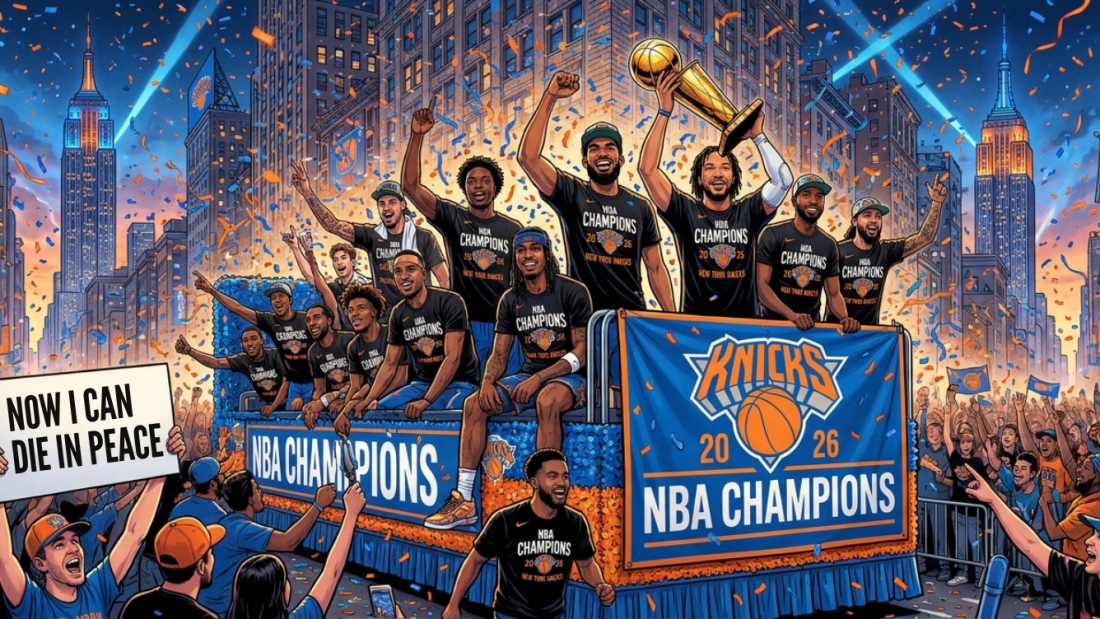
It has been days and the feeling is still surreal for many. Fifty-three years. The last time the New York Knicks won an NBA championship, Richard Nixon was president. Willis Reed limped onto the court and Walt “Clyde” Frazier dropped 36 in a Game 7 that most of our parents weren’t alive to watch. For those of us born in the late ’90s who inherited this franchise like a beautiful, dysfunctional heirloom — the championship was an abstraction. A grainy YouTube clip. A story your uncle told at Thanksgiving while shaking his head.
It’s not an abstraction anymore. On June 13, 2026, Jalen Brunson poured in 45 points in San Antonio, the Knicks beat the Spurs 94-90 in Game 5, and fifty-three years of scar tissue became a championship banner. Despite the Knicks team being branded as a scrappy underdog, they didn’t simply survive and advance. This was historically dominant basketball. The kind of run that demands a seat at the table alongside the greatest postseason teams the NBA has ever produced.
Elite Company: An All-Time Playoff Run
As we wrote earlier this postseason, the numbers were already absurd through two rounds. They only got more absurd. The Knicks finished the 2026 playoffs with a 16-3 record, a league-best Offensive Rating of 119.9, and a staggering Net Rating of +15.4 — the highest among all 16 playoff teams. Their efficiency metrics were historic: 56.6% eFG% and 60.0% TS% across 19 games.
Read that net rating column again. +15.4 — nearly two full points higher than the 2017 Warriors, a team with four All-Stars including two MVPs. Nearly three points higher than the 2001 Lakers — Shaq averaging 30 and 15 in the Finals, Kobe in his athletic prime, widely considered the most dominant playoff team in modern history. The Knicks outpaced both in net efficiency.
The comparison to the 2014 Spurs is instructive. That San Antonio team is the gold standard for system basketball — selfless ball movement, spacing, surgical precision. The 2026 Knicks share that DNA but did it with a higher net rating (+15.4 vs. +10.2) and fewer losses (3 vs. 7). Where the Spurs had their masterpiece in the Finals, the Knicks had theirs across the entire bracket.
The losses tell the story, too. The 2017 Warriors’ lone loss came with a 3-0 lead in hand. The 2001 Lakers lost only to Iverson’s legendary Game 1. The Knicks’ three losses? Games 2 and 3 against Atlanta in Round 1, and Game 3 of the Finals — each followed by immediate, devastating responses. This team punished opponents for thinking they had a chance.
The Full Journey: Round by Round
Round 1: Hawks in 6 — The Switch
The run almost started with a stumble. Atlanta took a 2-1 series lead, and the old familiar dread crept back in. We laid out the Hawks blueprint before the series, but for three games, execution was shaky. Then something flipped.
From Game 4 onward, the Knicks outscored the Hawks by a combined +96 points over three games, including a 51-point win in Game 6 — a franchise playoff record — where New York held a 47-point halftime lead, the largest in NBA playoff history. That game wasn’t basketball. That was an exorcism.
Round 2: 76ers Sweep — Combined 89-Point Margin
Philadelphia never had a chance. The Knicks swept the 76ers by a combined 89 points — the franchise’s first best-of-seven sweep since 1999. Game 4 featured 25 made threes on 44 attempts (56.8%), tying the all-time NBA playoff record. Joel Embiid called for organizational overhaul in the postgame presser. When your opponent is dismantling his own franchise after four games, you’ve broken something fundamental.
The seven-game winning streak from Atlanta Game 4 through the Philly sweep produced +185 combined points — roughly +26.4 per game — with a net rating hovering around +27.4. Those are numbers that shouldn’t exist outside of a video game.
Eastern Conference Finals: Cavaliers Sweep
We previewed the Cavs series as the biggest test — Donovan Mitchell, James Harden, Evan Mobley, a team that had survived two seven-game wars. We wrote that Mitchell was the most dangerous player in the bracket, that the Knicks needed to attack Harden relentlessly, and that rest would be the X-factor.
Every word of it played out. Game 1 was the masterpiece: trailing by 22 with 7:52 left in the fourth quarter, the Knicks ripped off an 18-1 run targeting Harden on every possession and won 115-104 in overtime. Brunson scored 38 points, converting 8-of-10 in the fourth quarter and OT. Mitchell later admitted the Game 1 collapse broke something in Cleveland’s psyche. It did. The Knicks won in four — closing with a 130-93 Game 4 blowout where they led by as many as 45.
NBA Finals: Spurs in 5 — The Comeback Knicks
San Antonio — young, talented, riding a seven-game WCF win over defending champion OKC with Victor Wembanyama named WCF MVP — was formidable. None of it mattered.
The Knicks won Games 1 and 2 in San Antonio — 105-95 behind Brunson’s 30-point, 13-in-the-fourth masterclass, then a razor-thin 105-104 escape when Wembanyama’s 20-footer rimmed out at the buzzer. Game 3 at MSG was the Spurs’ lone stand — Wembanyama going for 32/8/6 to snap New York’s 13-game winning streak.
Then came Game 4. Down 29 points in the third quarter on their own floor. The largest comeback in NBA Finals history. OG Anunoby’s tip-in with 1.2 seconds left — the new Willis Reed moment — sealed a 107-106 win that crushed San Antonio’s soul. The Knicks finished the playoffs 6-2 in games trailing by 10+ points, the best such record in 30 years of play-by-play data. “Comeback Knicks” wasn’t a nickname. It was an identity.
KAT finished with the highest +/- in NBA playoff history this postseason 😱
— Hoops Alerts (@TheHoopsAlerts) June 14, 2026
Brunson & Hart were also in the top 10
1. Karl-Anthony Towns (+258) — 2025-26
2. Stephen Curry (+244) — 2016-17
3. Jalen Brunson (+234) — 2025-26
4. Draymond Green (+227) — 2016-17
5. Kobe Bryant (+213)… pic.twitter.com/tafjiewp0v
The Knicks had one of the most dominant Playoff runs EVER
— Fullcourtpass (@Fullcourtpass) June 14, 2026
— Highest point differential ever (+283)
— Most road playoff wins ever
— 13 straight wins (2nd most ever)
— 4-0 in closeout games https://t.co/XSSfvXPa7X
The MVP: Jalen Brunson’s Coronation
There is a through-line from the day Brunson left $100 million on the table to sign his extension to the moment he hoisted the Finals MVP trophy. Every dollar he gave back, he earned back in legacy. Across 19 playoff games, Brunson averaged 28.4 points, 6.1 assists, and 3.2 rebounds and finished as the postseason’s leading scorer with 539 total points. In the Finals specifically: 32.6 points, 4.6 assists, 4.2 rebounds, and 2.0 steals per game on splits that made defenders look helpless.
The Game 5 clincher — 45 points on 14-of-27 shooting, 4-of-7 from deep, 13-of-15 from the line — set a franchise record for points in a Finals game and tied Michael Jordan for the third-most points in a Finals clincher. He received all 11 media votes for Finals MVP — unanimously, without debate. As we explored earlier in the season, the key to unlocking peak Brunson was building the system around his decision-making rather than forcing him to generate everything from scratch. In these playoffs, the system did exactly that — and Brunson delivered a performance worthy of all-time status.
KAT’s Transformation: From Scorer to Offensive Fulcrum
The single biggest unlock of this run wasn’t a scheme adjustment. It was Karl-Anthony Towns becoming a playmaker. In the first two rounds, KAT posted 66 assists in 10 games — matching his total across 34 playoff games over his previous two postseasons combined. Before 2026, KAT had never recorded more than 5 assists in any of his 50 career playoff games. During the seven-game winning streak through Atlanta and Philadelphia, he had 6+ assists in every game.
The mechanism was simple and devastating: KAT at the elbow, functioning as the control tower of Mike Brown’s high-post offense. Facing defenses collapsed on him, he saw over the top and found cutters. When they stayed home on shooters, Brunson came off screens into driving lanes. If they switched, KAT read it and hit the weak-side slash. A 7-footer with point-guard vision operating as the fulcrum of an offense that generated the highest shot quality in the league. His clinching performance against Cleveland — 19 points, 14 rebounds — was the embodiment of what he’d become: a player who didn’t need to score 30 to dominate, because his gravity and passing warped every defensive coverage Cleveland tried. The KAT trade was always about more than points and rebounds. It took the playoffs to prove it.
The System: Mike Brown’s Architectural Masterpiece
This championship was not random talent winning on talent. It was schematic basketball. The comparison to the Thibodeau era is night and day — last year’s offense had a ceiling; this one shattered it.
Mike Brown’s read-and-react system is predicated on decision trees that have no clean defensive answer. KAT at the high post is the first read. If the big shows, Brunson curls off stagger screens into open space or KAT faces up and shoots or drives. If they switch, the weak-side cutter — OG or Bridges slashing baseline — is open. Every possession generates multiple high-quality looks because the system forces defenders to choose, and every choice has a consequence.
The results: an Offensive Rating of 119.9 (best in the playoffs), five players shooting 40%+ from deep through the first two rounds, and an offense that produced an average of 120+ points per game while the defense held opponents under 100 in five of seven during the peak winning streak. This wasn’t a heater. This was architecture.
The supporting cast thrived inside it. OG Anunoby delivered the defining play of the Finals and was a lockdown wing all postseason. Mikal Bridges dropped 22 in the ECF Game 3 road win. Josh Hart exploded for 26 in ECF Game 2. McBride and Shamet tilted non-star minutes decisively in New York’s favor. Mitchell Robinson anchored the paint. Every piece fit. Every role was defined.
Looking Forward: Can They Run It Back?
The core is locked in. Brunson is 29. KAT is 30. OG and Bridges are 28. The window isn’t closing; it just opened. The league will adjust. Defenses will study the high-post action all summer. Wembanyama will be better. OKC will reload. Defending is the hardest thing in professional sports. But this team has something most champions don’t: a system that generates elite offense regardless of matchups, a defense that ranks among the league’s best, and a culture of resilience forged through years of losing and two straight Conference Finals before the breakthrough. The Knicks aren’t a superteam, but they are something sustainable — built on fit, depth, coaching, and a star who chose New York when he didn’t have to.
What This Means
The 2001 Lakers had Shaq at his most unstoppable. The 2017 Warriors had a roster that might never be replicated. The 1996 Bulls had the greatest player who ever lived capping the greatest regular season ever played. Those are the teams the 2026 Knicks just statistically outpaced.
This team didn’t have the best player in the world but had the best team in the world. A system, a culture, a collective identity that turned KAT into a playmaker, Brunson into a Finals MVP, and a roster of two-way wings into a championship machine. They came back from 22 down in the ECF and then came back from 29 down in the Finals which set the record for the largest halftime lead in NBA finals history. They swept two series and beat a generational talent in Wembanyama to claim the title.
For those of us who grew up watching Isiah Thomas gut this franchise, who survived the Bargnani trade and the lottery years and the hope-then-collapse cycles that stopped hurting only because we’d gone numb — this is vindication. Not just that they won, but how they won. With the highest net rating of any championship team in the modern era, a system that made everyone better and a 6-foot-2 point guard from Villanova who left $100 million on the table because he believed in this. Fifty-three years. The wait ended not with survival, but with dominance. New York has a championship. And the numbers say it might be one of the greatest ever.
Leave A Comment